TL;DR:
- Diffusers disperse sound waves and prevent comb filtering for a more natural sound.
- They improve spaciousness, stereo experience and vocal clarity in the studio.
- correct placement at first reflection points and behind the listening position is essential.
Many producers stop at absorption panels and think that means their studio is acoustically ready. The opposite often turns out to be true: too much absorption makes a room clinical, dull and lifeless. Your mixes then sound different on your monitors than in the outside world, and you make decisions based on a colored picture. Acoustic diffusers solve this problem by dispersing sound waves rather than absorbing them. They provide spaciousness, a fairer stereo image and a more natural sound. This article explains what diffusers do, when you really need them, and how to strategically place them for best results.
Table of contents
- What exactly do acoustic diffusers do?
- When are diffusers indispensable in your studio?
- What measurable benefits do diffusers provide?
- How and where do you place diffusers in your studio?
- Our vision: why every producer benefits from diffusion
- Getting more out of your music studio? Discover our solutions
- Frequently Asked Questions
Key Insights
| Item | Details |
|---|---|
| Diffusers bring balance | Diffusers create clear, spacious acoustics in your studio. |
| Measurable gains | Measurements show that diffusion directly improves sound, intelligibility and mix. |
| Smart placement needed | You achieve maximum effect by strategically placing diffusers at reflection points and back walls. |
| Not only for large studios | Small music rooms also benefit from well-applied diffusion. |
What exactly do acoustic diffusers do?
Now that the problem is clear, let’s dive into how diffusers actually work.
A sound wave hitting a flat wall bounces back as one coherent wave. That rebound arrives at your ear a little later than the direct sound. Your brain processes that as two separate signals that interfere. The result is filtering: certain frequencies are amplified, others are canceled out. This sounds like a comb-like, colored sound that directly influences your mixing decisions.
A diffuser breaks this process. The irregular surfaces, based on mathematical sequences such as the so-called quadratic residue diffuser, distribute the reflected energy over multiple directions and times. No specific sound point receives a large reflected wave. Instead, a subtle, dispersed aftertone is created that livens up the room without introducing echoes.
According to Floyd Toole’s research, diffusers break up coherent reflections, prevent comb filtering and improve Apparent Source Width (ASW), aka the spatial perception of a sound source. This has direct implications for how wide and realistic instruments sound in your mix.
The difference with absorption is fundamental. Absorption takes away energy. Diffusion redistributes energy. Both have a place in a good studio, but a room that only absorbs quickly becomes overdamped: quiet, dreary and filled with a smothered sound that has nothing to do with a professional monitoring environment. You can consult the basics of acoustics to better understand the difference between the two approaches.
| Feature | Absorption | Diffusion |
|---|---|---|
| Effect on energy | Reduces noise | Diffuses noise |
| RT60 impact | Lowers strongly | Lowers slightly to moderately |
| Spatiality | Reduces | Increases |
| Comb filtering | Partial solution | Effective prevention |
| Overuse risk | Dead, lifeless sound | Minimal risk |
“Diffusion is not the opposite of absorption; it is the complement that lifts a studio from clinical to professional. Without diffusion, you monitor in a vacuum.”
Another benefit of diffusers is the improvement of the stereo experience. Because reflections are evenly dispersed, your brain hears a more consistent and broader sound perspective. This makes it much easier to create space in a mix for different instruments. If you want to know how to improve your studio acoustics with a combination of techniques, it’s smart to think of diffusers as an integral part of your acoustic design.
When are diffusers essential in your studio?
Now that you know what diffusers do, you can assess when they are really necessary.
Not every studio suffers equally from poor acoustics. But there are clear signs that diffusion is lacking or insufficient. If you recognize one or more of the following problems, chances are that diffusers will greatly improve your situation.
Signals that your studio is missing diffusion:
- Your mix sounds good on your monitors, but bad on other systems
- Vocals in recording sound dull or ‘in a box’
- The stereo image is narrow or unclear
- There is a noticeable flutter echo when hand clapping in space
- High frequencies disappear while bass dominates
Small rooms are particularly vulnerable. In a room smaller than 20 m², the distances between walls are so short that reflections quickly affect each other. More absorption then helps temporarily, but does not solve the problem structurally. Large rooms have more room for reflections to weaken before they return, but even there diffusers in specific positions can make listening more pleasant.
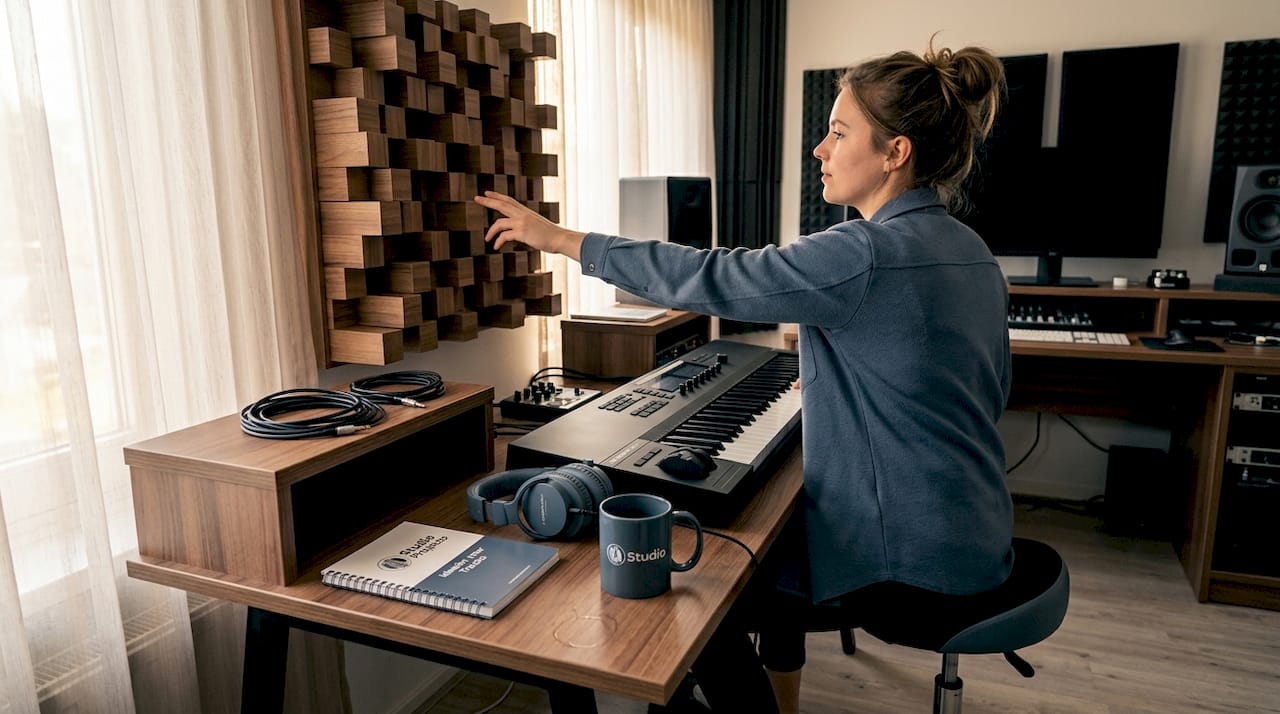
An interesting metric: in over-absorbed rooms, diffusers increase the RT60 by 20 to 40 milliseconds in the mid-high frequencies, improve the Energy Time Curve (ETC) and increase the ASW without losing brightness. Those are not small numbers. 20 to 40 ms more aftertone in the right frequencies instantly makes a room more pleasant to work in, without obscuring the monitoring perspective.
| Situation | Absorption only | Absorption plus diffusion |
|---|---|---|
| Spatiality | Low | High |
| Stereo image | Narrow | Wide and precise |
| Vocal clarity | Moderate to good | Excellent |
| RT60 mid-high | Too low | Balanced |
| Listening Fatigue | High | Low |
For a list of suitable acoustical products for your home studio, it makes sense to look at a combination of panels that address absorption and diffusion together. Acoustic ceiling fixtures also play a big role in how reflections behave in your studio.
Pro-tip: Use absorption on the first reflection points on the sides and diffusion on the back wall and ceiling behind the listening position. This will prevent flutter echoes and preserve the living breath of the room.
What measurable benefits do diffusers offer?
You know when diffusers are important. Now you see their proven effect in numbers.
Acousticians and producers work with three standard measurements to assess the quality of a room: RT60, C80 and D50. Each of these metrics tells a different story about how a space sounds and how well you can mix or record in it.
RT60 is the time it takes for a sound to drop 60 dB in level after the source stops. An ideal studio for mixing has an RT60 of 0.2 to 0.4 seconds. An untreated room often scores above 0.8 seconds, which creates too much aftertone and a murky low midrange.
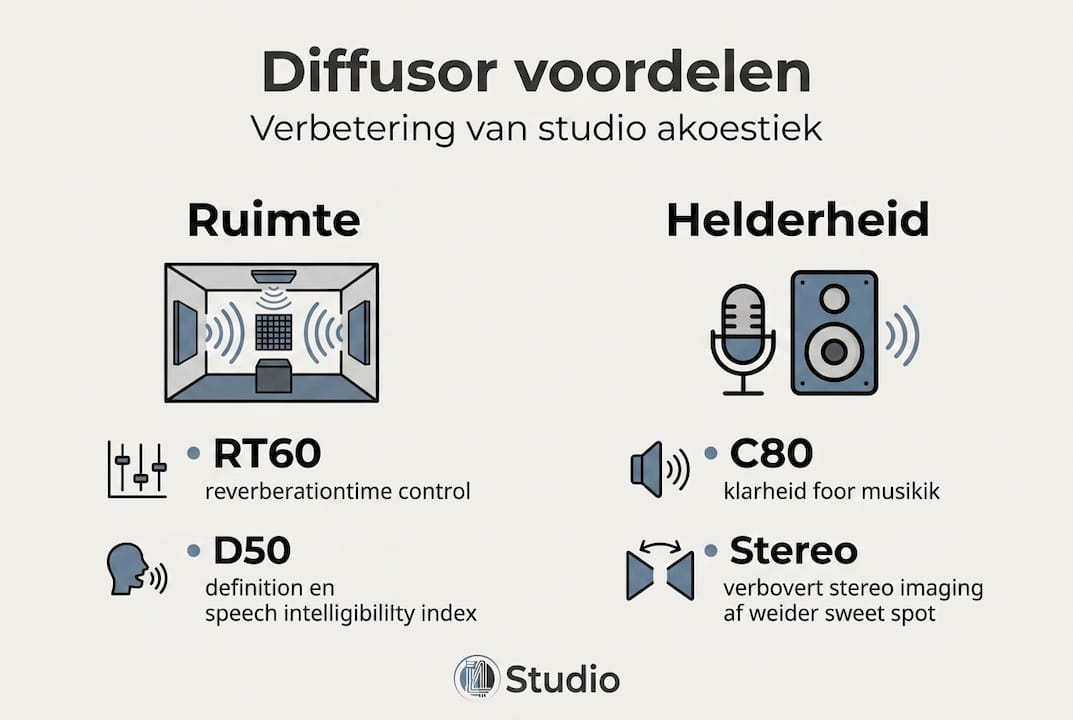
C80 measures the clarity of sound specific to music. A value above 0 dB means that the direct sound dominates over the aftertone. This is desirable for accurate listening and recording.
D50 expresses how much of the total energy arrives within the first 50 milliseconds. A D50 above 60% indicates good intelligibility of speech or music.
Treated studios with diffusion show RT60 values of 0.2 to 0.4 seconds versus more than 0.8 seconds in untreated rooms. C80 rises above 0 dB and D50 reaches the 60% mark. In addition, there is a demonstrable improvement in vocal clarity and transient response.
| Metric | Untreated | After treatment with diffusers |
|---|---|---|
| RT60 (s) | > 0,8 | 0.2 to 0.4 |
| C80 (dB) | Negative | > 0 |
| D50 (%) | < 50% | > 60% |
| Vocal clarity | Moderate | Excellent |
| Transient response | Blurred | Sharp |
Three concrete areas of improvement that diffusers provide:
- More accurate stereo image. Because lateral reflections are diffused rather than reflected back, you hear a wider and more detailed stereo space. This helps you when panning instruments and assessing depth in a mix.
- Better vocal clarity. Diffusers eliminate steep resonances that mask vocal frequencies. You recognize nuances in a vocal recording earlier, which has immediate benefits when editing and mixing voices.
- Less listening fatigue. A room with a healthy acoustic balance requires less of your concentration. Your brain does not have to compensate for comb filtering and interference, allowing you to work more focused for longer without your ears failing.
For an effective studio acoustics setup, these three points are a solid foundation. With the right measurement data, you know exactly where you stand and what to expect after installing diffusers.
How and where do you place diffusers in your studio?
With these readings, you know you want to get started. How do you tackle it practically?
Placement is everything. A diffuser in the wrong position accomplishes little. In the right spot, the same diffuser fundamentally changes the sound of your space. Use this roadmap as a starting point for your studio.
Step-by-step plan for diffuser placement:
- Determine your listening position. This is the starting point of everything. Sitting at your desk, that position is the reference point for all acoustic calculations.
- Identify initial reflection points. These are the points on the side walls where sound from your monitors first reflects back to your ear. Hold a mirror to the wall while a colleague moves: if you see the monitor in the mirror, that is the first point of reflection.
- For each point, decide: absorption or diffusion. At the first reflection points on the side, absorption works well for a sharp stereo image. On the rear wall behind the listening position, diffusion is the smarter choice.
- Treat the back wall with diffusers. This prevents sound from bouncing back from behind and disrupting your stereo presentation. A diffuser based on math works on specific frequency ranges matched to the dimensions of your room.
- Consider the ceiling. Ceiling diffusers improve vertical spaciousness, which makes a noticeable difference especially in vocal recordings.
- Measure the result. Use a measurement microphone and free software such as REW (Room EQ Wizard) to measure your RT60 and ETC before and after placement.
For a complete studio design, it is wise to combine these steps with your studio layout and equipment positioning. Even at your acoustics workstation, diffuser placement affects daily workflow and listening comfort.
Common placement mistakes:
- Place diffusers right behind the monitors (too close for effective diffusion)
- Only use diffusers without any absorption (too much aftertone)
- Attach diffusers in places where reflections are already weak
- Choosing decorative panels without acoustic specifications
Pro-tip: First attach diffusers temporarily with Velcro or lean them against the wall. This way, test how they sound for a week before permanently mounting them. This will save you the frustration of drilling holes in the wrong place.
Our vision: why every producer benefits from diffusion
Most advice on studio acoustics stops at “buy some absorption panels and you’re done.” We disagree, and the measurement data supports us.
Too many producers invest thousands of dollars in new microphones, preamps and plug-ins, when the biggest problem is the space itself. A good microphone in a poor acoustic space produces poor recordings. An average microphone in a well-treated space sounds amazingly good. That order is not correct in the budget choices of most beginning and advanced producers.
Diffusers are too often seen as luxuries or finishing touches. We see them as fundamentals. They are the reason your monitors give you a fair picture. They’re the reason your vocal recordings are instantly usable without dozens of correction plug-ins. They save you hours of post-processing.
Check out home studio acoustics solutions if you’re looking for concrete options. Our firm opinion: less gear, more acoustics. That choice pays off in every recording you make.
Getting more out of your music studio? Discover our solutions
Do you want to get started immediately on improving your studio acoustics? At i4studio you’ll find a wide range of acoustic solutions specially formulated for producers and musicians.

Check out our studio acoustic diffuser for a proven and instantly deployable solution. If you don’t yet have everything in order in your home studio, our overview of home studio supplies will help you along. And if you want to optimize your workspace, our Studio Desk Spirit is a strong addition to your acoustic space. Together they provide a setup that sounds professional and works pleasantly.
Frequently Asked Questions
What is the difference between absorption and diffusion?
Absorption removes sound waves, while diffusion diffuses reflections to create a more natural and spacious sound.
Where do you best place acoustic diffusers?
Place acoustic diffusers at first reflection points on the rear wall behind the listening position and possibly on the ceiling for best results.
Do diffusers improve speech intelligibility in the studio?
Yes, treated studios with diffusion show demonstrably better vocal clarity and sharper transients, making speech and vocals instantly clearer.
Are diffusers also useful in small spaces?
Even in smaller rooms, diffusers help prevent flutter echoes and dullness. In over-absorbed rooms, they enhance RT60 and ASW without compromising clarity.