

The ceiling is probably the most underrated element in any studio. You invest in high-quality microphones, monitors and preamps, but if the ceiling reflects sound back like a gymnasium, you’ll hear it immediately in your recordings and mixes. An acoustic ceiling is not a luxury addition; it’s a functional part of your sound environment. In this article you’ll learn how acoustical ceilings work, what materials are available, what the concrete benefits are for studios and businesses, and how to properly install and maintain them.
Table of contents
- How does an acoustic ceiling work?
- The benefits of an acoustic ceiling for studios and businesses
- Materials and types of acoustical ceilings: what suits your space?
- Installation and maintenance of acoustical ceilings
- Our view: why the ceiling should always be your first focus
- Want to know more about acoustic solutions? Discover our offer
- Frequently Asked Questions
Key Insights
| Item | Details |
|---|---|
| Instant sound improvement | An acoustic ceiling instantly reduces annoying reflections and provides clearer sound. |
| Increased comfort and productivity | Professional spaces with acoustic ceilings promote comfort and increase performance. |
| Various materials | Choose from a variety of materials, including durable options, for the best acoustic results. |
| Installation requires precision | Correct installation is essential for maximum ceiling performance and longevity. |
| Ceiling as a priority | The ceiling always deserves high priority in the acoustic design of any studio. |
How does an acoustic ceiling work?
An acoustical ceiling is a ceiling structure designed to absorb sound rather than reflect it. Standard ceilings made of concrete or drywall send sound waves back into the room, leading to echo, reverberation and a murky sound field. An acoustical ceiling interrupts that process.
Its operation is based on the principle of sound absorption. Porous or fibrous materials convert the energy of sound waves into heat through friction. The thicker and denser the material, the more low frequencies are absorbed. Higher frequencies are more easily attenuated and require less material thickness.
Acoustic ceilings reduce annoying reflections and absorb interfering frequencies that would otherwise contaminate your recordings. This applies both to direct reflections and to the so-called standing waves that occur between parallel surfaces such as floor and ceiling.
Commonly used materials include:
- Mineral wool: high absorption value over a wide frequency range
- Acoustic foam: light, easy to assemble, effective for mid and high tones
- Fiberglass: durable and suitable for professional environments
- Perforated panels: combine aesthetics with functional absorption
| Material | Absorption coefficient (average) | Best frequency range |
|---|---|---|
| Mineral wool | 0.80 to 0.95 | Wide, including bass |
| Acoustic foam | 0.60 to 0.80 | Mid and high tones |
| Fiberglass | 0.75 to 0.90 | Wide range |
| Perforated panels | 0.50 to 0.75 | Middle tones |
The performance of acoustical ceilings depends on the combination of material thickness, density and placement. Learn more about the right approach in our acoustic panel tips and in our guide to improving studio acoustics.
Pro-tip: When choosing materials, pay attention to the Noise Reduction Coefficient (NRC) value. An NRC of 0.85 or higher is ideal for recording rooms. The closer to 1.0, the more noise the material absorbs.
The benefits of an acoustic ceiling for studios and businesses
Knowing how it works, we now look at the benefits for studios and businesses. The difference between a standard ceiling and an acoustic ceiling is greater than many people expect.
Improved recording quality is the most immediate benefit. Fewer reflections means a cleaner signal, less post-processing and a more credible end result. You don’t have to spend more hours getting rid of spatial artifacts in the mix.
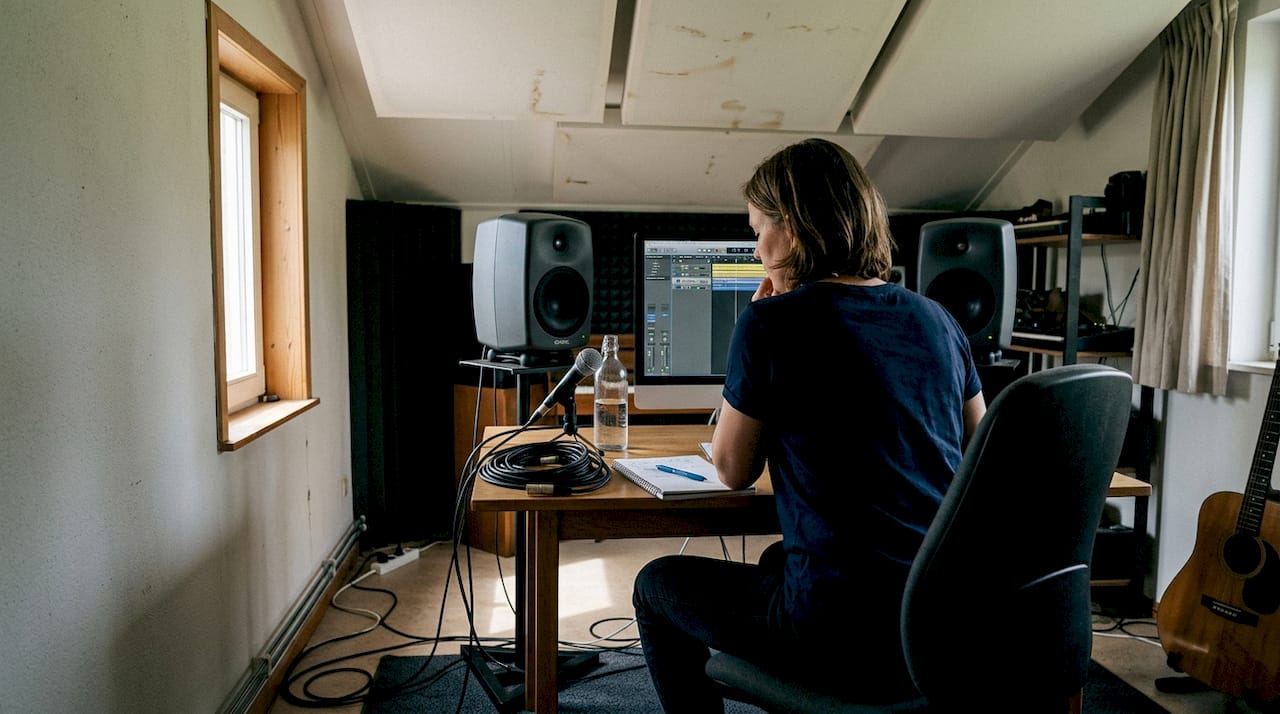
In addition, an acoustic ceiling improves intelligibility. In meeting rooms and offices, this is crucial. When speech comes across clearly without reverberation, communication is more efficient and listening is less likely to tire.
Good studio acoustics significantly increase productivity and listening comfort. Research shows that employees in acoustically treated spaces make up to 66% fewer errors in concentration tasks compared to noisy environments.
The benefits of acoustical ceilings are also noticeable in business environments such as conference rooms. Check out our page on acoustic solutions for meeting rooms for more applications.
A summary of key benefits:
- Cleaner recordings: less post-processing required, more immediately usable material
- Less listening fatigue: longer sessions without headaches or loss of concentration
- Professional look: a treated ceiling exudes craftsmanship to customers
- Better communication: higher intelligibility in meeting and recording rooms
- Higher productivity: fewer distractions from reverberation and echo
| Feature | Standard ceiling | Acoustic ceiling |
|---|---|---|
| Sound absorption | Low | High |
| Reflections | Many | Minimal |
| Understanding | Moderate | Excellent |
| Recording quality | Limited | Professional |
| Maintenance | Simple | Light periodic |
Materials and types of acoustical ceilings: what suits your space?
Now that it’s clear why an acoustic ceiling pays off, let’s look at what materials and types you can choose. The choice depends on your acoustic goals, budget and how you use the space.
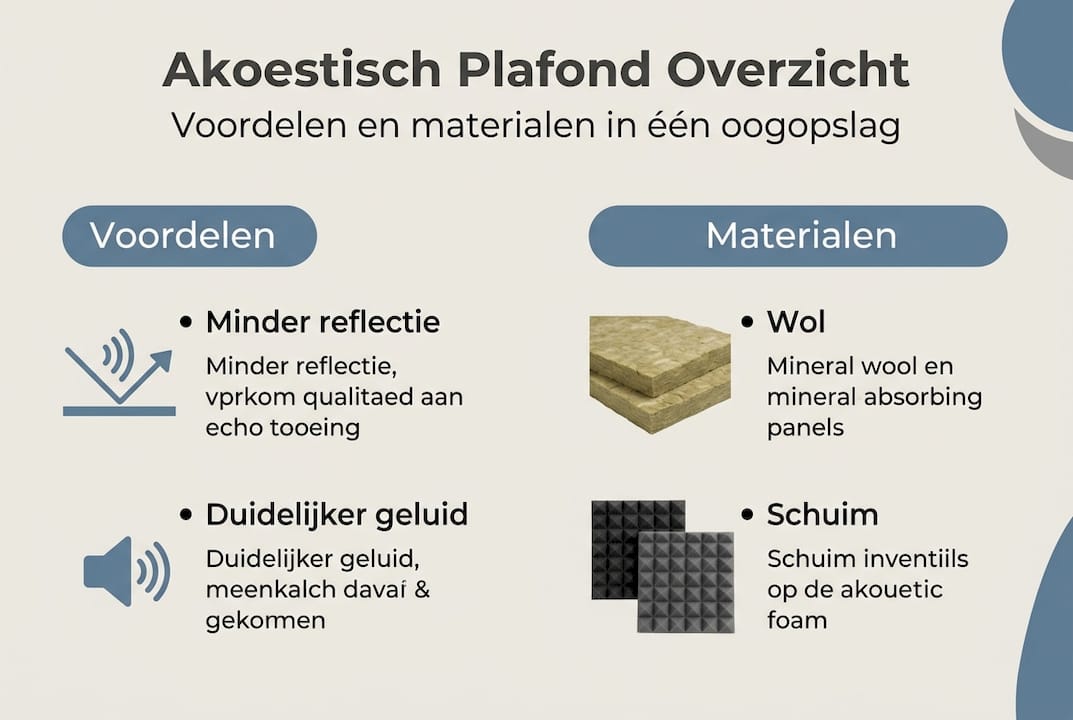
Wool is one of the most effective and durable options. It absorbs sound over a wide frequency range and is completely biodegradable. Ideal for studios that value sustainability.
Acoustic foam (polyurethane foam) is lightweight and easy to assemble. It works best for mid and high frequencies and is popular in home studios because of its low price and flexible application.
Fiberglass offers excellent acoustic performance and is resistant to moisture and mold. Suitable for professional environments where durability and performance both count.
Natural fibers such as hemp or flax are emerging alternatives. Sustainable acoustic materials can be just as effective as traditional options, with the added benefit of lower environmental impact.
In terms of types, there are three main categories:
- Loose panels: easy to install and replace, suitable for home studios
- System ceilings (roof tiles): professional solution for larger rooms, often in a grid structure
- Custom systems: fully customized for specific acoustic requirements
Choosing the right material for your acoustic ceiling also depends on the installation method. Learn more about sound absorption and material properties from specialized suppliers.
“The biggest misconception is that more expensive always means better. A well-placed wool panel of average price performs better in many cases than an expensive foam panel in the wrong place.”
Pro-tip: Combine different materials for best results. Use thicker panels of mineral wool or fiberglass for low frequencies and thinner foam for higher tones. That way you effectively treat the full frequency spectrum.
Installation and maintenance of acoustical ceilings
After material selection, correct installation and maintenance follows for optimum efficiency. An improperly installed panel performs significantly worse than its specifications suggest.
Step-by-step installation:
- Conduct an acoustic room analysis: measure reverberation time (RT60) and identify problem frequencies
- Determine coverage: calculate how much area to treat based on room size
- Mark the mounting points: use a spirit level for straight placement
- Fix the panels: use suitable brackets, glue or grid structure depending on the type
- Check placement: test acoustics after installation and adjust as needed
Accurate placement is essential for maximum effect. Also see Armstrong Ceilings’ installation guide for technical details for each system.
Common mistakes are:
- Panels placed too close together, preventing air from circulating freely
- Handle only high frequencies and ignore low tones
- Insufficient coverage of the total ceiling area
- No consideration of the studio acoustics setup as a whole
Periodic maintenance:
- Dusting with a soft brush or low vacuum setting
- Check quarterly for damage or looseness
- Replace damaged panels immediately to avoid loss of performance
- Consider additional acoustic solutions such as acoustic wallpaper for additional treatment
Pro-tip: Always perform an acoustic room analysis before installing. A simple clap test (clap your hands and listen to the reverberation) will give you an initial indication of the problem areas in your space.
Our view: why the ceiling should always be your first focus
Many studio owners start buying better equipment when recordings are disappointing. A new interface, a more expensive microphone, additional plugins. Understandable, but often the wrong order.
The ceiling largely determines how your space sounds. It is the largest untreated surface in most studios and, at the same time, the surface most directly above the sound source. Any reflection coming back from above colors your recording and your mix.
“We see it time and time again: a studio with a treated ceiling and mid-range equipment sounds more professional than a room full of high-end gear without acoustic treatment.”
Even a partial treatment of the ceiling, such as above the mix position and above the recording area, makes an audible difference. You don’t have to cover the entire ceiling to get results. Start small, measure the effect and expand. Check out our approach to practical studio acoustics to work step by step toward a better sounding space.
Want to know more about acoustic solutions? Discover our offer
At i4studio, we help studio owners and audio professionals achieve an optimal sound environment. From individual panels to complete room kits, we have solutions for every space and budget.
For example, check out the Studio Acoustic Diffuser Serious for professional diffusion, or the Primacoustic London 10 Acoustic Room Kit for a complete approach to walls and ceiling. Need panels that stay in place? Our adhesive for acoustic panels is specially selected for durable fastening. Contact us for personalized advice tailored for your studio.
Frequently Asked Questions
What is the biggest advantage of an acoustic ceiling?
The biggest benefit is improving sound quality and comfort by absorbing distracting reflections. Acoustic ceilings reduce annoying reflections that otherwise negatively affect your recordings and mixes.
Are there environmentally friendly options for acoustical ceilings?
Yes, there are sustainable alternatives such as wool and natural fibers that are just as effective as traditional materials. Sustainable acoustic materials offer excellent performance with a lower environmental impact.
How do I maintain an acoustic ceiling?
Regular dusting and periodic checks for damage are sufficient for most systems. For optimal performance, it is important that panels remain properly fastened, as described in the acoustic panel installation guide.
Is an acoustic ceiling only suitable for studios?
No, offices, conference rooms and other business spaces also benefit from an acoustic ceiling. Good acoustics in the workplace increases productivity and reduces listening fatigue in any environment.
Can I install an acoustic ceiling myself?
If you are handy you can start yourself with individual panels, but professional installation is recommended for optimal results. Accurate placement will determine the final acoustic effect.
Recommendation
- Acoustic Panels For Studio: Complete Guide For Optimal Recording And Mixing Spaces – https://i4studio.nl/
- The Best Products for Acoustics in a Home Studio – https://i4studio.nl/
- Installing Acoustic Panels: Practical Guide For Studios And Recordings – https://i4studio.nl/
- Acoustic Panels Tips: Practical Guide For Optimal Studio Acoustics – https://i4studio.nl/