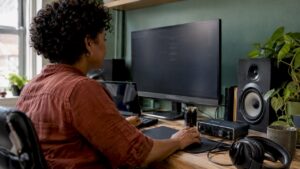

A few well-placed panels can dramatically improve sound quality in a studio. This guide contains concrete acoustic panel tips for audio professionals, musicians and content creators who want to take the plunge into better sound without gambling. The tips range from basic knowledge about materials and placement to measurements, DIY solutions and finishing advice – with examples for small home studios to mid-sized control rooms.
Why acoustic panels are essential
Many people invest in microphones, monitors and fast computers, but forget that the room itself has a big impact on the end result. Acoustic panels control how sound is absorbed and diffused. That makes the difference between a mix that is clear and balanced, and one that fits in one spot in the room but nowhere else.
Key issues that panels address:
- Early reflections: initial reflections that distort the stereo image and transient response.
- Flutter echo: rapid, repeating echoes between parallel walls.
- Standing waves / modal problems: low frequency accumulation at specific points that makes bass reproduction uneven.
- General reverberation (RT60): too long reverberation causes hazy transients and poorer intelligibility.
Basic elements: absorption, diffusion and reflection
Anyone working with acoustic panels must understand the difference between absorbent and diffusive solutions.
- Absorption reduces energy of sound (especially mid and high frequencies). Typical materials: rockcrete, glass wool, PET panels, foam. Absorption is essential at first reflection points and in rooms with too much reverberation.
- Diffusion scatters sound without absorbing it. Diffusers provide natural, lively sound without making the room “dead.” Useful behind listening position or on back wall.
- Reflection is not necessarily bad – controlled reflections build depth and spatiality. The goal is balance: not to absorb everything, but to treat it strategically.
How does one choose the right panels?
The choice involves material, thickness, dimensions and finishing options. Here are specific considerations.
Materials: advantages and disadvantages
- Polyester (PET) panels: environmentally friendly (many made from recycled materials), fire retardant possible, aesthetic and easy to assemble. Good for medium and high frequencies.
- Mineral wool / glass wool: excellent absorption, especially in thicker slabs. Widely used for basstraps and wall panels. Must be finished neatly (dust, irritation to installers).
- Foam (PU/foam): cheap and light, but often less effective below 250 Hz; make sure it has a good absorption value and is not a fire hazard.
- Wood microperforated panels: elegant finish, combinable with underlying absorption. They sometimes offer a good balance between absorption and visible structure.
- Diffusers (wood or plastic): for broadband scattering; more complex to design but very effective in larger spaces.
Understand metrics: NRC and alpha
NRC (Noise Reduction Coefficient) is a general indicator of absorption over mid and high frequencies. A higher NRC means more absorption. It is useful, but not all-inclusive: thickness and low-frequency performance (below 250 Hz) require separate attention.
Alpha values by frequency band give a better idea of what a panel is doing at 125 Hz, 250 Hz, 500 Hz, etc. Audio professionals often eliminate problems in the low frequencies first with bass traps, then fine-tune mid/high frequency absorption and diffusion.
Placement tips: where to place panels for maximum profit
Most gain comes not from covering the entire room, but from targeted placement. Here are practical, immediately applicable acoustic panel tips for different rooms.
Determining initial reflection points
- Have one person sit at the listening position (control room or mix chair).
- Place two speakers at normal distances and play a test tone or white noise.
- Use the mirror method: have someone move along the wall with a mirror; when in the mirror the speaker is visible from the listening position, mark that spot – here is an initial reflection point.
- Place absorbent panels on those markings on the side walls and ceiling (if ceiling reflections are audible).
Bassstraps: corners matter
Low-frequency energy collects in corners. For example, in a small home studio, one or two thick bass traps in each front and rear corner can reduce many modal problems. Recommendations:
- Use at least 60-100 mm thick absorption in corners; for serious bass problems, use 100-200 mm or more.
- Combine two plates (L or V configuration) for better operation over a wider bandwidth.
- Consider porous absorbers with rear air space for more low-frequency work.
Ceiling clouds: more than aesthetics
Ceiling panels below the listening position or above vocal booths effectively address early reflections and improve speech intelligibility. A simple wool panel 50-100 mm thick is usually worth a lot.
Back wall: diffusion or absorption?
In many control rooms, the choice between absorption or diffusion on the back wall is taste- and space-dependent. Small rooms often want more absorption to reduce reverberation; medium to large rooms gain transparency and natural ambience with a mix of diffuse elements and absorbent modules.
How many panels does one need? Practical rules of thumb
A hard rule does not exist, but one can start with these rules of thumb and then measure and adjust.
- Small studio (3×3 m): start with 4-6 panels of 600×1200 mm at first reflection points and 2-4 bass traps in the corners.
- Medium room (4-6 m): treat first reflections (4-8 panels), add ceiling clouds and place bass traps in all corners; cover 20-40% of surfaces with absorption/diffusion for good balance.
- Podcast/vocal booth: at least 4 panels all around, plus ceiling panel above microphone. Thick panels (50-100 mm) for better mid and low frequencies.
Measuring and fine-tuning: measuring is knowing
Hanging panels is step one; measuring and adjusting determines whether the treatment works. Use simple tools:
- Measurement microphone (e.g. UMIK-1) and free/software such as REW (Room EQ Wizard).
- Sweep testing and RT60 analysis to see reverberation times.
- Plot frequency response at listening position and view modal peaks.
Workflow:
- Measure the “as-built” space without treatment.
- Treat first reflections and measure again.
- Add bass traps and measure; correct modal peaks by strategic relocation of equipment or additional treatment.
- Use EQ only as a last resort; acoustic problems often correct better with physical treatment.
DIY vs prefab: when to use what?
Not everyone has an unlimited budget. Good results are often achievable with clever DIY solutions, but there are situation where prefabricated panels are preferable.
DIY solutions that work
- Homemade panels with wooden frames and mineral wool (ROCKWOOL) finished with fabric – inexpensive and effective.
- Bass traps with two or three layers of insulation in corners: great improvement for low frequencies.
- Bookcases as improvised diffusers: irregularly filled shelves scatter sound surprisingly well.
When precast is better
- Aesthetics and finish are more important (client-facing studio, broadcast environment).
- Fire safety and certification are required.
- Time or dexterity are lacking – professional assembly and warranty are then attractive.
Aesthetics and integration: acoustics don’t have to be ugly
From colorful upholstery to printed panels with artwork – acoustic panels can become part of the studio identity. Some creative tips:
- Use panels as wall art: prints on fabric made from PET panels or canvas.
- Color coding by feature (e.g., red panels for reflection points, gray for general absorption) helps with management during iterations.
- Built-in lighting behind microperforated wood for a high-end look without compromise on performance.
Safety and regulations
Fire safety regulations often apply in commercial settings. Materials must demonstrate fire class and suitability. When in doubt, professional advice is preferable. I4studio supports clients with technical advice on suitable panels and mounting methods, and can assist with fire certification and installation for larger projects.
Installation: fixing methods and tips
Proper mounting is important for safety and acoustic performance.
- Z-clips / Pioneer hooks / French cleat: provide neat finish and secure suspension.
- Standoff mount: small distance from wall increases low-frequency operation.
- Visual alignment: use level and ruler; symmetry around the listening axis improves not only sound but also appearance.
Common mistakes and how to avoid them
- Treat all walls: too much absorption kills the room. Balance is key.
- Only use foam: cheap foam is not effective below 250 Hz; don’t forget bass traps.
- Don’t do measurements: assumptions lead to suboptimal results – measuring and iterating works wonders.
- Place panels close to ventilation or equipment: this may obstruct airflow and overheat equipment.
Case studies: what works in different studios
Small home studio (2.5 × 3 m)
Problem: strong layer build-up and early reflections.
- 2 bassstraps in front corners, 2 in rear corners.
- 4 medium-sized first-reflection panels on sides and ceiling cloud.
- Measure before and after; if modal peaks remain, experiment with listening position (and monitors) or additional corner absorption.
Medium-sized control room (4 × 6 m)
Problem: Balance between transparency and spatiality.
- Combination of absorption on Early Reflection Points (ERP) and diffusion on back wall.
- Full bastrapping in all corners with 100-200 mm thick solutions.
- Ceiling clouds above mix position and reflector shields behind speakers if needed.
Podcast or vocal booth (1.2 × 1.5 m)
Problem: excessive near-microphone reflections and boxiness.
- Thick panels all around at mouth-height and overhead.
- Remember to treat or cover the door (often a reflective surface) with absorbent material.
Budget schedule: what to buy at what budget
- Low budget (≤ €200): DIY panels with mineral wool, 4-6 small absorbers, 2 bass traps; use existing furniture as diffusers.
- Medium budget (€200-€1000): mix of prefab PET panels and some professional bass traps; ceiling cloud and diffuser rear wall possible.
- High budget (> €1000): Professional design, custom wood diffusers, multiple bass traps, integrated fireproof finish and aesthetic solutions.
Maintenance and longevity
Panels are generally low maintenance. Some points of interest:
- Dust regularly with soft brush or low suction vacuum cleaner.
- Stains on fabric cover usually replaceable; many panels have removable covers.
- Periodically check suspension points and fasteners for safety.
Sustainability and materials
More and more manufacturers are using recycled PET as a filler or finish. These panels combine aesthetics, fire safety and environmental friendliness. I4studio advises on choosing sustainable options and can provide technical specifications for clients who also need to consider certifications.
How I4studio can help
For audio professionals who want more than standard solutions, I4studio offers support in designing a complete studio solution. In addition to high-performance audio and video computers, the company provides advice on acoustic components, helps with room analysis and can refer to professional installers. This is especially useful in complex projects where both hardware and space optimization must go hand-in-hand.
Step-by-step checklist: from plan to perfect acoustics
- Measure the space and note dimensions and building materials.
- Take a picture and a simple floor plan with listening position marked.
- Perform basic measurements with a measurement microphone (optional) and note RT60 and large modal peaks.
- Start with bassstraps in corners and treat first reflection points.
- Add ceiling clouds if ceiling reflections are audible.
- Measure again and adjust: move panels or add diffusion where needed.
- Finish the panels aesthetically and check all fixings.
- Schedule periodic checks and maintenance.
Conclusion
Strategic application of acoustic panels yields great gains in intelligibility, mix-trust and recording quality. With simple steps – measuring, treating first reflections, bass traps in corners, and checking with measuring equipment – one achieves a lot. For professionals who also want to optimally match their hardware to the room, a total approach, such as that of I4studio, offers added value: specialized computer and studio hardware combined with acoustic advice prevents equipment and room from working against each other.
These acoustic panel tips are a practical starting point. If you take a systematic approach and measure, you’ll quickly gain insight into what works for a specific room. And just like a mix: the right balance is subtle but audible – a few well-placed panels can dramatically improve the sound.
Frequently Asked Questions
What is the minimum number of panels a home studio needs?
A basic configuration is often 4-6 panels at first reflection points plus 2-4 bass traps in corners. The exact amount depends on room size, building materials and what one wants to do with the room (recording, mixing, both).
Are cheap foam panels effective?
Good foam types can reduce mid and high frequencies, but they usually perform poorly below 250 Hz. Serious bass control requires thicker pore panels or specially designed bass traps. Also pay attention to fire rating in commercial applications.
Should one always use diffusion?
No. Diffusion is useful in medium and large rooms to maintain spaciousness, but in small rooms diffusion can be secondary to absorption treatment. The best results often come from a deliberate mix of absorption and diffusion.
Is it possible to build panels yourself or better to buy prefabricated?
Both options are valid. DIY panels with mineral wool and fabric are cost-effective and work well. Precast panels have the advantage of finished looks, warranty and sometimes fire certifications. The choice depends on budget, time and desired finish.
Does acoustic treatment also help with speaker selection?
Yes. A treated room gives a more reliable picture of speakers, allowing one to make better choices. Poor acoustics can mislead even excellent monitors, causing one to make incorrect EQ decisions.