TL;DR:
- Nearfield monitors offer neutral sound reproduction at close range, allowing you to take accurate mix decisions. They minimize room influence and are suitable for both home studios and professional environments. Correct placement and acoustic treatment increase their effectiveness and significantly improve your mix quality.
If you think any loudspeaker is suitable for mixing, you are working with a fundamental disadvantage. The meaning nearfield monitors goes far beyond “small studio speakers.” They are designed to let you hear what’s really in your mix without the acoustics of the room clouding your judgment. In this guide, you’ll learn what sets nearfield monitors apart technically, why they’re indispensable in both home studios and professional environments, and how to best use them for better mixing results.
Table of contents
- Key insights
- What are nearfield monitors?
- Benefits of nearfield monitoring
- Acoustics and placement of nearfield monitors
- Technical variants and applications
- How to choose nearfield monitors
- My take on nearfield monitoring in 2026
- Nearfield monitors and studio gear at I4studio
- FAQ
Key insights
| Item | Details |
|---|---|
| Flat frequency response. | Nearfield monitors return sound uncolored, enabling accurate mix decisions. |
| Short listening distance | By sitting close to the monitor, you minimize the influence of room acoustics on your mix. |
| Active systems dominate | Active nearfield monitors are the standard in professional studios because of their integrated amplification. |
| Placement is key | Correct placement and treatment of reflection points significantly increase your mixing accuracy. |
| Choice based on space | Your studio environment helps determine which model and settings work best for you. |
What are nearfield monitors?
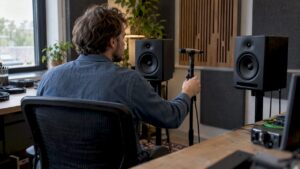
The term “nearfield” refers to the short listening distance between you and the monitors. Typically, this is between 60 and 120 centimeters. At that distance, you primarily receive the direct sound from the speaker, before room reflections affect the signal. That’s the core principle behind nearfield monitoring.
Technically, nearfield monitors are loudspeakers with a flat frequency response, typically from 50 Hz to 20 kHz. That flat response is no accident. It is a conscious design choice so that your mix is not colored or embellished. Consumer speakers often boost low and high frequencies to make music sound more appealing. Nearfield monitors do just the opposite.
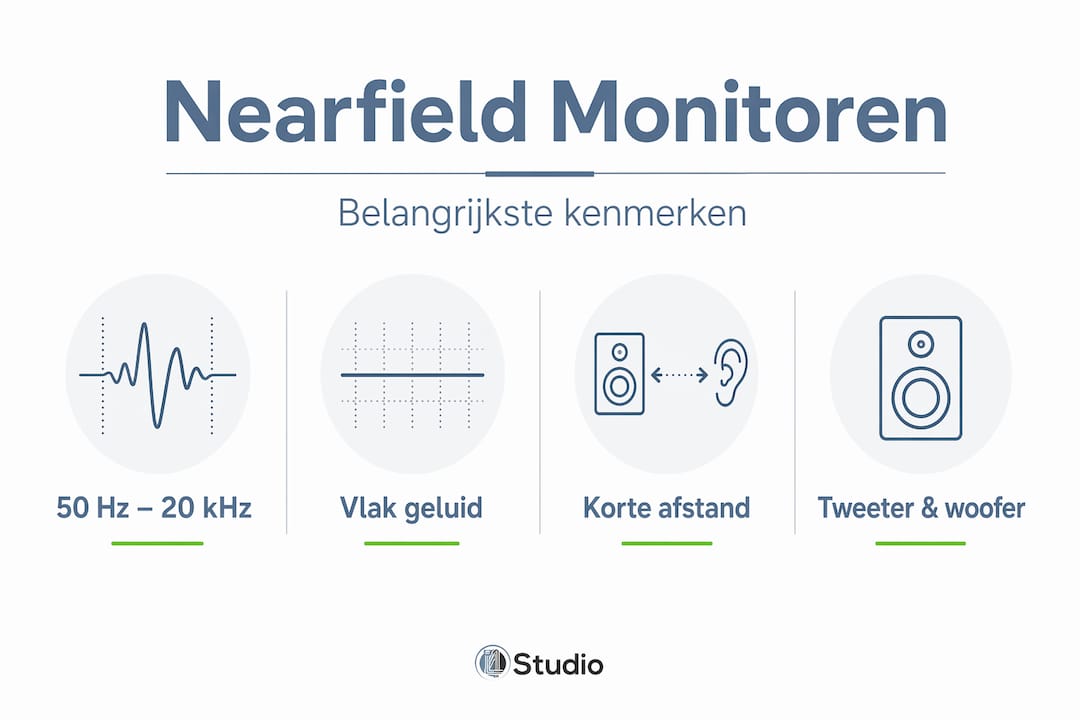
Most nearfield monitors have two drivers. A woofer for lows and mids, and a tweeter for high frequencies. The woofer typically ranges from 5 to 8 inches. Larger drivers give more base extension, but also require more space and better room acoustics to remain accurate.
Nearfield versus midfield and farfield
The difference between these three categories is in listening distance and purpose:
- Nearfield monitors (60 to 120 cm): ideal for individual mixing, minimal room influence
- Midfield monitors (1.5 to 3 meters): for wider mix checks and larger studio spaces
- Farfield monitors (3 meters and beyond): large control rooms, mastering studios
| Monitor type | Listening distance | Typical driver | Room influence |
|---|---|---|---|
| Nearfield | 60 to 120 cm | 5 to 8 inches | Minimum |
| Midfield | 1.5 to 3 meters | 8 to 12 inches | Medium |
| Farfield | 3+ feet | 12+ inches | High |
Nearfield monitors are the everyday working tool for most producers. They give you the most direct, honest representation of your mix without major investment in acoustic treatment.
Pro-tip: Always check your mixes on a second set of speakers or headphones as well. Nearfield monitors are accurate, but a second reference point reveals problems you may have become accustomed to hearing.
Benefits of nearfield monitoring
Why nearfield monitoring has become so popular in professional and home studios has everything to do with practical advantages that contribute directly to better mixes.
Minimal room influence: Due to the short distance, you mainly receive the direct sound from the loudspeaker. Room reflections play a much smaller role than with midfield or farfield monitoring. This makes nearfield monitors particularly suitable for rooms without extensive acoustic treatment.
Reliable mix translation: A mix that sounds good on accurate nearfield monitors translates reliably to other playback systems. Whether that’s a smartphone, a car audio system or a pa system. Accurate monitoring ensures that your mix sounds good on different systems worldwide.
Critical decisions about detail: Nearfield monitors expose balance, panning and subtle effects that remain hidden on consumer speakers. If you don’t hear a bass problem or an overly high reverb tail on your nearfields, you won’t hear it anywhere.
Compact size: They are suitable for home studios and small to medium-sized professional studios. No large control room required. A well-appointed study or bedroom with basic acoustics will suffice.
DSP and customizable settings: Modern nearfield monitors contain digital signal processing. This allows you to adjust the response to your specific space, for example, by attenuating low frequencies if your monitors are close to a wall.
Pro-tip: Use the EQ settings on the back of your nearfield monitors as the first step in room adjustment. Many manufacturers leave those factory default while they can correct a 3 to 6 dB difference in the low mid-range.
Acoustics and placement of nearfield monitors
Even the best nearfield monitors underperform with poor placement. Position in space and treatment of reflection points help determine what you actually hear.
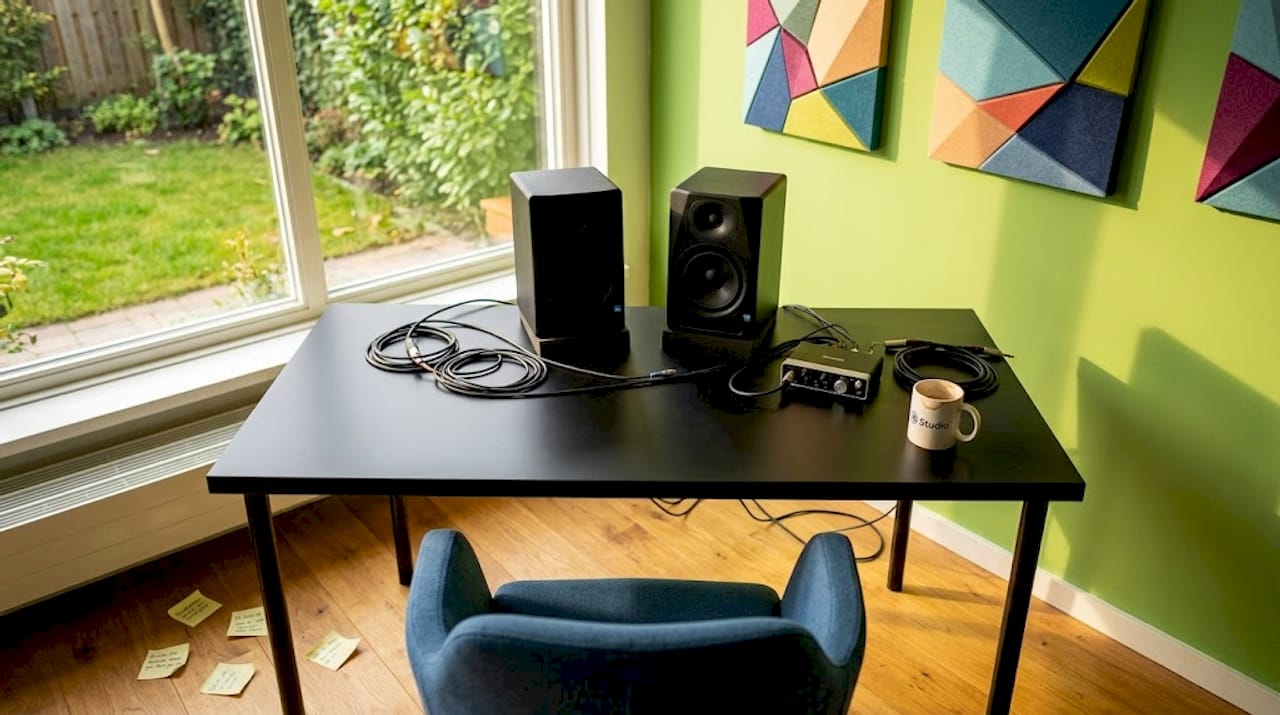
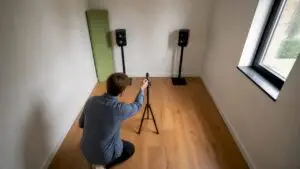
The ideal arrangement is an equilateral triangle. The two monitors and your head each form the vertices, with equal distances between them. The tweeters are at ear level. The monitors are angled slightly inward, toward your listening position. This gives the widest and most stable stereo image.
Learn more about optimal monitor setup on the I4studio website for specific configurations by studio size.
Practical guidelines for placement:
- Keep at least 30 centimeters away from back and side walls to avoid bass build-up
- Treat initial reflection points on side and rear walls with acoustic panels or diffusers
- Avoid placement in the center of the room, as this amplifies standing waves
- Use monitor stands instead of a desk whenever possible, this reduces vibration transfer from the work surface
Correct placement and acoustic treatment of first reflection points significantly increase mix accuracy. This is not a luxury for large studios. Even in a small home studio, you’ll notice the difference immediately.
Pro-tip: Stick tape on the floor to mark your ideal listening position. Consistently returning to that same position at each session provides reliable reference conditions.
A common mistake is to place monitors at the corners of a desk, with the tweeters at desk height. This creates asymmetrical reflections and a cloudy stereo image. Small adjustments in position and height make a bigger difference than many manufacturers expect.
Small versus larger spaces
In small spaces such as a home studio or bedroom, bass frequencies are the biggest problem. Standing waves build up quickly, amplifying some frequencies and eliminating others. Nearfield monitors limit room influence by amplifying direct sound over reflections, but that doesn’t completely solve bass problems.
In larger rooms, reflections come on later and are more complex. Here you help yourself with bass traps in the corners and broadband absorbers at the first reflection points. Also check out studio setup for a complete approach to sound quality and workflow.
Technical variants and applications
Not all nearfield monitors are created equal. The choice between different variants depends on your workflow, budget and the systems you already use.
Active versus passive
Active nearfield monitors dominate professional studios because of their integrated amplification and optimal tuning. The amplifier is internally tuned to the specific drivers, ensuring consistent and predictable response. Passive monitors require an external amplifier, which adds cost and complexity. For most manufacturers, active is the logical choice.
Overview of popular nearfield monitors
| Model | Woofer | Frequency Range | Special Features |
|---|---|---|---|
| EVE SC208 | 8 inch | 38 Hz to 21 kHz | DSP, multiple inputs |
| Adam T7V | 7-inch | 39 Hz to 25 kHz | Ribbon tweeter, tight |
| EVE SC3070 | 7 inch | 42 Hz to 21 kHz | Extensive DSP control |
The EVE SC208 is a good choice for producers who want some extra base extension without switching to midfield monitoring. The Adam T7V is distinguished by its ribbon tweeter, which reproduces high frequencies in exceptional detail.
Integration with your studio
Nearfield monitors work with your audio interface via balanced XLR or TRS connections. A monitor controller, such as the Mackie Big Knob, adds a central volume control and makes switching between multiple monitor pairs easy. This is particularly useful if you want to compare mixes between different speakers. Read more about the Mackie monitoring controller to complement your nearfield setup.
How to choose nearfield monitors
Choosing the right nearfield monitor is an investment in the quality of every project you produce next. Consider the following factors:
- Room Size: In a small room (less than 15 sq. ft.), a 5- to 6-inch woofer will suffice. An 8-inch in a small room almost always causes bass problems.
- Frequency range: Check that the monitor reaches low enough for the music you’re making. Electronic music and hip-hop require more base extension than acoustic folk.
- Connectivity: Make sure the monitor connects to your interface. Balanced XLR is the standard in professional environments.
- DSP capabilities: Built-in EQ adjustments are valuable in rooms with acoustic challenges.
- Budget: Between 200 and 600 euros each you can find quality nearfield monitors that deliver professional results. Cheaper is possible, but the frequency response then becomes less reliable.
Testing before purchase is the best thing you can do. Bring your own reference material, music you know inside out. If you hear details you missed before, that’s a good sign. Buy through specialized vendors such as I4studio, where technical knowledge is available to guide your choice. Also, see what types of studio monitors suit your studio for a broader comparison.
My take on nearfield monitoring in 2026
I’ve been working with producers and sound engineers setting up studios for years, and one thing strikes me every time. People invest in expensive monitors before thinking about the room. Then there are 1,000 euro monitors in an untreated room and everything sounds like you’re mixing through a blanket.
My belief is that nearfield monitors are the foundation of any good mix, but they should always be used in conjunction with basic acoustics. I recommend acoustic panels alongside nearfield monitors as the minimum standard for professional results. No panels? Then the world’s most expensive monitors are a partial solution.
Another thing I see: DSP technology in nearfield monitors is becoming more sophisticated. In 2026, I see models that use an app to measure room acoustics and automatically adjust the response. That’s a huge step for home producers without measurement microphones or acoustic knowledge.
My recommendation for producers who want to improve their monitoring is simple. Start with placement and treatment of initial reflection points. Only then upgrade your monitors. In that order, you will deliver the most results per dollar you invest.
– harold
Nearfield monitors and studio gear at I4studio
Are you ready to get serious about your monitoring? I4studio offers a wide range of nearfield monitors, monitor controllers and acoustic treatment for home studios and professional environments.
Whether you’re just starting out or want to upgrade your setup, at I4studio you’ll find the knowledge and range to make the right choice. From specialized advice on placement to suitable accessories. Start with the studio gear guide for beginners for a complete overview of what you really need. Want to tackle the listening environment acoustically, too? Then check out the Studio Acoustic Diffuser for an immediate improvement to your mixing space. I4studio is a trusted partner for Dutch producers who are serious about their sound.
FAQ
What is the significance of nearfield monitors?
Nearfield monitors are studio speakers designed for use at short distances, typically 60 to 120 centimeters. They have a flat frequency response so your mix is not colored.
Why choose nearfield monitoring over regular speakers?
Regular speakers color the sound to make music sound more appealing. Nearfield monitors give a neutral reproduction so that mix decisions about balance, panning and effects are accurate.
Are nearfield monitors suitable for a home studio?
Yes. Nearfield monitors are ideally suited for small spaces because they minimize the influence of room acoustics due to their short listening distance and direct sound reproduction.
What woofer size fits my studio?
In rooms smaller than 15 square meters, it’s best to work with a 5- to 6-inch woofer. In larger rooms with good acoustics, you can go to a 7 or 8 inch for more base extension.
What are the special features of modern nearfield monitors?
Modern nearfield monitors often have built-in DSP, multiple inputs (XLR, TRS, RCA) and acoustic EQ filters that you can adjust to your specific space for better mixing results.