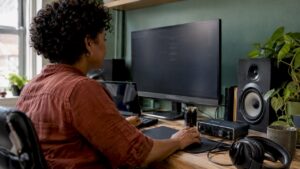
A thoughtful approach to acoustics studio design transforms a simple space into a reliable, creative workspace where recordings and mixes sound great. This guide covers fundamental principles, practical steps, budget-friendly solutions and examples that help audio professionals, musicians and content creators build a studio that sounds consistent-from the first recording to the final master.
Why good acoustics are essential
Anyone working in a poorly treated space will constantly run into ambiguities: fat bass passages that sound far too heavy on the mix, a dull midrange that swallows away detail, or exaggerated high frequencies due to harsh reflections. A cleverly designed studio delivers:
- more reliable mixing decisions-what sounds good in the studio also sounds good outside the room;
- better recording quality-less post-processing and more nuance;
- more comfort-less listening fatigue during long sessions;
- higher productivity-less time spent correcting and more time spent creating.
Basic principles of studio acoustics
Designing a studio starts with a few non-negotiable physical concepts. Understanding what sound does in a space helps make effective choices.
Sound, frequency and wavelength
Sound is air pressure variation that propagates as a wave. The wavelength of a frequency f is approximately λ = c / f, where c is the speed of sound (about 343 m/s at 20°C). That means that low frequencies (for example, 50 Hz) have wavelengths of nearly 7 m-that are hard to control in small rooms without smart handling.
Reflection, absorption and diffusion
- Reflections cause early echoes and slapback; they affect clarity and stereo imaging.
- Absorption (such as foam or fiber panels) reduces energy and lowers reverberation; effective in mid-high and high, less so at low without thick bass traps.
- Diffusion spreads reflections more evenly, maintaining spaciousness without monotonous attenuation.
Chamber modes and standing waves
Small rooms are dominated by room mode resonances between parallel walls at specific frequencies. These lead to peaks and valleys in the frequency response. Recognizing the influence of dimensions is crucial: cubes and near-cubes are problematic because they give many overlapping modes.
Different studio types and their acoustic purposes
Not every studio has the same purpose. When designing, one must consider function and usage profile.
Control Room (mix room)
Purpose: neutral reproduction for mixing and mastering.
- RT60 (reverberation) target: about 0.25-0.4 s in the extended midrange (125 Hz-4 kHz), with controlled low frequencies.
- critical: mirror point suppression, speaker and listening position optimization and subwoofer integration.
Live Room (recording room)
Purpose: to capture character and naturalness of instruments.
- RT60 target: typically 0.5-1.0 s depending on desired “live” feel.
- more diffusion and selective absorption to achieve a nice balance between direct sound and room sound.
Vocal Booth / Iso Booth
Goal: direct, dry signal with minimal reflections.
- RT60 target: often 0.15-0.4 s; for some voices want a little more warmth, but mostly dry.
- in small booths, bass management is difficult; door and ventilation problems require extra attention.
The design process: step by step
A structured workflow prevents miscues and delivers faster results. Below is a hands-on approach one can take when acoustically designing a studio.
- Inventory: size room, building materials, windows, doors, HVAC, determine desired use and budget.
- Measure and simulate: use measurement microphone and Room EQ Wizard (REW) to determine current problem frequencies and RT60; simulate modes as possible.
- Set targets: Establish RT60 targets and desired timbre for each room.
- Plan: determine how much absorption and diffusion is needed, where bass traps will be, and where speakers and listening position will be.
- Choosing materials: select panels, traps, diffusers and insulation materials; calculate required thickness and surface area.
- Install: follow priority-first the minimum reflection points, then bass traps and finally diffusion.
- Measure and fine-tune: measure again after installation and adjust where necessary.
Measuring equipment and software
Good measurement makes all the difference. Investing in basic equipment pays off.
- Measurement microphone: e.g. miniDSP UMIK-1 or similar; use calibration profile.
- Software: Room EQ Wizard (REW) for measurements and waterfall/RT60 analysis; plugins for subwoofer crossover simulation.
- Stereo test files and sweeps: use impulse responses and sweep signals to analyze reflections and standing waves.
Acoustic treatment: techniques and materials
Effective treatment combines different agents, matched by frequency and reflection type.
Porous Absorbers (fiber panels, foam)
Work mainly from the mid to high spectrum. Wall thickness and spacing affect efficiency at lower frequencies. For control room walls often choose 50-100 mm panels with air cavity for additional layer absorption.
Bass Traps
Low tones require voluminous solutions. Basic options:
- Corner traps (triangulated bass traps) effectively address fundamental room modes in corners.
- Membrane or panel resonators (also: panel absorbers) are useful for specific low-frequency problems.
- Helmholtz resonators can target a narrow band where there is a problematic peak.
Diffusers
Diffusion preserves spaciousness and prevents “dead” rooms. QRD diffusers or poly-diffusers work well in live rooms and behind the listening position in control rooms.
Reflective and decorative materials
Wood slats or bookshelves can be both aesthetic and functional. They offer limited absorption but valuable diffusion and character.
Insulation and soundproofing (soundproofing)
Where transmission of sound between rooms is critical (for example, recording studio in a residential building), measures are needed in addition to internal acoustics:
- Mass: more mass (heavy drywall, Mass Loaded Vinyl) blocks sound better.
- Decoupling: floating floors, spring constructions or struts prevent transmission through structures.
- Damping: within hollow walls use thermal insulation (glass wool, rock wool) to absorb sound.
- Joints and seams: door seals, window rubbers and gaps are often weak areas.
Speaker and listening position: the practical rules
Choosing a good arrangement yourself often provides the most return over expensive panels.
Basic setup
- Make an equilateral triangle between left, right and listening position; listening position often 38% of room length (not in the middle).
- Speakers at ear level and aimed at the listening position with slight toe-in.
- Distance from front wall: not too close; ideally at least 0.8-1 m, depending on speaker and room. Too close causes frontwall modes.
Subwoofer integration
Subwoofer location dramatic effect on bass response. Tip: temporarily place subwoofer in different locations and measure; use phase/Polarity and a low-pass crossover (60-120 Hz) to match main speakers. Dual subs (placed symmetrically) can equalize room modes.
Addressing reflection points
The mirror trick helps: someone moves a mirror along the side walls while the listener sits in position; spots where one sees the speaker in the mirror are reflection points and earn absorption or diffusion.
Designs for small spaces
Small home sessions are most common. Practical tips for small control rooms and project studios:
- Prioritize low frequency control with corner stages and possibly an active subwoofer with EQ.
- Use mobile solutions: movable panels or bass traps set behind monitors or in corners.
- PlafOnd treatment: a ceiling panel above the listening area effectively captures early reflections.
- Use furniture intelligently: a filled bookcase behind the listening area acts as a diffuser.
Budget strategies and DIY options
Not everyone has a big budget. Creative solutions and smart priorities help tremendously.
- Start with measurement microphone and REW diagnosis is cheaper and determines right investment.
- Make your own panels: wooden frames, glass wool (ROCKWOOL), dust-safety first with gloves and mask.
- Use thick curtains and carpets temporarily; these help mid-high absorption and reflection control.
- Choose modular solutions: movable traps and panels that grow with the project.
Common mistakes and how to avoid them
Experienced designers often see the same mistakes repeated by beginners. Here are the pitfalls and solutions:
- Too much high-frequency absorption and not enough low-frequency solutions: low frequencies are difficult and require priority-otherwise everything sounds “thin.”
- Ignoring symmetry: imbalance in treatment left/right disrupts stereo image.
- No measuring: assumptions lead to overtreatment or wrong places; measuring prevents that.
- Too much diffusion just in front of the listening position: that makes the stereo image unclear; diffusion usually belongs behind and to the sides in higher positions.
Integrate technology and workflow: hardware, software and ergonomics
Acoustics and equipment combine to form the total work experience. A well-optimized workspace combines sound and performance.
- A powerful audio PC or workstation reduces latency and enables real-time monitoring and plugin-heavy sessions-here’s where I4studio comes in: one can go for high-performance machines specializing in audio and video workflows.
- Use low-latency audio interfaces and reliable drivers (ASIO) for monitoring during recordings.
- Ergonomics: console height, monitor stand and cable management contribute to comfortable and productive sessions.
Examples and case studies
Small project studio (home, 3 x 4 m)
Problems: strong bass peaks, early side reflections, harsh ceiling reflection.
- Solution: corner bass traps (top and bottom), 4 x 50 mm absorption panel on side walls at mirror points, ceiling cloud above listening position, bookshelf behind listening position for diffusion.
- Result: more consistent bass, improved stereo imaging and less listening fatigue.
Podcast space in office environment
Problems: ambient noise via HVAC and neighboring rooms, resonances in midrange.
- Solution: door and window sealing, ventilation with silencer, wall bass traps and gray panels aesthetically integrated. Microphones with near horn gain and pop filters.
- Result: much cleaner shots and less post-edit time.
Commercial control room for tape recording
Problem: mix room needed neutral, live room more “live.
- Solution: control room with asymmetrical treatment, QRD diffuser rear position, extended angle traps. Live room with variable absorption/diffusion (movable curtains and panel walls).
- Result: flexible environment suitable for both heavy rock and acoustic sessions.
Maintenance, upgrades and scalability
A studio is never “done.” Sound changes with new equipment, other projects and wear and tear. Helpful guidelines:
- Periodic measurement: remeasure and calibrate once a year or after major changes.
- Add modules: start with basic treatment and add traps or diffusers based on measurement results.
- Record setups: note where speakers and subs are, and which panels are working-that helps with future iterations.
How I4studio can support
A successful studio combines acoustics with reliable hardware. I4studio supplies specialized audio, video and broadcast computers and offers customized advice for studio environments. Practical ways a partner like I4studio can help:
- advice on system configurations for real-time audio, rendering and video editing;
- recommendations for audio interfaces and monitors appropriate to the acoustic situation;
- Technical support for integration of hardware into the specific studio setup;
- consulting projects that combine acoustic recommendations with hardware choices-so that one not only hears well, but also works efficiently.
Checklist For Those Who Want to Design a Studio
- Measure first: purchase measurement microphone + REW.
- Document room dimensions and building construction.
- Set RT60 goals for each room.
- Plan first reflection treatment (mirror trick).
- Add bass traps in corners; measure effect.
- Optimize speaker and listening position; apply with sub/phase scans.
- Provide good insulation if noise protection is needed.
- Integrate hardware: low-latency interface, reliable workstation-request advice from specialists such as I4studio as needed.
Common questions in acoustic design
Below are brief answers to questions that often arise during the process of acoustics studio design.
Frequently Asked Questions
What is the first thing to do in acoustics studio design?
Start measuring: proper measurement provides insight into current problems and prevents unnecessary expenses. Use a measurement microphone and software such as REW to analyze frequency response and RT60.
How important are bass traps really?
Very important. Low frequencies dominate small rooms and cause large variations in reproduction. Without decent bass traps, a mix remains unreliable, no matter how much high-frequency absorption one adds.
Are expensive diffusers always necessary?
Not always. Diffusion is useful for maintaining a sense of space, especially in larger live rooms and behind the listening position. In small home studios, first priority is usually absorption and bass management.
Should one invest in professional insulation (soundproofing)?
It depends on the situation. If there is a lot of transmission to neighbors or other rooms, professional insulation is necessary. There are budget options for home projects, but for true soundproofing, constructional approaches (floating floors, decoupled walls) are often unavoidable.
Can one mix well without professional acoustics?
It is possible, but difficult. One will have to rely more on reference listening (on different systems) and possibly spend extra time on revisions. Good acoustics will speed up the process and increase consistency.
Summary
A successful process for acoustics studio design combines physical principles, smart measurement methods and practical execution. Start with measurement, prioritize bass control and initial reflections, choose materials that fit the objectives of the space and integrate equipment that fits the workflow. For audio professionals and content creators, investing in acoustics pays off in reliability, speed and end result. Those who need additional help or specialized hardware can turn to experts such as I4studio for advice on computing, audio interfaces and integration of equipment into the studio setup.
With a clear approach, smart choices and periodic evaluation, one develops a studio that not only sounds good, but also works pleasantly and efficiently-from the first recording to the last export file.