TL;DR:
- Room acoustics are crucial for clear recordings and good mixing decisions.
- Measurements with REW and calibrated microphone provide targeted room improvement.
- Physical treatments such as bass traps and absorption panels are the basis, software correction is supplementary.
Many home studio owners invest in good microphones and monitors, but forget that the room itself has the greatest effect on the sound. One well-placed bass kick in a corner can instantly tell the difference between a muddy bass and a tight, controlled low tone. Yet most musicians and producers skip this step. In this article you’ll learn why studio acoustics are so critical, how to measure problems with reliable tools, which treatments really work and when software correction makes sense as an adjunct.
Table of contents
- Why studio acoustics are crucial for home recording
- Measuring is knowing: The first step for improving acoustics
- Acoustic treatments: Bass traps, absorption panels and diffusers
- Software correction and additional solutions for studio acoustics
- Our view: What you don’t read about in standard guides on studio acoustics
- Discover solutions for your studio acoustics
- Frequently asked questions about studio acoustics
Key Insights
| Item | Details |
|---|---|
| Start measuring | Use REW and a measurement microphone to identify and target acoustic problems. |
| Prioritize bass traps | Bass traps in corners are crucial for controlling low-frequency reflections. |
| Combining Absorption and Diffusion. | Place absorption panels at reflection points and diffusers for a balanced, lively sound. |
| Software is complementary | Use software correction as support, but focus on physical treatment for optimal results. |
| Patience and consistency | Keep measuring and adjusting; improving acoustics is a process of fine-tuning for best results. |
Why studio acoustics are crucial for home recording
Poor acoustics is not just an annoying side effect of a small space. It’s an active problem that directly sabotages your recordings and mixes. Reflections from hard walls cause your monitor to produce a different sound than what your ears hear. You then mix based on the wrong information.
The three biggest culprits in an untreated room are:
- Standing waves (room modes): Low frequencies accumulate in corners and along walls, making certain tones sound too loud or too soft.
- Early reflections: Sound that bounces back directly from side walls or the ceiling and disrupts the direct sound from your monitors.
- Reverberation (RT60): Excessive reverb time makes recordings unclear and mixes unreliable.
A well-treated room gives you a neutral listening surface. You hear what’s actually on your recording, not what the room adds to it. That means better mixing decisions, fewer corrections in mastering and recordings that sound good on other systems, too.
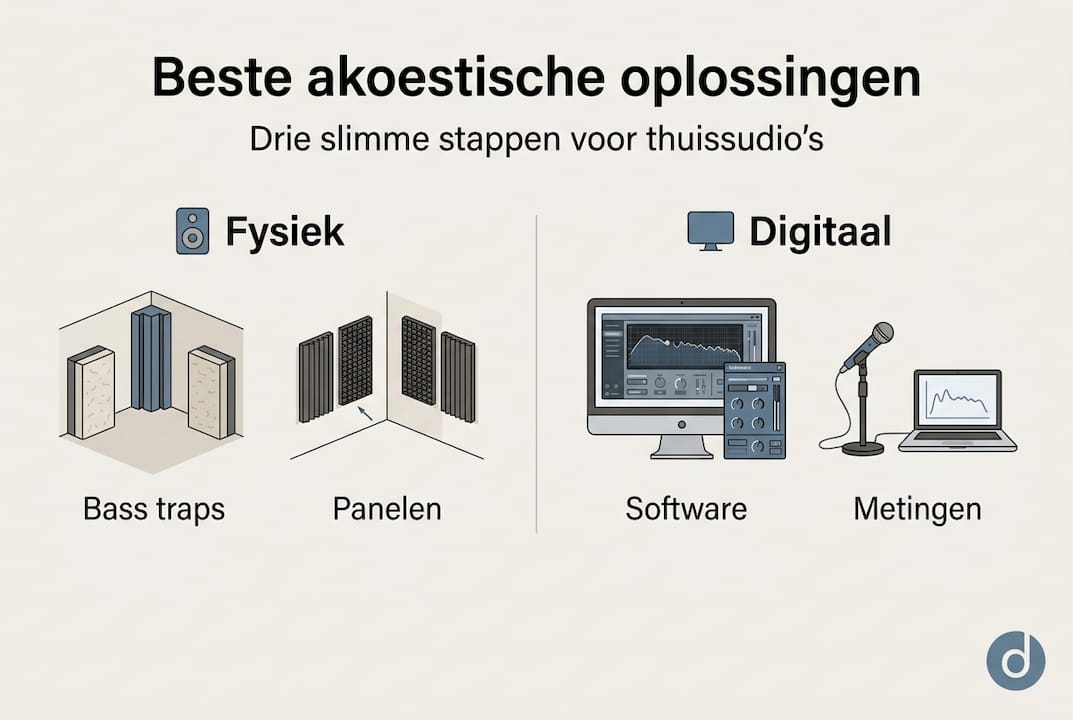
“The best solutions for studio acoustics include bass traps in corners, absorption panels at first reflection points, ceiling clouds and diffusers on the back wall for balance.”
The basics of acoustics are not complicated, but they are often underestimated. Those who understand how sound behaves in a room make much better choices when setting up their studio. If you want to get straight to work on improving sound quality, it starts with understanding what goes wrong in your particular space.
A good reference for those who want to learn more about the technical background is this studio acoustics explanation, which clearly describes how treatments work together. Now that we understand the importance of studio acoustics, let’s look at how to address problems directly and effectively.
Measuring is knowing: The first step for improving acoustics
Many producers start by putting up some foam rubber and hoping for the best. That’s a waste of your money. Measuring first will give you exact information about where the problems are and how serious they are.
The most reliable and affordable approach works as follows:
- Download Room EQ Wizard (REW): This free program analyzes the acoustics of your room and displays frequency response, waterfall graph and RT60 values.
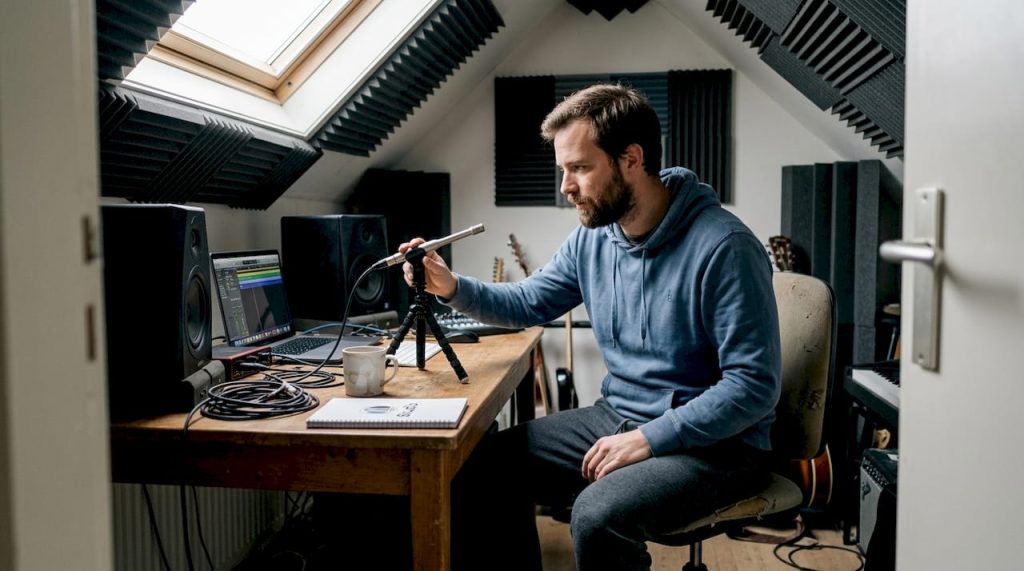
- Use a calibrated measurement microphone: miniDSP’s UMIK-1 is the standard choice. It comes with a calibration profile that you load directly into REW.
- Measure at listening position: Place the microphone at ear level at your mix position. This is the spot that matters most.
- Analyze the results: Look for peaks and valleys in the low frequencies (below 200 Hz) and the RT60 value. An RT60 between 0.2 and 0.4 seconds is ideal for a small studio.
- Prioritize bass traps: Measure first with REW and UMIK-1 to identify problems, and address bass problems first before dealing with reflections.
The absorption values of panels are measurable and comparable, making it easier to make targeted choices based on data rather than feeling.
Pro-tip: Measure your space after each adjustment, too. That way you can see exactly what effect each bass kick or panel you add has. This will prevent you from placing too much treatment and making the room sound too dead.
Good studio design advice always starts with measurement. Without measurement, you work by feel, and feeling is rarely reliable in acoustics. With a clear picture of the problems you can get to work with acoustic solutions.
Acoustic treatments: Bass traps, absorption panels and diffusers
Now that you know where the problems are, it’s time to address them. There are three main categories of treatments, each with its own function and ideal placement.
Bass traps are the most effective investment for a home studio. Low frequencies accumulate in corners, both vertical and horizontal. Thick broadband absorbers at least 10 cm thick in all corners of the room give immediate results. The bigger and thicker, the more effective.
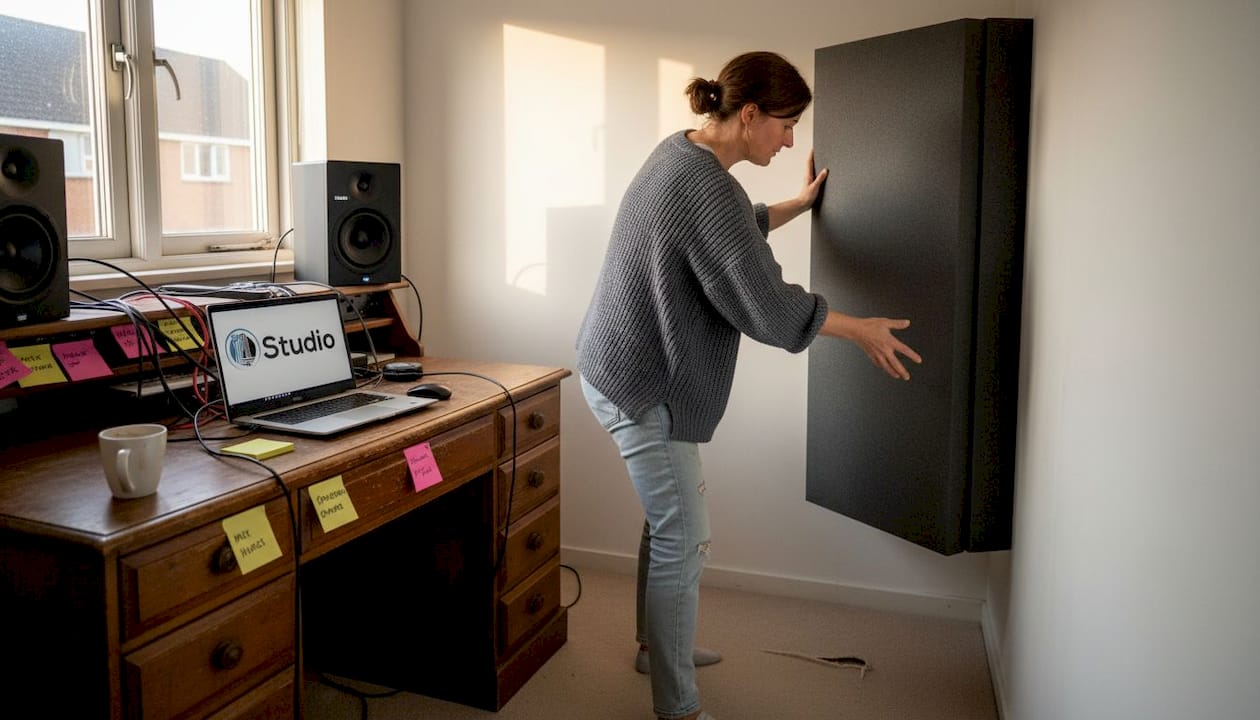
Absorption panels tackle early reflections. Hang them on the early reflection points: the side walls next to your monitors, the ceiling above your mix position (ceiling cloud), and possibly the back wall. Good panels have absorption coefficients above 0.9 for the mid frequencies, with an αw value between 0.75 and 0.90.
Diffusers are not absorbers. They diffuse sound rather than absorb it, creating a more lively and natural sounding room. Place them on the back wall behind your listening position for the best balance of absorption and diffusion.
| Treatment | Function | Ideal placement | Effectiveness low freq. | Effectiveness high freq. |
|---|---|---|---|---|
| Bass kick | Absorbs low tones | Corners (floor/ceiling) | Very High | Low |
| Absorption panel | Reduces reflections | First reflection points | Medium | High |
| Diffuser | Diffuses sound | Back wall | Low | High |
| Ceiling cloud | Absorbs ceiling reflections | Above mix position | Average | High |
For more detail, review diffusion and absorption principles for a clear overview of how these treatments work together.
Pro-tip: Never start diffusers when your room is still untreated. Diffusion in an already reverberant room makes the problem worse. Absorption and bass traps always come first.
Want to know which panels are best for your situation? Our panel guide and panel tips will help you out. The complete guide on indispensable panels is also a good next step. After you know which treatments are effective, you can combine them for optimal balance.
Software correction and additional solutions for studio acoustics
Software such as Sonarworks SoundID Reference is popular and certainly useful. The program measures your listening environment and adjusts your monitors’ EQ to compensate for space. Useful, but there are limits to what it can do.
| Solution | Benefit | Limitation |
|---|---|---|
| Sonarworks SoundID | Fast, affordable, flexible | Does not compensate for recordings |
| Physical absorption | Permanent, broadly effective | Requires investment and placement |
| Bass traps | Approach at the source | Effective only in corners |
| Combination physical + software | Best result | Requires planning and measurement |
The core problem with software-only correction is this: Sonarworks adjusts what you hear through your monitors, but not what your microphone records. A reverberant room remains reverberant on the recording, no matter how much digital correction you apply to your listening room.
“Treat bass and reflections first, add diffusion for liveliness; software correction like Sonarworks is supplement, not replacement.”
The smartest approach is a combination. Treat your space physically as well as you can within your budget, and use software correction as the final layer to eliminate minor imperfections. That way you get the most out of both worlds.
Want to optimize your studio with the right combination of physical and digital? Or are you looking for information on effective panels that already have proven results? Then a structured approach is the best investment you can make. With all options clear, here is the unique advice for those who really want to make a difference.
Our view: What you don’t read about in standard guides on studio acoustics
Most guides tell you what to buy. We want to tell you what to do: measure, adjust, measure again. Studio acoustics is not a one-time job. It’s an ongoing process, especially if you move furniture, add new equipment or work in a different room.
What we see time and again with home studio owners is that they are too quick to reach for quick fixes. A few slices of foam on the wall, a cheap panel behind the chair, and then they expect studio quality. That doesn’t work. Patience and a systematic approach always yield better results than random placement.
Empirical data support this. Absorption coefficients above 0.9 and RT60 measurements give you objective feedback on each step. Use that data. Don’t rely on your ears alone, especially in an untreated room.
Also check out our studio decorating tips for practical ideas that can be applied immediately in a home environment.
Discover solutions for your studio acoustics
At i4studio.co.uk you’ll find everything you need to acoustically optimize your home studio. From high-quality diffusers to focused absorption panels and powerful audio production computers.
Check out the Studio Acoustic Diffuser Serious for professional diffusion on the back wall. The Mini Acoustic Panel Artic is ideal for targeted absorption at reflection points. And for those who also want to upgrade their production environment, our audio production computers are built specifically for music and audio. Everything in one place, tailored to the serious home studio.
Frequently asked questions about studio acoustics
How do I optimally place bass traps in my home studio?
Bass traps belong in the corners, both vertical corners and floor and ceiling corners, because low frequencies accumulate most strongly there.
What is the difference between absorption panels and diffusers?
Absorption panels reduce reflections and reverberation, diffusers disperse sound for a more natural and vibrant room feel. They complement each other and are not substitutes for each other.
Should I measure first or install panels right away?
Always start with measurement via REW and a calibrated measurement microphone so that you target the biggest problems and maximize your return on investment.
Is software correction like Sonarworks enough?
Software correction is an adjunct, not a replacement for physical treatments. It improves your listening session, but does not solve reverberation and reflections in recordings.