
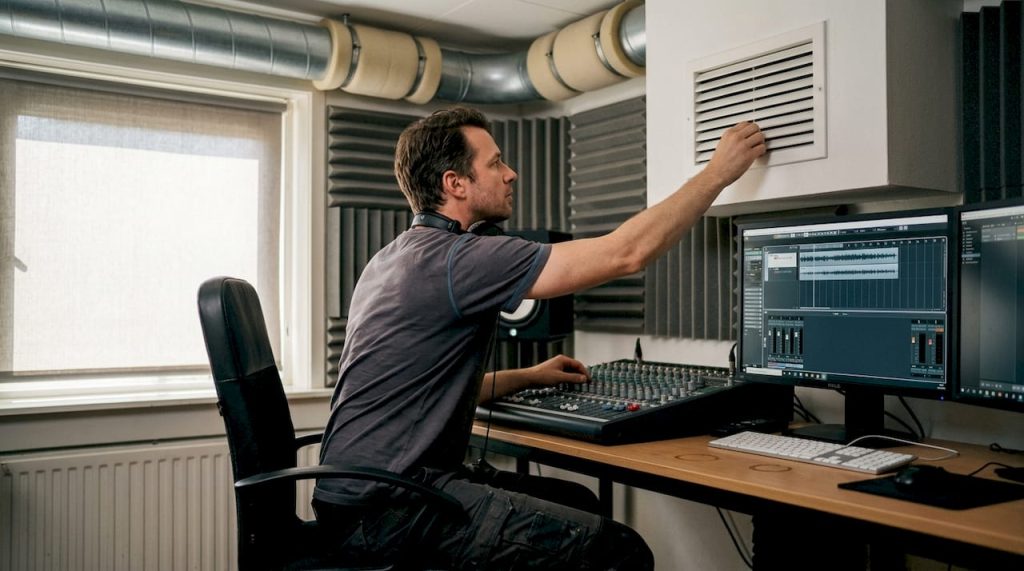
Many musicians and studio owners invest heavily in high-quality microphones, interfaces and acoustic panels, but forget an essential element that directly affects recording quality: ventilation. The idea that ventilation is only about comfort is a misconception that can cost you dearly. Poorly designed airflow introduces unwanted noise into recordings, damages expensive equipment by overheating, and makes long production sessions uncomfortable. This guide explains why thoughtful ventilation is as important as your studio equipment and how to perfectly match the two for optimal results.
Table of contents
- Key insights
- The influence of ventilation on studio acoustics
- Why good ventilation is crucial for comfort and equipment
- Practical ventilation solutions for home studios
- Discover our specialized solutions for studio ventilation and acoustics
- Frequently asked questions about studio ventilation
Key Insights
| Item | Details |
|---|---|
| Balancing air and sound | Ventilation and acoustics required a careful balance between adequate airflow and minimal sound transmission. |
| Preventing noise through ductwork | Duct placement, materials and air velocity determine how much sound is transmitted and must be matched to the room. |
| Acoustic attenuation and baffles | Silencers in ventilation shafts effectively absorb high-frequency sounds, while low frequencies require additional attenuation. |
| Exhaust location avoid microphones | Never place exhausts opposite microphones or in the primary recording room and use technical areas or behind treatments. |
| Zigzag pattern for attenuation. | Install acoustic baffles in a zigzag pattern within ventilation shafts to reflect and attenuate sound waves multiple times without significantly reducing airflow. |
Key insights
| Aspect | Impact on studio |
|---|---|
| Air Quality | Prevents fatigue during long recording sessions and improves concentration |
| Temperature Control | Protects sensitive audio equipment from overheating and extends lifespan |
| Sound insulation | Well-designed systems minimize ventilation noise without restricting airflow |
| Humidity Control | Stable humidity prevents damage to instruments and electronics |
The influence of ventilation on studio acoustics
Sound travels through air, and any ventilation system you install creates potential sound paths that could interfere with your recordings. Ventilation and acoustics require a careful balance between adequate airflow and minimal sound transmission. Traditional vents and standard exhaust systems often produce a constant low-frequency hum that interferes with your recordings, especially problematic with quiet passages or acoustic instruments.
The acoustic impact of ventilation depends on three key factors: the placement of ventilation ducts, the materials you use and the speed at which air flows through the system. Passive ventilation via grilles operates silently but offers limited control over airflow and temperature. Mechanical systems with fans give more control but introduce potential noise sources that you need to control. The choice between the two depends on your studio size, the number of heat-producing devices and your budget.
Modern ventilation solutions must prevent noise from interfering with recordings while supplying sufficient fresh air. Silencers in ventilation shafts effectively absorb high-frequency sounds, but low frequencies require longer attenuation sections or special baffle designs. Acoustic lining in ductwork significantly reduces airflow noise without impeding flow. The placement of inlet and outlet points also determines how sound circulates through your studio.
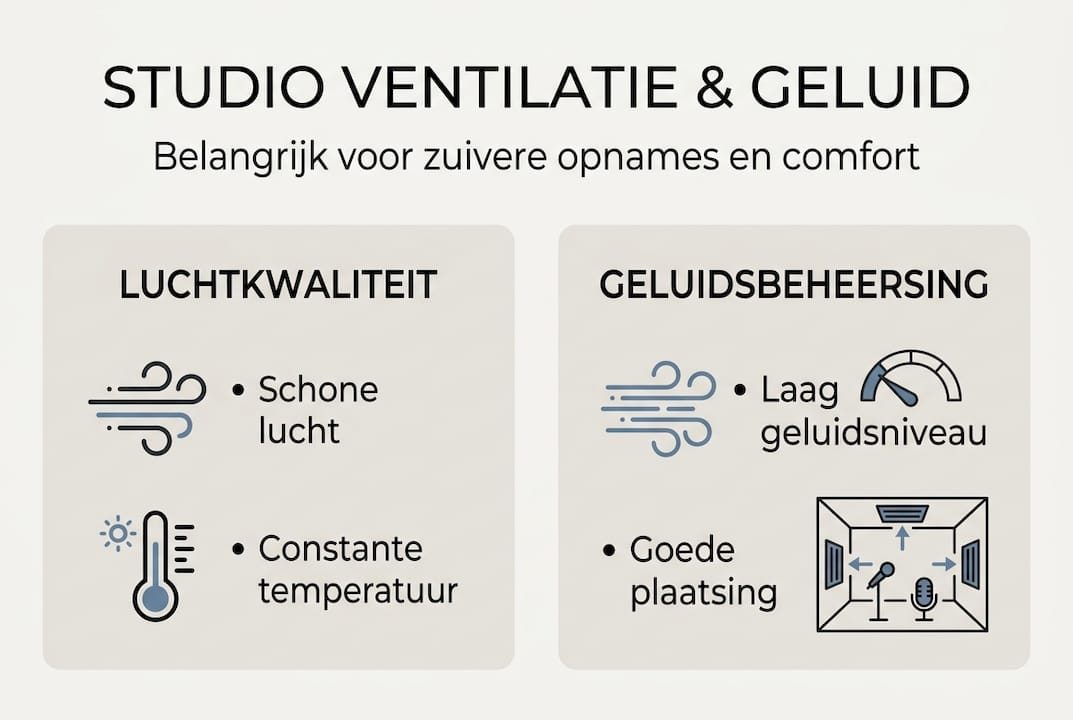
Pro-tip: install acoustic baffles in a zigzag pattern within ventilation shafts to reflect and attenuate sound waves multiple times without significantly reducing airflow. This design combines effective noise reduction with optimal ventilation performance.
Material choiceе for ventilation ducts affects both noise transmission and airflow efficiency. Flexible plastic ducts are inexpensive but create turbulence that results in audible noise. Smooth metal ducts with sound-insulating casings perform better but cost more. Also consider the diameter of your ducts, as narrower ducts force air through faster and generate more noise. Larger diameters with lower air velocities produce less noise for the same ventilation volume.
The location where ventilation outlets end up in your studio requires strategic planning. Never place exhausts directly across from microphones or in the primary recording space. Preferably position them behind acoustic treatments or in technical areas where equipment is located. This minimizes direct sound interference while still benefiting from effective airflow throughout the studio.
Why good ventilation is crucial for comfort and equipment
Your creativity and technical precision suffer directly from uncomfortable studio conditions. Temperatures above 24 degrees Celsius reduce concentration and increase error rates during mixing and mastering. High humidity above 60% creates an oppressive atmosphere that makes prolonged sessions exhausting. Good ventilation maintains stable conditions that support your productivity and decision-making.

Audio equipment generates significant heat during operation, especially studio computers, amplifiers and outboard gear with tube electronics. Heat and moisture from inadequate ventilation progressively damage expensive studio equipment and shorten the life of critical components. Digital interfaces and AD converters contain sensitive chips that become unstable at temperatures above 35 degrees and introduce artifacts into your signal path. Capacitors in analog gear degrade faster in humid environments, resulting in reduced sound quality and eventually complete failure.
Professional studio owners implement systematic approaches to optimize ventilation:
- Calculate the heat production of all equipment by adding power ratings and add 20% for unanticipated sources.
- Determine the required air change rate based on room volume and heat load, aiming for at least 6 to 8 complete air changes per hour.
- Select ventilation systems that provide sufficient capacity without excessive air velocities that generate noise.
- Integrate dehumidifiers or humidifiers depending on your climate to keep humidity between 40% and 55%.
- Install temperature and humidity sensors with continuous monitoring and automatic adjustments.
- Schedule quarterly maintenance checks for filters, fans and duct inspections.
Pro-tip: Place digital hygrometers and thermometers at different heights in your studio because temperature and humidity vary vertically, with warmer, more humid air rising to the ceiling and cooler air staying near the floor.
The relationship between ventilation and sound attenuation in studio requires integrated planning from the design stage. Ventilation openings create potential sound leaks that undermine your acoustic insulation if you don’t treat them correctly. Every hole in your studio walls for air circulation should receive the same acoustical attention as doors and windows. Use soundproof ventilation boxes with internal damping materials to block transmission of external sounds while air flows freely.
Equipment cabinets and rack units generate concentrated heat that requires special ventilation attention. Passive cooling via convection works only in small setups with limited power. Larger systems need active cooling with quiet fans specifically designed for audio environments. Consider fans with fluid dynamic bearings that produce less than 20 decibels at normal operating speeds, inaudible under typical studio background levels.
Practical ventilation solutions for home studios
Home studios vary greatly in size and budget, but all have access to effective ventilation strategies that protect sound quality. The choice between natural and mechanical ventilation determines your installation complexity, maintenance needs and acoustical challenges. Both approaches have specific applications where they perform optimally.
| Ventilation System | Advantages | Disadvantages | Best application |
|---|---|---|---|
| Natural ventilation | No energy costs, totally silent, no maintenance | Limited control depending on outdoor temperature, seasonal effectiveness | Small studios in temperate climates with flexible recording schedules |
| Mechanical ventilation | Precise control, consistent year around, independent of external conditions | Energy consumption, potential noise source, regular maintenance required | Professional studios with strict climate requirements and continuous use |
| Hybrid systems | Combines advantages, adapts to seasons, energy efficient | More complex installation, higher initial cost, requires smart controls | Mid-sized studios seeking optimal balance between cost and performance |
Implementing ventilation systems introduces noise without correct acoustical measures, so integrate both disciplines from the beginning. Start with a thorough analysis of your current studio layout and identify where heat is concentrated. Measure existing temperatures during typical sessions to pinpoint hot spots that should be prioritized. This data will inform your ventilation design and prevent over-engineering parts that are less critical.
Quiet fans are at the heart of effective studio mechanical systems. Look for models with specifications below 25 decibels at maximum speed and consider PWM control for variable speeds that adjust to current cooling needs. Larger fans running slower produce less noise than small, fast-spinning units at equal airflow. Install fans on vibration-damping mounts to prevent mechanical noise transmission to studio walls.
Acoustic duct lining effectively absorbs airflow noise and improves thermal insulation at the same time. Choose materials with a minimum thickness of 25mm and a density between 48 and 96 kg/m³ for optimal sound absorption without significant air resistance. Attach lining with heat-resistant adhesive or mechanical fasteners that do not cause compression, which reduces absorption effectiveness.
Quick installation tips for optimal ventilation in home studios:
- Position air inlets low to the floor and outlets high to the ceiling to utilize natural convection
- Create indirect air paths by directing ventilation flows through adjacent rooms before they reach the recording room
- Use multiple smaller vents instead of a few large openings for better sound insulation
- Install adjustable grilles that allow you to optimize airflow without permanent modifications
- Place sound absorbing materials directly around ventilation outlets to provide local acoustic treatment
- Test ventilation impact with recordings of silence at different system speeds to identify audible interference
Design studio acoustics should incorporate ventilation elements as natural parts of your overall design. Hide vents behind acoustic panels with perforated surfaces that absorb sound as air flows through. This approach combines functional ventilation with aesthetically pleasing acoustic treatment. Consider custom-built diffusers with integrated ventilation paths that optimize both sound diffusion and airflow.
For studios in existing spaces without the possibility of extensive ductwork installations, portable air conditioners with soundproof enclosures offer practical alternatives. Place these units outside the recording room and duct cooled air in through insulated flexible ducts. Although less efficient than permanent systems, they avoid costly renovations while providing adequate climate control. Combine with strategic placement of quiet fans for air circulation within the studio.
Discover our specialized solutions for studio ventilation and acoustics
Optimal studio conditions require more than just good intentions, they require integrated systems that work together. We understand that every studio presents unique challenges, from compact home setups to professional facilities. Our PC for music production are specifically designed with optimized cooling that minimizes noise levels without compromising performance. These systems integrate seamlessly into well-ventilated studios and reduce the overall heat load you have to manage.

Explore our comprehensive guides on studio acoustics improvement that offer practical strategies for combining ventilation with acoustic treatment. Our team offers consulting that analyzes your specific space and suggests solutions that fit within your budget. From initial design to implementation and optimization, we support studio owners in creating environments where technical excellence meets creative flow. Visit audio pc and acoustics for complete information on our products and services.
Frequently asked questions about studio ventilation
Why is ventilation so important in a recording studio?
Ventilation maintains stable temperature and humidity essential for equipment reliability and human comfort during long sessions. Inadequate airflow results in overheated electronics that introduce artifacts and eventually fail, while poor air quality negatively affects concentration and decision-making.
How do I prevent ventilation from adding noise to my recordings?
Use quiet fans with specifications below 25 decibels, install acoustic dampers in ventilation shafts, and place exhausts strategically away from microphones. Larger ducts with lower air velocities generate less turbulence noise than narrow ducts with high flow rates.
Which ventilation system is best for a small home studio?
Hybrid systems that combine natural ventilation with strategically placed quiet fans offer optimal flexibility for home studios. Apply mechanical ventilation during recordings when absolute silence is required, and switch to natural ventilation between sessions for energy-efficient climate control.
How often should I maintain my studio ventilation system?
Check and clean filters every three months, inspect fans and ducts semi-annually for dust accumulation, and verify that sensors are giving accurate readings. Regular maintenance prevents gradual performance degradation and identifies problems before they interfere with recordings or damage equipment.
Can I upgrade existing ventilation without major remodeling?
Yes, start by replacing standard vents with acoustically optimized alternatives and add sound-damping lining to existing ductwork. Install quiet inline fans in existing shafts and use portable air handling systems outside the recording room for immediate improvement without structural changes.
Recommendation
- Ventilation and Acoustics: Optimal Air Circulation Without Offset Noise – https://i4studio.nl/
- Furnishing Studio Acoustics: From Space Analysis to Perfect Mix – https://i4studio.nl/
- Sound attenuation in Studio: Complete Guide For Optimal Acoustic Management – https://i4studio.nl/
- Basics of Acoustics: A Practical Guide for Studios – https://i4studio.nl/