TL;DR:
- A professional studio is distinguished by high-quality equipment, controlled acoustics and a streamlined workflow.
- Acoustic treatment is just as important as the technical equipment for neutral sound reproduction.
- Investing in knowledge, experience and a good space is essential for consistent excellence.
Many studios present themselves as professional, but only a handful truly meet the rigorous demands of top production. The difference is not just in the price of the equipment, but in the combination of high-quality gear, thoughtful acoustics and a streamlined workflow. Clients and artists notice this difference immediately: in the clarity of the recording, the speed of the session and the end result that sounds from the monitors. In this article, we explain what characteristics make a studio truly professional, what equipment goes with it, and how acoustics and workflow combine to make the difference.
Table of contents
- Why professional studio characteristics are decisive
- Essential equipment for professional studios
- Acoustics and spatial design: The silent force
- The workflow: Efficiency and flexibility in the professional studio
- What most studio owners overlook
- Here’s how to build your own professional studio
- Frequently asked questions about professional studios
Key Insights
| Item | Details |
|---|---|
| Professional set-up required | Only with essential equipment, optimized acoustics and a structured workflow will you achieve top results. |
| Investment in quality | A truly professional studio requires substantial investment, but it pays off in consistent sound quality. |
| Acoustics are crucial | A balanced room and proper positioning of diffusers make at least as much difference as hardware. |
| Workflow determines efficiency | The use of DAWs and routing systems makes productions faster, more reliable and professional. |
Why professional studio characteristics are decisive
A hobbyist with a good microphone and a laptop technically has a recording studio. But the difference from a truly professional environment is enormous. Whereas a home studio often struggles with untreated room resonances, limited dynamics and generic monitor setups, a professional studio offers control over every part of the signal chain.
This has a direct impact on recording quality. Noise, coloration and phase errors that go unnoticed in an amateur environment become painfully visible in the mix. Clients paying for a professional studio expect a result that is immediately radio or streaming-ready, without extensive corrections afterwards.
A common misconception is that a home studio becomes equivalent to a professional environment with a few upgrades. That’s not true. The equipment checklist professional studio shows how many components work together to ensure top quality. Consider the combination of signal processing, room handling and monitor accuracy.
Here are the most common misconceptions listed:
- Myth 1: A good DAW compensates for bad acoustics. It doesn’t.
- Myth 2: Expensive microphones automatically make a professional recording. Without a good preamp and room, you lose the advantage.
- Myth 3: A home studio with a few upgrades is equivalent to a professional studio. The signal chain as a whole determines the result.
- Myth 4: Streaming platforms will accept anything. Loudness standards and dynamic requirements are more stringent than ever.
“A professional studio is not a sum of separate parts, but an integrated system where each element reinforces the next.
”
The investment in professional equipment such as Neve consoles and Pro Tools HDX ranges from €50,000 to €500,000+. That number scares, but it also clarifies why the results differ so fundamentally. For sound engineers looking to retain clients and generate repeat bookings, the leap in quality of professional features is not a luxury but a necessity. Familiarity with jargon studio equipment helps make the right choices and advise clients well.
Now that the importance has been outlined, let’s take a closer look at what equipment is essential for a professional studio.
Essential equipment for professional studios
The core of any professional studio consists of a number of fixed building blocks. Each component has a specific function and influences the rest of the chain.
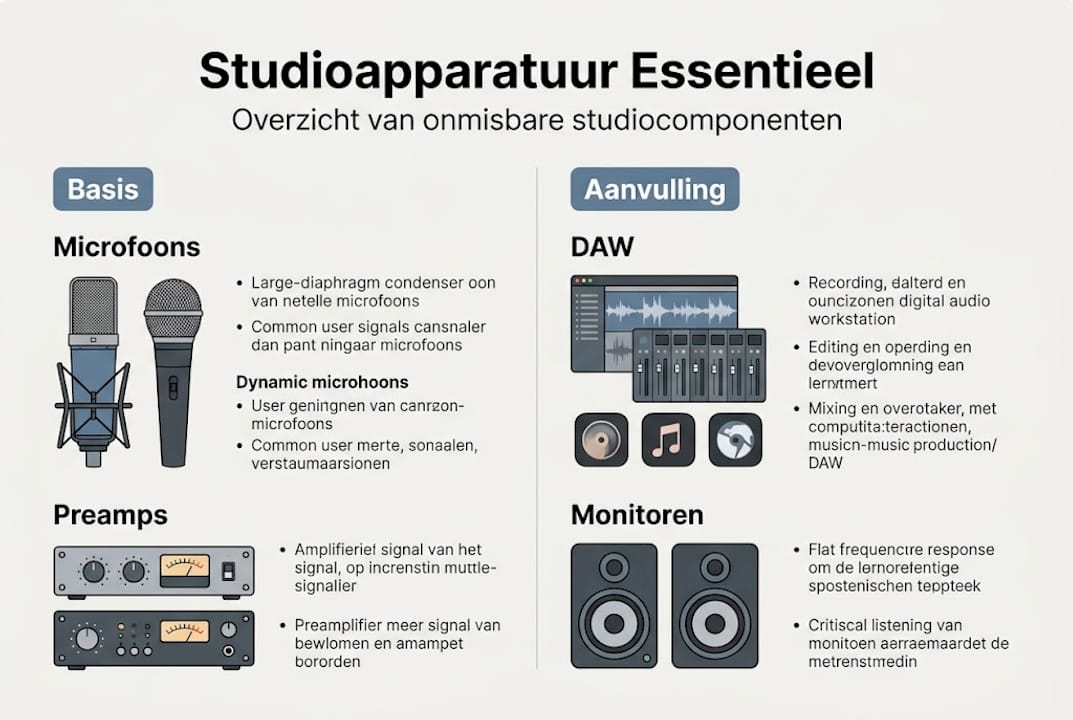
Microphones are the first point of contact with sound. Top studios use, among others, the Neumann TLM103, Shure SM7B and Sennheiser MKH416 for vocals, broadcast and location recording, respectively. The choice of microphone already largely determines the character of the recording.
Preamps and interfaces color and amplify the signal before it enters the digital world. Brands like Focusrite ISA430 and Neve 88RS are industry standards. A weak preamp undermines even the best microphone. Essential Recording Equipment gives a good overview of what you need at each level.
DAW and monitoring close the chain. Pro Tools Ultimate HDX is the standard in commercial studios because of its low latency, stable performance and wide compatibility. Dynaudio monitors provide a neutral, accurate view of the sound. Plugins from FabFilter and iZotope complement the processing side.
Below is a list of commonly used equipment by category:
| Category | Sample models | Application |
|---|---|---|
| Microphone | Neumann TLM103, Shure SM7B | Vocals, broadcast |
| Preamp | Neve 88RS, Focusrite ISA430 | Signal amplification and color |
| Console | SSL 4000E, Neve 88RS | Mixing and routing |
| Interface | AVID MTRX | AD/DA conversion |
| DAW | Pro Tools Ultimate HDX | Recording, editing, mixing |
| Monitors | Adam Audio | Reference Playback |
| Plugins | FabFilter, iZotope | EQ, compression, restoration |
An example of a typical workflow: the artist sings in an isolated booth with a TLM103 through a Neve preamp to Pro Tools. The engineer mixes in real time on Dynaudio monitors, while FabFilter Pro-Q 3 provides the EQ. This is no accident, but the result of conscious choices in the signal chain.
For an accessible entry level, the sE Electronics X1 S microphone is a solid choice that offers professional quality without the price tags of the absolute best. For computer operation, choosing the right Avid ProTools computer is crucial for stable, latency-free sessions.
Pro-tip: Always invest in the source and signal chain first, only then in luxury accessories. An excellent mic with a mediocre preamp will yield less than a good mic with a high-quality preamp.
The specific equipment is closely related to the acoustic properties of the room.
Acoustics and spatial design: The silent force
Equipment is visible and tangible. Acoustics are not, but their impact is at least as great. An untreated room colors the sound in ways you don’t discover until later in the mix, often too late to fully correct.
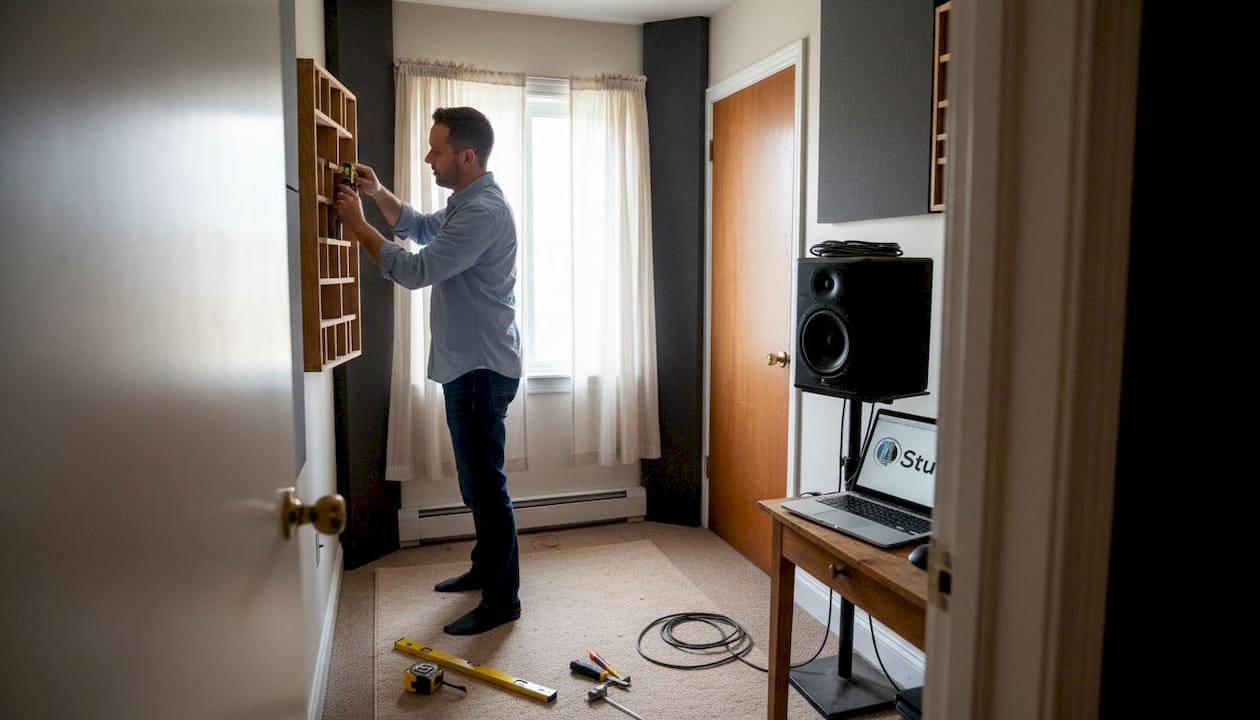
Professional studios invest heavily in acoustic solutions such as diffusers, absorbent panels and strategic layout in addition to equipment. The goal is a neutral listening environment: a space that colors the sound as little as possible so that the engineer hears what was actually recorded.
The difference between an untreated room and a professionally treated room is concretely measurable. In a generic room, standing waves occur at specific frequencies, making certain tones sound too loud or too soft. In a treated studio, these resonances are controlled by a combination of absorption and diffusion.
Here’s a comparison:
| Feature | Untreated room | Professional studio |
|---|---|---|
| Low frequencies | Angled construction | Controlled with bass straps |
| Mid/high frequencies | Echo and flutter | Absorbed and diffused |
| Stereo image | Vague and wide | Sharp and precise |
| Reference reliability | Low | High |
A practical roadmap for acoustic optimization:
- Measure the room with a measurement microphone and software such as Room EQ Wizard. Identify problem frequencies.
- Treat the corners first. Bass traps in the corners address the most problematic low frequencies.
- Place absorbers at the first reflection points on the sides, ceiling and behind the listening position.
- Add diffusers to the back wall to keep the room lively without creating echo.
- Check and repeat with reference shots you know well.
The studio acoustics tips on our site provide additional guidance on setting up your space, from small home studios to large control rooms.
Pro-tip: Always test with reference recordings you know thoroughly before assessing your studio’s acoustics. Commercial releases from artists you know well will give a more reliable picture than new, unfamiliar material.
In addition to equipment and acoustics, workflow and digital integration determine consistent top results.
The workflow: Efficiency and flexibility in the professional studio
A professional studio does not run on hardware alone. The way you work helps determine the quality and consistency of the end result. A streamlined workflow saves time, reduces errors and allows artists to focus on their performance rather than technical problems.
DAWs such as Pro Tools Ultimate HDX and controller integration via Neve, SSL and AVID provide unprecedented workflow efficiency and flexibility, essential at top level. The combination of hardware and software allows rapid switching between tasks without loss of quality.
A professional workflow consists of four main phases:
- Preparation: prepare session template, check routing, go over input lists with the artist. Proper preparation prevents wasted time during recording.
- Recording: Monitor signal path, review takes and communicate with artist. Real-time monitoring via high-quality headphones or monitors is essential.
- Editing: Comping of takes, timing and pitch correction where necessary, preparation for the mix. Precise edit work determines how smoothly the mix goes.
- Mix and master: Match balance, space and dynamics to the final medium. Use reference tracks to remain objective.
Within these phases, there are additional tools that make a difference:
- Custom macros in Pro Tools or Logic Pro automate repetitive tasks such as labeling tracks or applying default EQ settings.
- Session templates ensure that each session begins with a proven routing and plugin structure.
- Automatic backups prevent data loss in the event of software crashes or power outages.
- Latency management via dedicated hardware buffers keeps latency minimal, which is crucial in live monitoring.
Risk factors that professional studios actively manage include latency in large sessions, software crashes due to incompatible plugins and loss of session data. A reliable DAW Pro Tools computer with sufficient RAM and a fast SSD is not an afterthought but the backbone of your workstation.
Collaboration with artists and co-producers is also more efficient in a professional environment. Clear communication protocols, shared session files via cloud storage and an established feedback routine keep projects on track.
What most studio owners overlook
After years in the industry, we keep seeing the same pattern: studio owners invest in expensive gear, but neglect the two factors that contribute most to consistent top-notch results. Those are a neutral listening environment and the ability to listen critically.
A Neve console in an untreated room yields less than a mid-range setup in a perfectly treated room. Still, the temptation is to invest in visible, tangible hardware rather than acoustic panels or training sessions for the ear.
The comparison between a home studio and a professional studio shows that the difference is rarely in one specific piece of equipment. It is in the combination of a neutral reference environment, a consistent workflow and the experience to make the right decisions quickly.
Invest in knowledge, too. An engineer who knows how to measure a room, how to deploy reference tracks and how to quickly switch between tasks delivers more value than the most expensive console without those skills. Gear and knowledge reinforce each other, but knowledge has the longest shelf life.
Here’s how to build your own professional studio
Want to take your studio to the next level? At i4studio, you’ll find a carefully curated assortment that meets the needs of professional studio owners and sound engineers.
Whether you start with acoustic treatment via our studio acoustic diffusers, are looking for a reliable USB audio interface for low latency and high conversion quality, or want to start immediately with a complete studio set: our range is always tailored to professional application. Contact us for personal advice or check out our product pages for the latest specifications and bundles.
Frequently asked questions about professional studios
What equipment is really indispensable in a professional studio?
High quality microphones, preamps, interfaces, a stable DAW, reference monitors and processing plugins make up the basic equipment. Top studios use Neumann TLM103, Shure SM7B, Neve 88RS, Pro Tools Ultimate HDX and Adam monitors, among others, as industry standards.
How important are acoustics versus expensive equipment?
Good acoustics are at least as important as high-quality equipment because they determine what you actually hear and record. Professional studios invest heavily in diffusers, absorbent panels and strategic layout next to their equipment.
What does it cost to set up a professional studio?
A full-fledged professional studio requires an investment between €50,000 and €500,000+, depending on equipment and space. The investment in professional equipment such as Neve consoles and Pro Tools HDX largely determines the final budget.
What benefits does a professional workflow offer?
A professional workflow ensures efficiency, flexibility and consistent results with every recording. DAWs such as Pro Tools Ultimate HDX combined with hardware controller integration enable fast switching without loss of quality.
Recommendation
- Home Studio Sound Recording Tips: From Space to Mix – https://i4studio.nl/
- Music studio setup: step by step the best sound
- Furnishing Studio Acoustics: From Space Analysis to Perfect Mix – https://i4studio.nl/
- Studio Acoustics Improvement: Practical Guide For Professional Sound Spaces – https://i4studio.nl/