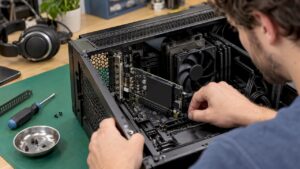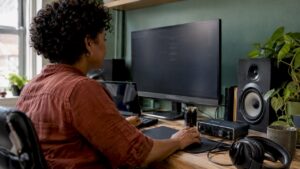
A smart home studio for content creators combines a well-chosen space, decent acoustic treatment, reliable hardware and an efficient workflow. Those who align these elements not only get better recordings, but also less frustration during mixing and rendering. I4studio supports content creators with specialized audio, video and rendering computers and customized advice – exactly what is needed when performance and reliability count.
Why investing in a real home studio pays off
Many content creators start with a laptop and a microphone, and that can be fine for experimentation. Once quality, efficiency or scalability become more important, it quickly becomes apparent that smart investments save time and energy. A well-equipped home studio provides benefits such as:
- Better sound quality – less echo, clearer vocals.
- Faster workflow – less rendering and waiting time in video and mixing.
- Consistency – reproducible results and more reliable live broadcasts.
- Professional appearance – important for customers, labels or sponsors.
For creators who want to deliver serious work, a purpose-built home studio is the foundation of professional work.
Choosing and preparing space
Which space is suitable?
A rectangular room with minimal symmetry between walls is ideal. Large rooms often give fuller low sound, but are more difficult to handle. Smaller rooms are easier to handle quickly, but are more likely to contend with standing waves and muddy bass. More important than size is: not a room below a living room with loud talking neighbors (noise pollution!) and as few hard, reflective surfaces as possible in the immediate listening area.
Basic acoustics: what should be done first?
The three main focal points are:
- Direct reflections – first reflection points left/right above the listening point and to the side opposite the monitors. Attenuating these with absorber plate prevents time shifts in the stereo image.
- Bass traps – problems below ~200 Hz are usually room related. Bass traps in corners or against long walls dampen standing waves.
- Check reverb time – too much reverb makes mixes fuzzy; too little makes it unnatural. Aim for a balance depending on genre (pop usually has shorter reverb, acoustic can be longer).
Practical tip: improvise with pillows and towels to make a quick audible difference, but then go for professional panels or custom solutions as budget and ambition grow. I4studio also offers acoustic solutions and advice for room tailoring – from DIY tips to installation of professional panels.
Furniture and positioning
The correct position of the workstation is crucial. A common rule of thumb: the monitors and the listening position form an equilateral triangle. Don’t put the listening position exactly against the back wall – a small distance (0.5-1 meter) helps reduce direct bass problems. Put in rugs and curtains to reduce reflections without “dead dampening” the room.
Essential hardware for a home studio for content creators
The exact gear depends on the type of content: podcasts, music production, videos or livestreams each require slightly different gear. Below is a comprehensive overview of the core components and choices creators face.
Microphones: which one to choose when?
Microphones come in many flavors, each with its own character and application.
- Dynamic – robust and less sensitive to room noise; ideal for podcasts, speaking voices and amplified guitars. Examples: Shure SM7B (podcast, vocals), Sennheiser MD421 (instruments).
- Condenser – wider frequency range and detail; perfect for vocals and acoustic instruments, but gets unwanted room noise faster. Popular choices: Neumann TLM 103, Rode NT1-A.
- Ribbon – warm, natural sound, often used for specific application such as vintage-sounding vocals and horns. Careful use and good preamp are required.
Practical tip: for beginning creators, one good dynamic microphone can already do wonders. For those who want to improve: add a condenser later for more nuance in vocals and acoustic instruments.
Audio interface: the heart of the chain
The audio interface converts analog to digital (and back). Important specifications to watch out for:
- Preamp quality – determines the signal sound. Economical preamps are often acceptable, but for higher quality, invest in interfaces with excellent preamps or external preamps.
- Number of inputs/outputs – depending on recording needs (solo podcast vs tape recording).
- Connection – USB is common; Thunderbolt offers lower latency and higher bandwidth for large sessions.
- Converters – AD/DA converters affect transparency and dynamic range.
For livestreaming, an interface with loopback or dedicated routing is useful. I4studio often recommends based on workloads: whether multi-track recording or heavy plugin processing, there are interfaces that match well with the chosen workstation architecture.
Studio monitors and headphones
Monitors let you hear the real mix – combined with good acoustics. Choose nearfield monitors that fit the room (meter spacing, woofer size). Key points of interest:
- Positioning: at ear level, away from walls, and with acoustic isolation below or behind the monitors.
- Subwoofer: adds layer extension but needs tuning via crossover and layer treatment.
- Headphones: closed for recording (less leakage), open for critical listening and mixing.
Preamps, compressors and outboard
External hardware often adds character to the sound. Preamps add color and gain, compressors give control and sometimes vibe. For content creators, start digital and add outboard where it really adds something.
The computer: the beating heart of the home studio
For content creators, the computer is not just a tool – it defines the capabilities for real-time processing, sample libraries, video rendering and stability during broadcast. I4studio specializes in audio, video and rendering computers optimized for studio environments and broadcast workflows.
Key specifications and why they matter
- CPU – in DAW workloads, both single-thread performance and multi-core are important. Synthesizers and real-time effects benefit from higher single-core clock speeds; large mix sessions and renders benefit from many cores.
- RAM – sample-based instruments and large video projects require a lot of memory. 16 GB is a minimum for serious audio, 32-64 GB is quickly becoming the norm with extensive sample libraries or 4K video editing.
- Storage – SSD/NVMe drives for OS and project files; separate NVMe or SATA drives for sample libraries and scratch. RAID sets or fast NAS for backup and shared storage are valuable.
- GPU – less relevant for audio but essential for video rendering, color correction and real-time previews in NLEs such as DaVinci Resolve or Premiere Pro.
- Cooling and power supply – reliable cooling prevents throttling during long renders; stable power and UPS prevent projects from being corrupted during blackouts.
Examples of configurations
Here are some sample setups, indicative of budget and use.
Entry level (podcasts, simple music production)
- CPU: 6-core midrange (e.g. Intel i5/AMD Ryzen 5)
- RAM: 16 GB
- Storage: 1 TB NVMe for OS & projects + 2 TB HDD for backup
- Audio: simple USB interface with 2 inputs
- Purpose: podcasts, livestreams, light music production
Mid-range (serious music production and 1080p video)
- CPU: 8-12 cores (strong single-core performance)
- RAM: 32 GB
- Storage: 1 TB NVMe (OS) + 2 TB NVMe (samples) + NAS for backup
- GPU: midrange for video acceleration
- Purpose: larger DAW sessions, sample-heavy virtual instruments, 1080p/60fps video editing
High-end (professional audio, 4K video, broadcast)
- CPU: 16+ cores or high-clock hybrid setups
- RAM: 64GB+
- Storage: multiple NVMe drives in RAID, dedicated scratch disks, high-speed NAS with 10GbE
- GPU: powerful card for 4K/8K workflows
- Purpose: film production, real-time broadcast encoding, large sample libraries and physical modeling synths
I4studio builds and delivers workstation and broadcast servers tailored precisely to such workflows. Their advice helps determine which trade-offs make sense: more cores or higher clock speed, how much storage and what type of I/O is most efficient.
Backups and workflow for data-intensive projects
Backups are not an extra – they are life insurance for projects. A simple strategy:
- Local fast storage for active projects (NVMe).
- Daily backup to an external drive or NAS.
- Offsite backup (cloud or physical storage at trusted partner’s location).
Use version control for projects whenever possible (some DAWs and video NLEs have project versions; combine with filename conventions for clarity).
Video, lighting and visual presentation
For content creators who also create video, image quality and lighting are often as important as audio. Here’s a compact guide.
Camera choices
- For starters: a good webcam (Logitech Brio) or smartphone with ringlight can already provide excellent content.
- For higher quality: mirrorless cameras (Sony, Canon, Fuji) with clean HDMI output and capture card for live streaming.
- Lenses: prime lenses for portrait look; kit lenses for flexibility.
Exposure and color
A simple 3-point exposure (key, fill, back) makes a huge visual improvement. LED panels with adjustable color temperature are practical and energy efficient. Pay attention to consistency in white balance, especially with multiple cameras.
Capture and workflow
Live recording requires a capture card (HDMI-in) when working with mirrorless cameras. For high-end workflows, hardware encoders offer less CPU load and more stable streams; I4studio provides systems specifically for broadcast encoding and multi-camera setups.
Livestreaming and broadcasting: tips for stable broadcasts
Live broadcasts combine audio, video and network components. Some points of interest:
- Prioritize audio: good microphone and low-latency interface ensure professional-sounding streams.
- Use hardware or dedicated streaming PCs for large events – separate machines for game/scene rendering and encoding prevents hiccups.
- Map network: wired Ethernet (Gigabit) is more reliable than Wi-Fi; consider bonding or failover if uptime is critical.
- Always test under live conditions and keep redundancy behind you (spare microphones, extra cameras, backup PC).
I4studio builds broadcast-ready solutions with multiple I/O, professional audio routing and redundant power. For broadcasters or creators making money from streams, such an investment pays off in stability and quality.
Workflow, ergonomics and production habits
Signal flow and gain staging
A clear signal chain prevents noise and clipping. Provide:
- Correct gain settings on preamps (about -12 dB during peaks).
- Activation of pad or input switches as needed.
- Monitoring levels in the DAW and on the interface, not just on the plugin’s meter.
Ergonomics of the workplace
A comfortable workspace increases productivity. Consider monitor height, adjustable chair, well-placed keyboard/mouse and cable management. Small investments such as monitor arms or a DAC/monitor controller on the desk make life more pleasant.
Templates and presets
Templates in the DAW for frequently used sessions (2-speaker podcast, vocal recording, live stream) save many hours. Presets for EQ/comp for dialog and vocal chains help with consistent quality.
Remote collaboration and remote recording
Remote collaboration requires good workflows and tools. Popular solutions:
- Audiomovers – real-time audio streaming between DAWs with high quality.
- Source-Connect – industry standard for remote sessions with low latency.
- DAW-compatible cloud projects (Some services offer collaborative workflows).
Important is synchronous sample rate and bit-depth, and clear communication about monitor mix and latency. For drummers or bands, it is often more practical to share voice or click tracks and record locally.
Budget setups: examples with context
Here some concrete build proposals tailored to purpose and budget.
Budget podcast studio (± €800-€1,500)
- Dynamic microphone (e.g. Shure SM58 or Shure SM7A for better quality).
- USB or entry-level audio interface with 2 channels.
- Headphones closed type.
- Computers: stable laptop or entry-level desktop (16 GB RAM).
- Simple acoustic panels or DIY solution with absorbent materials.
Multitrack music and video studio (± €2,500-€7,500)
- Condenser microphone for vocals, dynamic for instruments.
- Audio interface 4-8 inputs, Thunderbolt if possible.
- Nearfield monitors and subwoofer, bass stages.
- Workstation: 32 GB RAM, fast NVMe, 8-12 cores CPU, midrange GPU.
- Lighting and mirrorless camera for video.
Professional broadcast/workflow setup (€10,000+)
- High-end preamps and outboard (compressors, EQs).
- Multi-channel interface or dedicated console with top-quality AD/DA.
- Workstation with 64+ GB RAM, multi-core CPU, fast RAID storage and 10GbE network.
- Redundant systems, hardware encoders, professional cameras and switchers.
I4studio provides systems tailored to such workflows and helps technically translate what a creator really needs – not overkill, but robust enough for professional use.
Maintenance and common problems
Clicks, pops and audio dropouts
- Check buffer settings in the DAW and driver (ASIO for Windows).
- Sufficient CPU and RAM; shut down unnecessary background processes.
- Use high-quality cables and make sure chipset drivers are up-to-date.
Latency and timing
Lower buffer helps with monitoring during recording, but requires more CPU. Use direct monitoring of interface when tracking to eliminate latency sensation. For mixes increase buffer so CPU spikes don’t cause clicks.
Ground loops and hum
Ground loops cause 50/60 Hz hum. Solutions: use different outlets, good cables, DI boxes with ground elevator or isolators; have an electrician take a look at persistent problems.
Case study: a day in a well-appointed home studio for content creators
A typical session day might look like this: the creator starts with a template in the DAW for a vocal track, checks levels, does a short pre-effect recording (dry) and activates a light comp/EQ during overdub. While the vocal is being recorded, the producer performs minor edits in the video editor. After recording, voices are exported to a shared folder, where a remote engineer later does color and finalization based on the flat mix. At the end of the day, a raw mix is already ready and the render of the video is queue’d on a separate rendering machine – exactly the kind of parallel workflows where powerful hardware and smart setup save time.
Final words: step by step to a better home studio
One does not build a full-fledged home studio for content creators overnight. Start with the things that make the most impact: better microphones and proper positioning, basic acoustics training, and a stable computer with adequate storage and RAM. Then delve into monitors, preamps and video setup. Those who want to work professionally would do well to get advice from specialists who know studio environments and can provide systems tailored to the workflow – exactly what I4studio offers: advice, specialized audio/video and rendering computers, and acoustic solutions.
With thoughtful construction, consistent workflow and reliable hardware, the home studio becomes not just a place to create content, but a productive creative hub. And that turns work from hobby to craftsmanship.
Frequently Asked Questions
What is the minimum investment for a professional home studio for content creators?
The minimum investment depends on goals. For a good podcast setup including microphone, interface, headphones and basic acoustics, count on €800-€1,500. For serious music production or video editing, a reliable workflow starts around €2,500-€7,500. Those who want broadcast quality invest substantially more and look at professional interfaces, monitoring and workstation hardware.
What computer specifications are most important for audio and video?
For audio: good single-core performance and sufficient cores, at least 16-32 GB RAM, NVMe storage and reliable audio drivers (ASIO on Windows). For video: powerful GPU, plenty of RAM (32-64 GB+), fast storage and multi-core CPU for rendering. A balanced setup prevents bottlenecks.
How much acoustic treatment does an average home studio need?
Start with first-reflection panels and bass traps in the corners. Add absorbers or diffusers in areas where the room still sounds distracting. Often 6-12 panels is a good start for an average room; custom or professional advice will help optimize.
Is it better to invest in outboard gear or in better plugins and computer power?
Plugins today are very powerful and often cost-effective. Outboard gear often adds character and workflow advantages. For pure sonic upgrade, outboard is interesting; for flexibility and cost savings, investing in computer power and high-quality plugins is often more practical. A mix of both is ideal for many studios.
Can I4studio help put together a specific setup?
Yes. I4studio provides custom consulting for audio, video and broadcast workstations, studio equipment and acoustic solutions. They can provide configurations tailored to workflow, desired software and budget – with implementation and optimization support.