Yes, a door corner is a great place to install a bass trap, and often it’s even a corner you don’t want to skip. The best placement is a bass trap that spans the corner. If the door’s swing radius doesn’t allow for that, split the treatment: place one panel against the wall and one on or next to the door, or slide the bass trap up into the triangle above the door frame. With a ready-made corner bass trap in the right size and some advice about your space, you’ll have that tricky corner under control faster and more reliably than with loose insulation panels and a frame you cut yourself.
In a nutshell
- A diagonal placement is best. A bass trap positioned diagonally across the corner, with air behind it, is most effective. If that’s not possible, the alternative is to place two panels parallel to the wall and the door.
- The door determines your options. The direction of rotation, the hinge side, and the clear opening are your constraints. Always keep an escape route clear.
- There is often space above the door. The triangular corner between the wall and the ceiling is usually the easiest spot in a door corner.
- Thickness and volume matter. The deeper the step, the lower it operates. A narrow, flat plate has little effect at low levels.
- Measure before and after. Only by taking measurements will you know if the door angle was the problem and if the staircase solves it.
Table of contents
- Why Corners Are So Important for Your Layer
- Three layouts for a corner with a door
- Floor corner or ceiling corner?
- Which shape is best: triangular, square, or round?
- Thickness, material, and finish
- Step-by-step guide: Installing a bass trap in a door corner
- How many bass traps do you need?
- Testing if it works
- Corner bass traps that fit in your corner
- Here’s how we look at the door corner
- Frequently Asked Questions
- Sources
Why Corners Are So Important for Your Layer
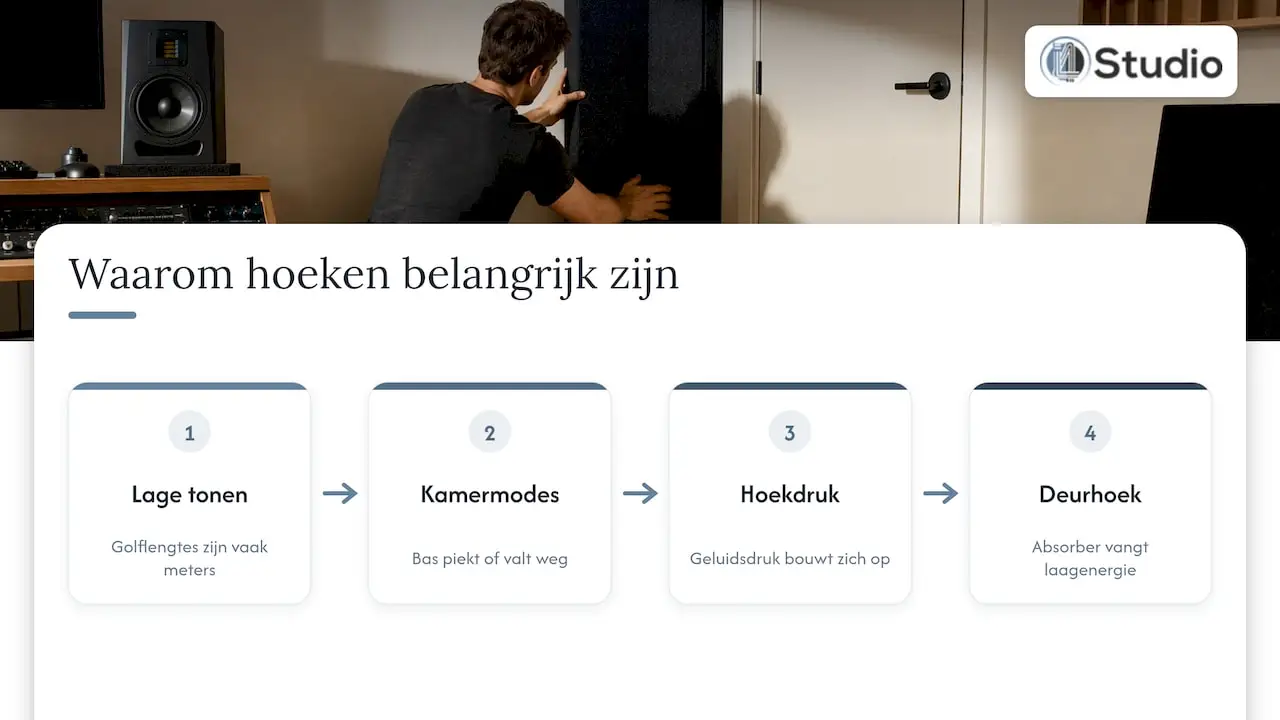
Low frequencies behave differently in a small space than mid and high frequencies. The wavelengths are long—often several meters—and they bounce back and forth between parallel walls. This creates standing waves, also known as room modes: in one spot in your room, a certain bass note sounds much too loud, while a meter away, it’s barely audible.
Corners are the points where walls, floors, and ceilings meet. That’s where the sound pressure from those standing waves builds up. An absorber placed in a corner therefore has to handle a lot of low-energy sound. That’s why virtually every acoustics guide starts with the corners, and why our explanation of why bass traps are indispensable also leads to that conclusion.
A door corner is just one of those corners. Sound doesn’t know there’s a door there. If you skip it because it’s difficult, part of your room modes will remain untreated, and you’ll hear that as an uneven response at your listening position. This makes a difference especially in a home studio, where the door is often located in a corner close to your monitors or your listening position.
If you want to get a clear understanding of the basics of reverberation, reflections, and modes first, read up on the basic principles of acoustics.
Three setups for a corner with a door
The best configuration depends on which way the door opens and how much space you have next to the door frame. Here are the three approaches that work in practice.
| Lineup | When to Choose | Strength | Note |
|---|---|---|---|
| Diagonally across the corner | The door swings away from the corner, or there is enough wall space next to the door frame | Best performance, air behind the stairs | The door must not touch the panel |
| Split: wall + door | The door turns into the corner | The corner remains accessible without obstruction | Weight and mounting on the door |
| High up in the triangular corner | Little space at eye level or floor level | Completely off the walking path | Mount securely; check the height of the window frame |
1. Diagonally across the corner
This is the classic placement: a triangular staircase or a panel positioned diagonally across the corner, creating an air gap behind the material. In a test published by ProSoundWeb in November 2021, spanning the corner was deemed the best placement.
In a door corner, this works if the door opens away from the corner—that is, if the hinges are on the opposite side of the door frame. Then you have the entire corner at your disposal. If there’s at least one panel width of wall between the door frame and the corner, the staircase can often remain in place even with a door that swings into the corner. Measure the door’s swing radius and allow a few centimeters of clearance so that the doorknob or door leaf never touches the panel.
2. Split: one panel on the wall, one on the door
If the door opens around the corner, a staircase cannot be placed diagonally across the corner. In the ProSoundWeb test mentioned, this is exactly the situation in which two staircases are used parallel to the surfaces: one against the wall and one against the door.
Here’s how it works in practice:
- The wall panel hangs right next to the door frame, on the side where the door rests when it’s open.
- The second panel is mounted on the door itself, on the studio side. When the door is open, the two panels rest against each other and together form a sort of corner trim.
- Choose a panel for the door that isn’t too heavy for the hinges, and secure it with screws or brackets that can support the door panel. A hollow interior door offers little support, so screw into the door jambs along the edge.
It’s not as good as overhanging, but it’s much better than leaving the corner empty.
3. High up in the triangular space above the door
Where two walls and the ceiling meet, there is a triangular corner. Above a door, there is often unused space there: the door frame usually ends well below the ceiling. A triangular corner staircase that hangs from the ceiling is completely out of the way of the walking path and the door’s swing radius.
Measure the clearance between the top of the door frame and the ceiling, and add the height of the door closer or any transom window. Mount the staircase using sturdy ceiling or wall fasteners: a panel above a doorway must be securely fastened.
Floor corner or ceiling corner?
Every vertical corner has two triangular corners: one at the floor and one at the ceiling. If you only have a limited number of steps, the question is where they will be most effective.
Acoustically, both triangular corners are areas where bass pressure builds up. In a door corner, practical experience is the deciding factor:
- When placed near the floor, a staircase quickly gets in the way of the door, a baseboard, or a doorstop, and you’ll bump into it when you walk in.
- Near the ceiling, the corner is almost always clear. That’s why the space above the door, in a door corner, is usually the logical choice.
If you have enough headroom, a staircase that spans the entire vertical angle from floor to ceiling is the strongest option. This is rarely possible in a door corner, so it’s best to combine a ceiling-mounted staircase above the door frame with full-height treatment in the other corners of the room.
Which shape is best: triangular, square, or round?
This question comes up again and again on forums, and the short answer is that the shape matters less than the volume and depth of the material. A bass trap works because the airflow from low frequencies has to pass through a thick layer of porous material. The more material there is and the more airspace behind it, the lower the trap can go.
When it comes to a door corner, what matters most is what fits:
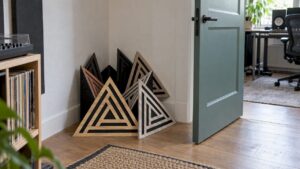
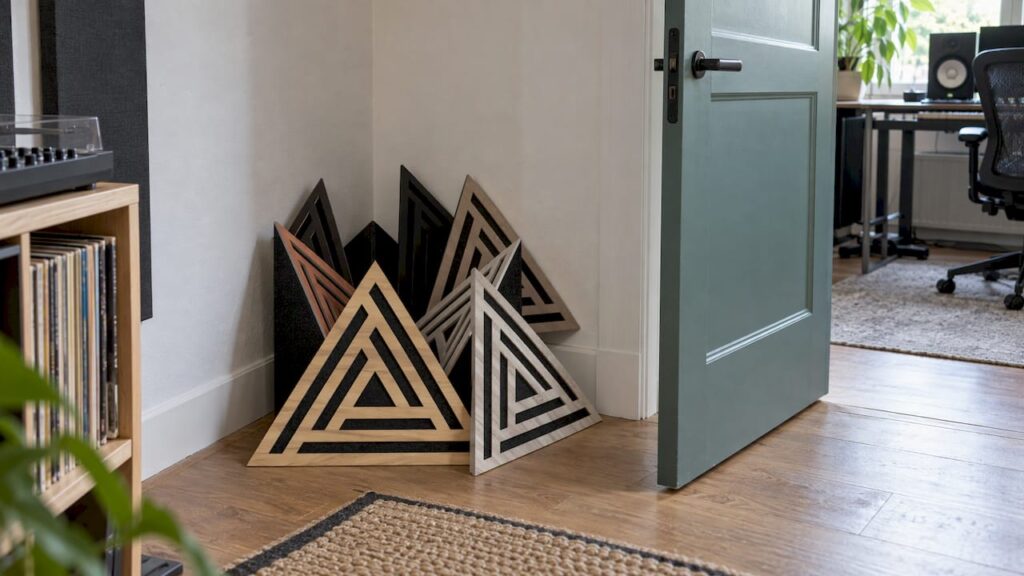
- A triangular shape fills the corner best and is the most commonly used shape for corners. Ideal for the triangle above the door or an open vertical corner.
- A square or rectangular shape works well as a split solution: a flat, deep panel on the wall and one on the door. A square panel placed diagonally in a corner also leaves space behind it.
- Round or semicircular shapes require more floor space and can quickly get in the way in a door corner.
If you’re unsure which design to choose for your room, take a look at our studio acoustics design, where we treat the entire space as a single unit.
Thickness, Material, and Finish
A bass trap needs to be thick. A thin foam panel a few centimeters thick dampens high-frequency reflections, but it’s too shallow for low frequencies. Professional corner traps are therefore built to be deep, with a core of porous absorbent material and an acoustic fabric that allows air to pass through.
What should you look for when choosing a staircase for a door corner?
- Depth. The deeper it is, the lower the operating height. In a door corner, choose the deepest step that fits without hitting the door.
- Breathable fabric. The fabric on the front must allow air to pass through; otherwise, the layer will not reach the material.
- Finished edges. You walk past the stairs every day when you go through the door. A fully wrapped panel keeps fibers from coming loose and stays looking neat even if you bump into it.
- Weight. For a door or above a window frame, you want a panel that’s light enough for the mounting hardware you have.
- Fire safety. A studio is full of equipment and cables. Choose ready-made panels whose material properties the seller can explain, especially if there’s a staircase near the only exit.
A custom-built frame with loose-fill insulation has no known absorption values: you don’t know how it performs until you measure it. A pre-finished staircase is more predictable in that sense and can be installed more quickly.
Step-by-step guide: Installing a bass trap in the corner of a doorway
- Determine your listening position and monitor setup. The placement of your studio monitors and your chair determines which modes you hear most clearly. Make sure to position them correctly first.
- Measure the door. Note the direction of opening, the hinge side, the swing radius, the space between the door frame and the corner, and the clear height above the door frame. This is where things usually go wrong: a step that’s just a little too deep will hit the doorknob.
- Choose the configuration. Diagonal if the door swings freely, split if the door swings into the corner, and high if you have space above the door frame. Refer to the table above.
- Choose the trap. For an open corner or the triangle above the door, a triangular “Triangle-CIFI” Corner Bass Trap is the shape that fills the corner. For the other corners of the room, a set like the Triangle-CIFI SONOMA (4-piece set ) is a natural choice. Also check out the EYE4 Bass Trap Kick if you’re looking for a different shape. If you’re unsure about size or type, we’re here to help with our advice on acoustic panels.
- Install securely. On the door: screw into solid wood or the door jambs. Above the door frame: secure it to the wall or ceiling, not just to a baseboard or decorative molding.
- Check the clearance. Open and close the door fully, including quickly and while carrying a bag. The door must always open freely—it’s your escape route.
- Measure and listen. Compare the sound level at your listening spot before and after. More on that below.
How many bass traps do you need?
There is no single number that works for every room. A small bedroom studio faces different challenges than a spacious control room. However, there is a clear order to follow:
- Start with the vertical corners. A rectangular room has four of them. The door corner is one of them.
- Next, the triangular corners: the wall and ceiling, and where possible, the wall and floor.
- Then, the wall behind your listening position. In small rooms, sound tends to build up significantly there.
More low-frequency treatment in small spaces is rarely excessive, because the low end is the hardest to control in a small room. Always combine bass traps with absorption at the primary reflection points; otherwise, your stereo image will remain unstable, even if the low end is tight.
For an overview of all the steps involved in setting up a home studio, check out our guide on improving studio acoustics.
Measuring Whether It Works
It’s difficult to assess bass based on hearing alone, precisely because it varies depending on where you are in the room. A measurement shows in black and white which frequencies peak or drop off at your listening spot, and how long they linger.
You can take a simple measurement using:
- An omnidirectional measurement microphone positioned at ear level at your listening position; see our microphones;
- an audio interface to connect the microphone and your monitors;
- measurement software that plays a sweep and displays the frequency response and low-frequency reverberation.
First, measure without the step in the corner of the door, place it there, and measure again with the microphone in exactly the same position and at the same volume. If you see the peaks level out and the reverberation become shorter, then the step is doing its job. If the difference is disappointing, the problem may lie in a different corner, or you may need to shift your listening position.
If you want to get it right the first time, have the room measured. On our page about on-site acoustic measurements, you can read about the benefits of a professional studio measurement, and for the Amsterdam area, you’ll find the packages under “Studio Acoustic Measurements in Amsterdam.”
Corner bass traps that fit in your corner
A door corner requires a bass trap that is deep enough for the space and compact enough to fit in the doorway. In our collection of acoustic panels, you’ll find corner bass traps such as the Triangle-CIFI and the EYE4 Bass Trap Kick, as well as sets for the entire room.
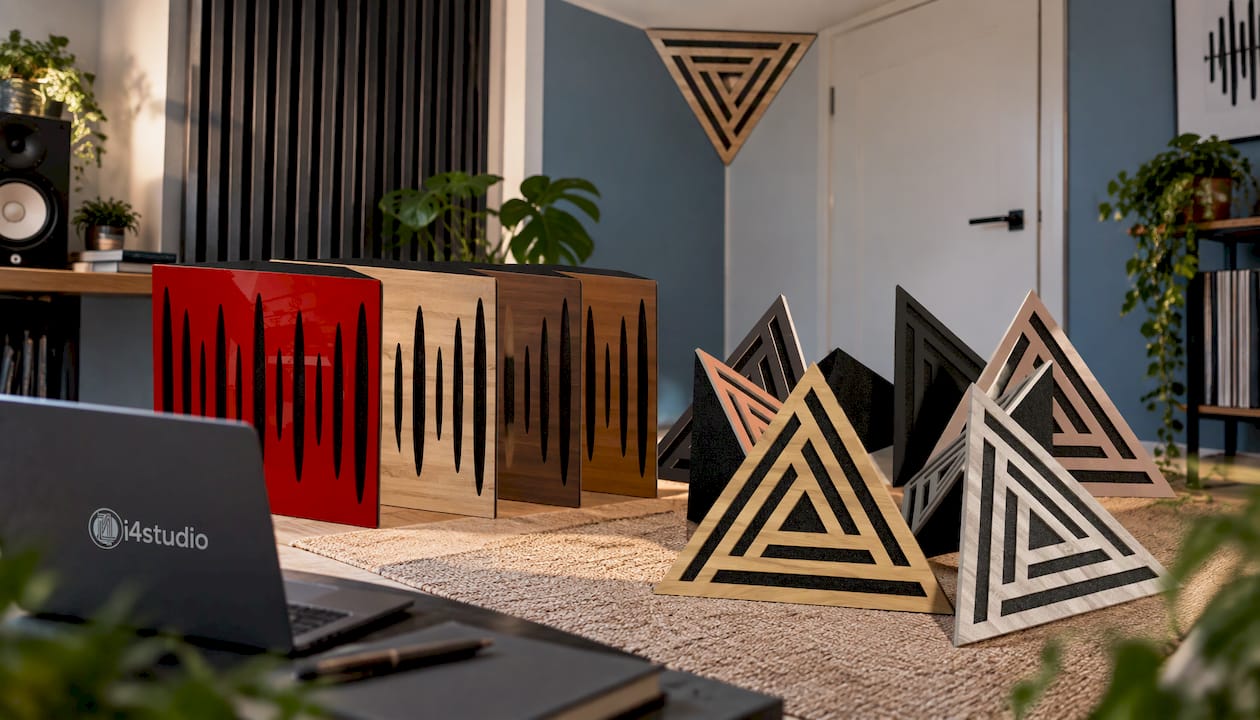
Not sure which layout is right for your door? Our advice on acoustic panels will help you choose, so you can install them correctly the first time.
This is how we view the door corner
In many home studios, the door corner is the last corner to be treated—if it’s treated at all. That’s understandable, since a door needs to open. But sound doesn’t stick to your floor plan, and an untreated corner will remain audible in your mix.
We combine high-end equipment with hands-on advice on hardware and acoustics. That’s exactly what a tricky corner needs: not just any panel, but the right shape, depth, and location, tailored to how your door opens and where you sit.
Our preference is clear: span the opening wherever possible, split it between the wall and the door where necessary, and use the triangle above the door frame as a bonus. Choose a finished staircase that you’ll use every day, and double-check with a measurement to ensure it works as you hope. Then the door corner will no longer be a weak spot, but simply a corner that works in your favor.
Harold
Frequently Asked Questions
Can a bass trap block the door?
No. A door must always be able to open fully and quickly, especially if it’s the only exit from your studio. Therefore, place the trap outside the door’s swing radius, split it between the wall and the door, or hang it above the door frame.
Does a panel on the door itself actually work?
Yes, as part of a split configuration. For a door that opens into a corner, use one panel on the wall and one on the door. Spanning the corner works better, but this solution covers the corner without blocking the doorway.
Is a square bass trap just as good as a triangular one?
The shape is less important than depth, volume, and the air space behind the material. A triangular staircase fills a corner most efficiently, while a deep square panel is useful for a split setup on the wall and door.
Should the bass trap be placed at the top or bottom of the corner?
Both triangular corners are areas where debris tends to accumulate. In a door corner, the area above the door frame is almost always the practical choice, because the floor corner gets in the way of the door and your feet.