Rupert Neve Designs is an independent American company that has been developing new analog designs based on classic traditions but with modern innovations since 2005. Many audio product specialists confuse RND with AMS Neve, but they are separate entities with their own philosophies. RND specializes in updated analog equipment with custom transformers, wide frequency range and Class-A circuits. This technology offers studio producers unique opportunities for harmonic refinement and dynamics control. In this article you will discover the technical innovations, product lines and practical applications that set RND apart in professional studio production.
Table of contents
- Key points about rupert neve designs
- The philosophy and technology behind rupert neve designs
- Introduction to the main product lines of rupert neve designs
- Technical nuances and insights when using rupert neve designs equipment
- Practical applications of rupert neve designs in modern studios
- Discover high-quality studio technology at i4studio
- Frequently asked questions about rupert neve designs
Key Insights
| Item | Details |
|---|---|
| Custom transformers | Custom transformers per product line deliver targeted frequency response and harmonic richness. |
| Wide frequency range | Range to above 100 kHz maintains accurate phase response and better transient reproduction across the heard spectrum. |
| Silk and Texture | Silk and Texture provide adjustable harmonic coloring for different sources and timbres. |
| Three product lines. | Portico offers modular desktop preamps and equalizers and compressors, Shelford combines vintage inspiration with modern gain, and 500-series modules maximize rack density. |
| Professional studio production | RND delivers analog sound with modern innovation for high quality standards in professional studio production. |
The philosophy and technology behind rupert neve designs
Rupert Neve Designs follows a design philosophy that revolves around three core principles: wide frequency range above 100 kHz, high dynamics and custom transformers for harmonic enhancement. This approach differs from exact vintage clones. RND deliberately chooses continuous innovation where classic principles serve as a starting point, not a final destination.
Class-A discrete amplifier stages are at the heart of every RND design. These circuits operate without switching distortion and provide linear amplification over the full dynamic range. Transformer coupling adds subtle harmonic richness that digital emulations cannot match. Custom transformers are designed specifically for each product, with attention to frequency response and magnetic saturation.
Silk and Texture circuits offer producers control over harmonic coloring. Silk adds second and third harmonics that create warmth without muddiness. Texture increases the intensity of this effect, similar to increasing tape saturation. This functionality makes it possible to adapt the same preamp or compressor to different sources.
The wide frequency range beyond 100 kHz may seem redundant for audio that ends at 20 kHz. Yet this design affects phase response and transient behavior within the audible spectrum. Circuits that perform well up to 100 kHz exhibit minimal phase rotation at 20 kHz, resulting in accurate transient reproduction.
Technical features RND design philosophy:
- Class-A discrete amplification without switching distortion
- Custom transformers per product line for optimal frequency response
- Silk/Texture circuits for adjustable harmonic coloring
- Wide frequency range up to 100 kHz+ for phase integrity
- Variable impedance inputs for optimal source matching
Pro-tip: Experiment with Silk settings on different sources. What works for vocals may be too much for acoustic guitar. Start subtly and increase only when the source calls for it.
These design principles come to life in concrete product lines. Integration with modern DAW hardware makes RND equipment accessible to contemporary producers seeking analog color without workflow compromises.
Introduction to the main product lines of rupert neve designs
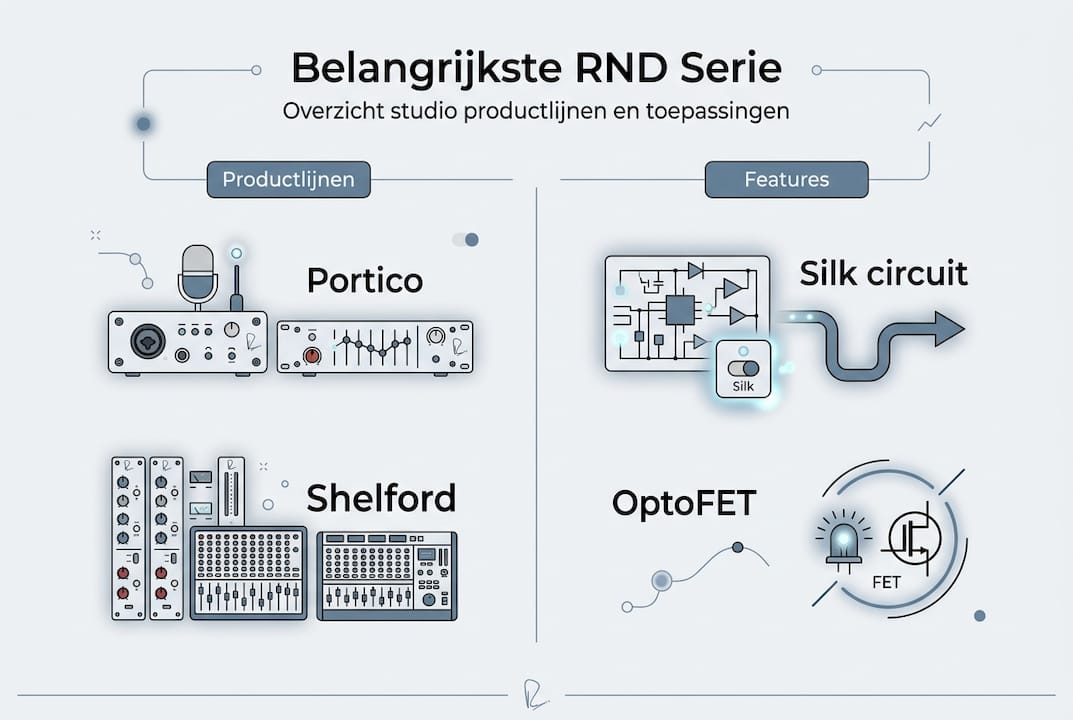
Rupert Neve Designs offers three main product lines, each serving specific studio applications. The Portico series focuses on modular flexibility, Shelford combines vintage inspiration with modern gain, and the 500-series modules maximize rack density without sacrificing sound quality.
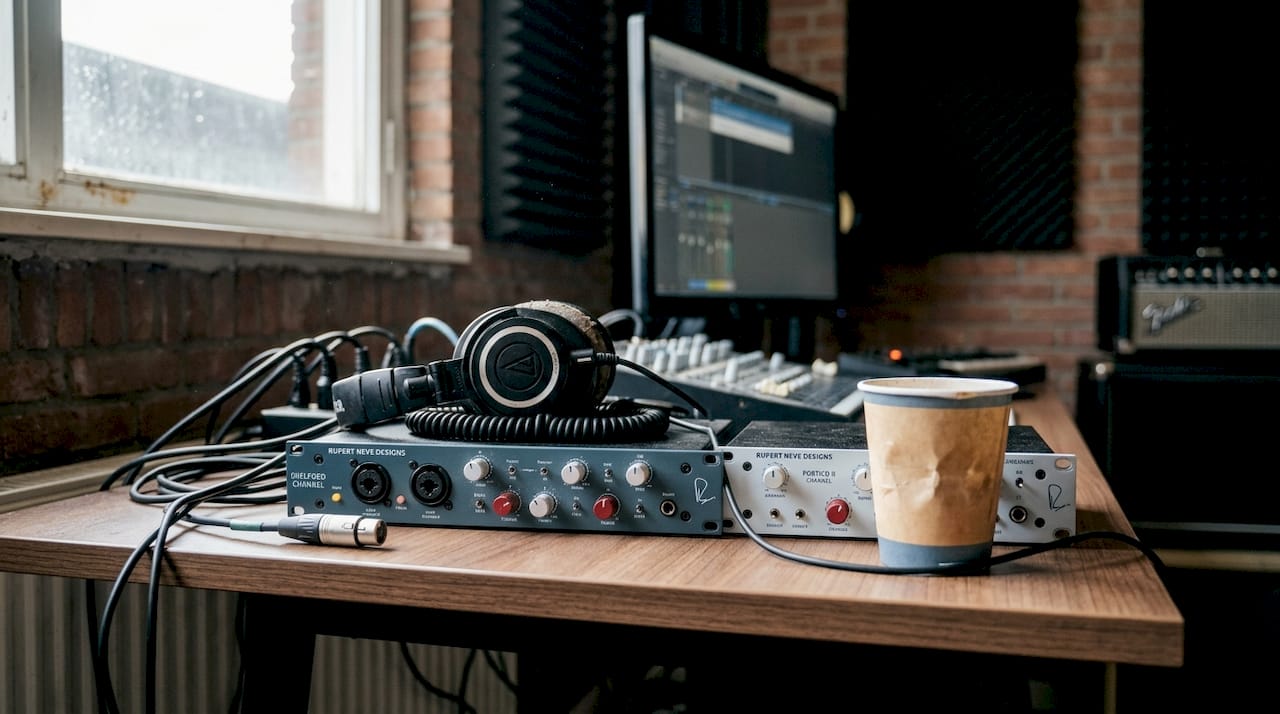
The Portico series includes preamps, equalizers and compressors in desktop format. These units share the RND design philosophy but offer standalone functionality. The 5033 five-band EQ combines inductive and capacitive filters with Silk texture control. The 5043 compressor uses a variable ratio design with fast attack capabilities of up to 100 microseconds.
Shelford products are inspired by the legendary 1073 but continue with modern improvements. The Shelford Channel offers 72 dB of gain with three gain stages for flexible drive characteristics. The built-in compressor combines FET and optical elements for versatile dynamics control. Variable impedance input matching optimizes the interface with different microphones and instruments.
The 500-series modules bring RND technology to the popular 500-series format. The 517 combines preamp and compressor functionality in one module with high dynamics and low noise floor. The 551 inductor EQ offers three bands with Silk harmonic control. These modules integrate seamlessly into existing 500-series racks and offer the same sonic quality as larger Portico units.
Product line comparison:
| Series | Format | Typical Gain | Main features | Ideal application |
|---|---|---|---|---|
| Portico | Desktop | 66 dB | Silk/Texture, modular | Tracking and mixing |
| Shelford | Desktop | 72 dB | Variable impedance, dual compressor | Premium vocal/instrument tracking |
| 500-series | Rack module | 66-72 dB | Compact integration, full features | High-density studio setups |
The OptoFET compressor represents a unique innovation within RND. This dual-stage design combines optical and FET compression in series. The optical stage provides soft knee characteristics for transparent gain reduction. The FET stage adds punch and attack control. Both stages operate across the full frequency spectrum with minimal phase rotation.
MBT Master Bus Transformer offers bus refinement without active circuitry. This passive unit uses custom transformers for subtle harmonic enrichment and mono preservation of low frequencies. The design avoids phase cancellation problems that occur with stereo summering of bass content. MBT integrates between DAW output and monitor controller for mix sweetening.
500-series module highlights:
- 517 preamp/compressor with 72 dB gain and variable ratio compression
- 551 inductor EQ with three bands and frequency-dependent Silk
- 542 tape emulator with three bandpeeds and variable bias
- Full compatibility with standard 500-series racks
- Identical sonic quality to desktop Portico equivalents
Pro-tip: Consider 500-series modules for smaller studios where space is premium. The sonic quality matches desktop units but with higher density per rack unit.
These product lines share common technology but serve different workflows. Integration with professional recording equipment maximizes the benefits of RND designs in modern studio production.
Technical nuances and insights when using rupert neve designs equipment
Class-A amplifiers and transformer coupling in RND equipment create harmonic richness beyond simple gain. The transformers introduce subtle second harmonic distortion that increases with input level. This progressive saturation adds cohesion to individual tracks and complete mixes. The effect is similar to tape compression but with more control and consistency.
Variable compressor settings allow precise dynamics control for different sources. The OptoFET compressor offers variable attack/release times, dual-band crossover and side-chain high-pass filter. Attack times range from 100 microseconds to 30 milliseconds. Release times range from 50 milliseconds to 3 seconds. This range serves everything from aggressive drum transient control to transparent vocal leveling.
Dual-mono OptoFET configuration provides a practical workflow for stereo sources. Both channels can be set up independently for mid-side processing, or linked for traditional stereo compression. The mid-side approach compresses center and side information separately, resulting in wider stereo imaging without center instability. This technique works extremely well on overhead microphones and room ambience.
Gain staging determines the amount of transformer coloration in RND devices. Higher input gains drive the transformer further into saturation. This creates more harmonic content but reduces headroom. The optimal setting balances desired coloration with dynamic range requirements. For clean tracking, stay below -10 dBu input. For characterful recordings push to -3 dBu.
Optimal compressor settings per source:
- Vocals: Attack 3-10 ms, Release 200-400 ms, Ratio 3:1, side-chain HPF 80 Hz
- Drums (kick): Attack 100 μs, Release 50-100 ms, Ratio 4:1, no HPF
- Drums (overhead): Attack 1-3 ms, Release 300-600 ms, Ratio 2:1, dual-band crossover 2 kHz
- Bass: Attack 10-30 ms, Release 100-200 ms, Ratio 4:1, side-chain HPF 60 Hz
- Acoustic instruments: Attack 5-15 ms, Release 400-800 ms, Ratio 2:1, minimum threshold
The dual-band crossover in OptoFET compresses high and low frequencies at different ratios. This prevents bass content triggering compression at high-frequency transients. The crossover frequency is variable between 500 Hz and 5 kHz. For drum bus compression, 2 kHz works well, with kick and snare receiving separate treatment from cymbals and hi-hats.
Side-chain high-pass filters prevent low frequencies from dominating in compressor detection. Without an HPF, bass and kick trigger excessive gain reduction that causes pumping. An 80 Hz HPF lets the compressor respond to midrange and treble content while bass remains natural. This technique is essential for transparent vocal compression and full-mix processing.
Pro workflow tips:
- Start with conservative settings and increase intensity incrementally
- Monitor gain reduction meters during tracking for real-time feedback
- Use Silk sparingly during tracking, more aggressively during mixing
- Test different impedance settings with condenser microphones
- Document successful settings per microphone/instrument combination
“The dual-mono OptoFET configuration is cheat code for cohesion. Process vocals, bass and kick with identical settings but independent threshold. The result is a mix that feels like everything went through the same console.” – RND application note
These technical insights transform RND equipment from simple processors to creative tools. Integration into a well-designed home studio maximizes these capabilities with minimal compromises over commercial facilities.
Practical applications of rupert neve designs in modern studios
Shelford and Portico preamps excel in tracking scenarios that require high gain with no noise penalty. Ribbon mics on guitar cabinets, dynamic mics on vocals and condenser mics on acoustic instruments all benefit from the clean gain architecture. Variable impedance matching optimizes source loading for different microphone types, resulting in extended frequency response and enhanced transient detail.
MBT transformer integration in the master bus adds subtle sweetening without active processing artifacts. The transformer preserves mono low frequencies while keeping stereo imaging in mid and high frequencies intact. This avoids phase cancellation problems that arise when stereo summering bass content. MBT placement between DAW output and monitor controller allows A/B comparison without routing changes.
OptoFET compressor on drum buses creates cohesion without losing individual track character. The dual-band crossover compresses kick and snare separately from cymbals, resulting in punch without cymbal ducking. Attack times around 1 millisecond allow transients to pass through while sustain is controlled. Release times between 300-600 milliseconds follow natural drum decay.
Stereo group compression with OptoFET dual-mono configuration provides mid-side processing capabilities. Compress center information more aggressively than sides for vocal forward mixes, or reverse for ambient heavy productions. This flexibility makes one compressor suitable for different mix aesthetics without hardware modifications.
Practical studio integrations:
- Shelford Channel for lead vocals with 72 dB gain and variable impedance matching
- Portico 5043 on mix bus for 2-3 dB transparent gain reduction
- OptoFET dual-mono on drum overhead with mid-side processing
- MBT between DAW and monitors for real-time mix sweetening
- 500-series modules in satellite tracking rig for location recording
Modern DAW workflows integrate seamlessly with RND equipment via high-quality converters. Record through Shelford or Portico during tracking for committed tone, or use as an insert during mixing for hybrid workflows. The latter approach combines DAW recall with analog sonics. Re-amping by RND compressors and EQs during mix revision cycles maintains flexibility without tracking compromises.
Expert gain staging optimizes transformer coloration without headroom problems. Target -18 dBFS in your DAW with peaks down to -10 dBFS. This level corresponds to +4 dBu analog reference and maximizes transformer harmonics without clipping risk. Monitor input meters on RND units during tracking to ensure optimal drive.
Pro-tip: Use MBT during tracking sessions for client monitoring. The subtle enhancement instantly makes raw material more finished, providing confidence boosts for performers without committed processing on the recording.
These practical applications demonstrate RND versatility in various studio scenarios. Combination with optimized studio acoustics and thoughtful sound recording techniques maximizes the investment in premium outboard gear.
Discover high-quality studio technology at i4studio
Professional studio production requires equipment that matches your ambitions and workflow. i4studio.co.uk understands the demands of audio product specialists seeking high-quality recording technology.
Our studio sets and recording bundles combine premium components that work seamlessly together. From preamps and interfaces to monitoring and acoustic handling, each element has been selected for professional results. We offer advice on purchasing studio equipment that fits your specific production needs and budget.
Whether you’re setting up a complete studio or expanding existing setups, our expertise will help you make the right choices. Discover what you need for a home recording studio with practical guides and product recommendations. i4studio.co.uk supports you from planning to implementation with a focus on sustainable investments that grow with your skills.
Frequently asked questions about rupert neve designs
What is the difference between rupert neve designs and AMS Neve?
Rupert Neve Designs is an independent American company founded in 2005, while AMS Neve is a British company that manufactures and maintains vintage Neve consoles. RND focuses on new analog designs with modern improvements, not exact vintage reproduction. Both companies share Rupert Neve’s legacy but follow separate development paths and product philosophies.
Why are rupert neve designs products more expensive than other preamps?
RND equipment uses custom wound transformers, Class-A discrete circuits and hand-assembled construction that increase manufacturing costs. The wide frequency response to above 100 kHz requires premium components and extensive testing. These investments result in sonic quality and reliability that budget alternatives do not match, justifying the price to professionals.
Can I use rupert neve designs equipment with my digital DAW?
Absolutely, RND equipment integrates seamlessly with modern DAW workflows via audio interfaces. Use preamps and compressors during tracking for committed tone, or as hardware inserts during mixing via interface routing. Combining analog processing with digital editing offers the best of both worlds without workflow compromises.
Which rupert neve designs products are best for beginners?
The Portico series offers accessible entry-level preamps with full RND sonics in desktop format. The 5017 mobile preamp combines two channels with DI inputs for versatile tracking. For compression, the 5043 starts with intuitive controls and transparent characteristics. These units grow with you as your skills develop and remain relevant in professional setups.
How do I maintain rupert neve designs equipment for long-term performance?
RND equipment requires minimal maintenance due to robust construction and premium components. Keep units clean and dust-free, avoid extreme temperatures and humidity, and use voltage regulators in areas with unstable power. Periodic calibration by qualified technicians every 3-5 years ensures optimum specifications. Most units maintain factory performance for decades with basic care.
Do rupert neve designs products really make an audible difference in my mixes?
The impact depends on your current setup and listening environment. In well-treated studios with quality monitoring, the difference is immediately audible in harmonic richness, transient detail and stereo imaging. Budget interfaces and untreated rooms mask subtle improvements. Invest in acoustics and monitoring first before adding premium outboard for maximum return on investment.
Recommendation
- Audio PC – Acoustics – Recording-video editing computers
- Video Editing Tips and Tricks: Practical Guide For Creative Professionals – https://i4studio.nl/
- Home Studio for Content Creators: From Space to Professional Recording – https://i4studio.nl/
- Video Editing Workflow Tips: Efficient Workflows For Creative Professionals – https://i4studio.nl/