TL;DR:
- Networking provides valuable feedback and insight that material choices cannot completely replace.
- Offline events and online platforms provide opportunities to make contacts and share knowledge.
- A strong network speeds up acoustic problem solving and improves sound quality.
Many producers assume that better acoustics start with the right panels, diffusers or bass traps. That’s true, but it’s only half the story. In fact, the biggest leaps in sound quality are made by musicians and producers not by investing more in equipment, but by knowing the right people. An experienced mastering engineer who listens to your control room once, or an acoustics specialist you meet through an event, can save you months of trial-and-error. In this article, you’ll learn why networking and studio acoustics are inextricably linked, and how to actively leverage that networking for better sound quality.
Table of contents
- Why networking is essential in the studio
- Concrete networking opportunities: from events to online platforms
- How networking accelerates acoustics improvement
- Practical tips: how to build a powerful study-oriented network
- Our vision: why people make your studio better than technology
- Getting started: taking your studio and network to the next level
- Frequently asked questions about networking in the studio
Key Insights
| Item | Details |
|---|---|
| Network is crucial | Good collaborations and contacts determine the quality of your studio acoustics. |
| Events and platforms help | Physical and online meetings provide access to valuable knowledge and advice. |
| Accelerated progression | Through networking, you speed up your learning process and find practical acoustics solutions faster. |
| Practical tools that can be used immediately | With targeted tips and concrete products, you can enhance your studio experience today. |
Why networking is essential in the studio
Many people immediately think of technical terms when they think of studio acoustics: absorption, reflection time, mode problems, reverberation time (RT60). These are indeed the building blocks of a good-sounding room. But who determines whether your choices are correct? Who signals that your low-mid stacking is exactly where you don’t want it? That is rarely you alone.
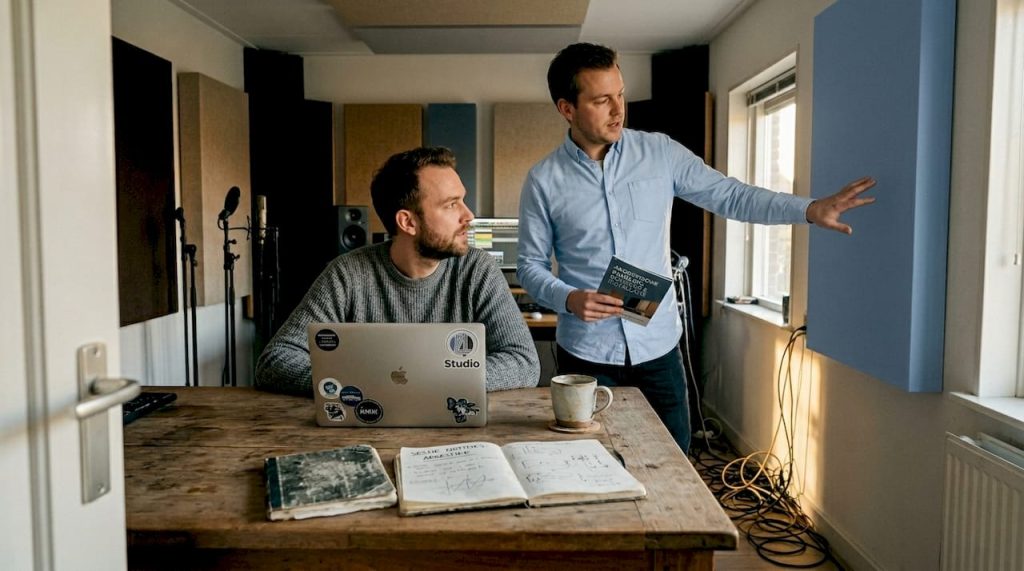
Networking in music studios functions as an ecosystem of collaboration between producers, engineers, artists and assistants. Each of those roles brings a different perspective. A recording engineer hears different things than a mixing engineer. A mastering engineer judges a space from completely different criteria than a producer who works in that same space every day. That very diversity is what makes collective feedback so valuable.
“The best acoustic decisions are rarely made individually. They come from bringing together experience, listening perspective and openness to criticism.”
When you actively network in the music business, you build trust with people who understand your work. You show off your studio, and you hear their studio. That exchange yields concrete insights you won’t find anywhere else, not in a manual and not in a YouTube tutorial. You also learn to look at the basics of acoustics from different angles, which sharpens your hearing and decision making.
Another benefit of networking is access to honest feedback. Fellow producers say things that clients or friends would never say. They hear when your mix is off, not because of the acoustics of your studio but because of the treatment of the space. That kind of direct, honest feedback is golden if you really want to grow.
Want to know specifically where to start with the acoustics of your own studio? Then check out our page on improving studio acoustics for a clear starting point.
In summary, what networking gets you when it comes to acoustics:
- Feedback from professionals with different listening experiences
- Access to knowledge sharing on specific acoustic problems
- Accelerated learning through shared experiences
- Access to recommendations for trusted suppliers and installers
- Understanding what does and does not work in similar studio setups
Concrete networking opportunities: from events to online platforms
Now that you know why networking is so important for your studio, the next question is: where do you do it? Fortunately, there are many opportunities in the Netherlands and internationally, both offline and online.
Events and recording venues like WORM Sound Studio Nights, Masterclass Networking through STAD Leiden and professional recording studios like Wisseloord are essential places to make contacts. Here, in one evening, you meet people who would otherwise remain out of reach for months.
Relevant offline events in the Netherlands
| Event or location | Type | What you get there |
|---|---|---|
| WORM Sound Studio Nights (Rotterdam) | Networking evening | Practical interviews with engineers and producers |
| Masterclass Networking, STAD Leiden | Masterclass | Targeted skills training and contacts |
| Wisseloord Studios (Hilversum) | Recording location | Access to professionals in professional environment |
| Amsterdam Dance Event (ADE). | Festival and conference | Wide range of talks, workshops and informal networking opportunities |
| Eurosonic Noorderslag (Groningen) | Music Conference | Technology presentations, label meetings and production panels |
Each of these places offers something different. WORM Studio Nights are more informal and therefore more accessible for an initial conversation about acoustics or production techniques. ADE is on a larger scale, but it is precisely there that you find international engineers and producers you would otherwise never come into contact with.
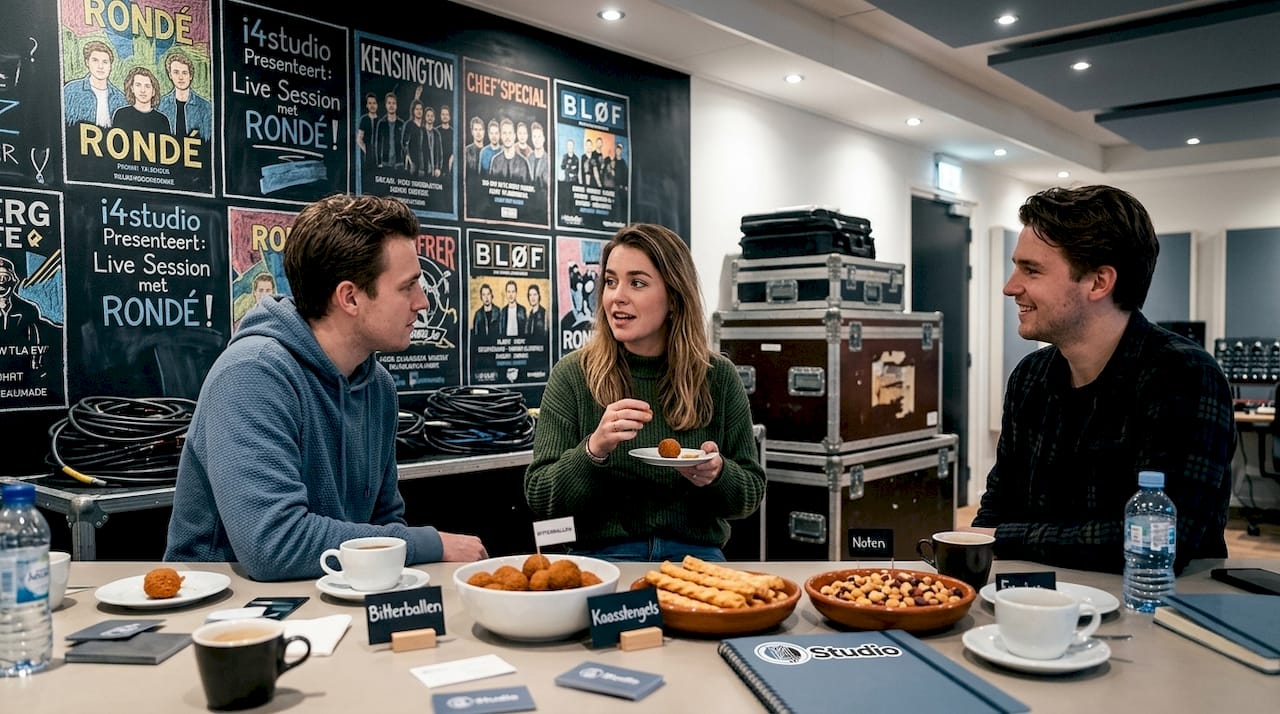
Online platforms that work for studio professionals
In addition to offline events, online platforms have grown tremendously in recent years as a networking hub for music professionals:
- SoundBetter is a platform where you can find mixing and mastering engineers, producers and vocalists ánd be found yourself. Ideal for remote collaboration.
- Vampr functions as a kind of LinkedIn for musicians, with a focus on active collaboration and shared projects.
- Reddit (r/audioengineering, r/mixingmastering) contains active communities where questions about acoustics are asked and answered daily by experienced professionals.
- Gearslutz (now Gearspace) is one of the oldest and most respected forums for studio professionals, with detailed discussions on space handling and equipment.
- Facebook groups such as “Studio Acoustics” or Dutch production groups offer more direct access to local contacts.
Pro-tip: Make sure your profile on these platforms shows a clear photo of your studio. A well-appointed workstation instantly communicates that you are serious about acoustics and production. That attracts the right people.
Roadmap: from zero to active network
- Choose one online platform and create a complete profile, including reference work.
- Respond daily to three posts in relevant groups with a useful contribution.
- Attend one event per quarter, even if it is local and small-scale.
- After an event, invite one contact to your studio for a listening session.
- Share your own experiences with acoustics openly so that others know how to find you as a source of knowledge.
For specific tips on how to get your recording environment ready for that first visitor, check out our sound recording tips. And if you’re in the process of setting up your space, our page on studio acoustics setup will help you with concrete advice.
How networking accelerates acoustics improvement
You now have a pretty good idea of the networking possibilities. But how, specifically, does that networking lead to better acoustics? That’s the crux of this article. Let’s make it tangible.
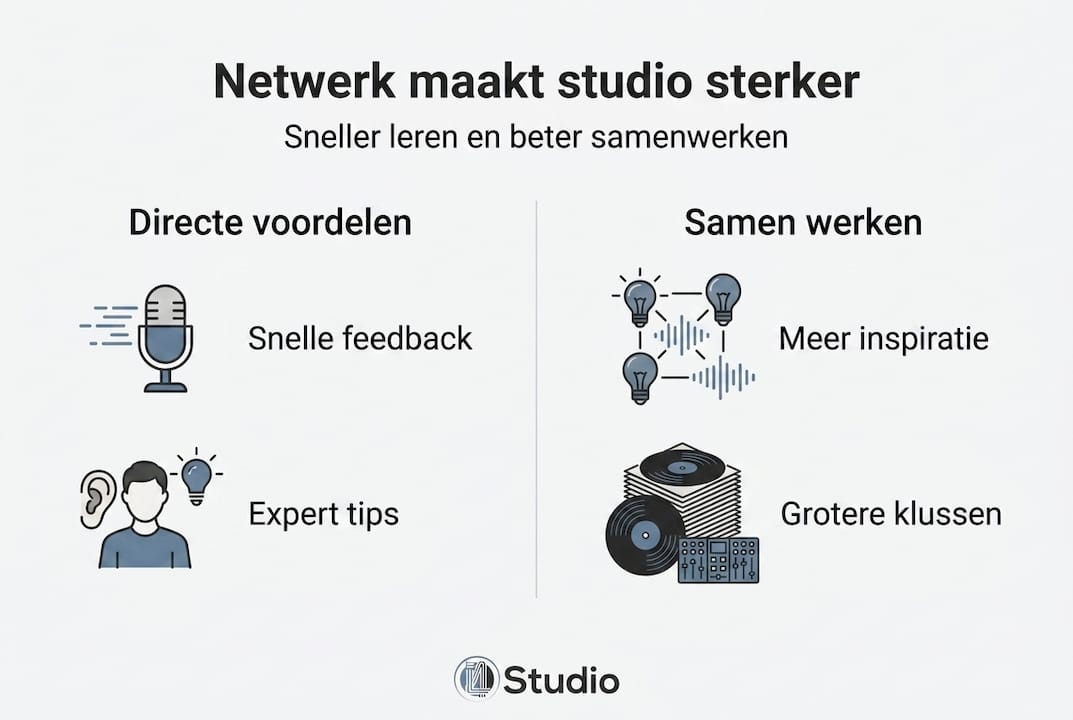
Through workshops and collaborations in professional studios, you get direct access to acoustics experts not normally accessible to individual producers. This is a huge advantage.
Comparison: working alone versus networking
| Situation | Working alone | With network |
|---|---|---|
| Identify acoustic problem | Weeks of trial and error | Quick diagnosis through experienced contacts |
| Finding a solution | Find out everything yourself online | Direct recommendations from practice |
| Choosing equipment | Risk of wrong investment | Experience knowledge prevents mistakes |
| Assessing results | Subjective assessment | Objective feedback from multiple ears |
| Cost | High because of mistakes and repetition | Lower because you throw well the first time |
The table makes it clear: those who work alone pay more and wait longer. That’s not a weakness, it’s simply the reality of complex acoustical issues. Acoustics is not something you just look up online and then are done. It is a combination of space geometry, material selection and listening experience that you only build up through years of practice or through the right contacts.
When you’ve built a network, it’s also quicker to address specific questions. Suppose you are suffering from a buildup of standing waves (room resonances, also called modes) in your low frequencies. An acquaintance who has already solved this problem in a similar room can tell you more in ten minutes than a week of searching by yourself. That will save you time, money and frustration.
Pro-tip: At every networking event, ask not just for opinions, but for specific experiences. “What worked for you in a 20 sq. ft. space?” yields much more than “What do you think about bass traps?” Concrete questions get concrete answers.
Want to get started with your home space yourself? Check out our page on improving studio acoustics at home for practical steps. And for a full list of best approaches, see best acoustics approaches. Or go directly to home studio solutions for product-focused guidance.
Besides knowledge sharing, there are two more concrete benefits of a good acoustics network:
Joint purchases: If you have good contact with other producers, you can purchase materials jointly. Acoustic panels, diffusers and absorbers are cheaper per piece when purchased in larger quantities. It sounds simple, but it makes a serious difference in budget if you want to achieve a full room approach.
Organize feedback rounds: Set up an informal listening network. Once a month join someone in the studio to review each other’s work, including the spatial sound. This way you systematically build up an understanding of how different studio setups sound and what your own space lacks.
Practical tips: how to build a powerful study-oriented network
Networking in the music industry feels uncomfortable for many producers. You don’t want to be pushy, you don’t want to ask for help before you have something to offer, and you sometimes don’t know where to start. We understand that. But networking in the studio context is different from business networking in a suit. It’s about shared passion and mutual curiosity.
Acoustics in the control room are crucial for correct mixing decisions. Studios function optimally through collaboration. That includes building the knowledge and contacts you need to optimize those acoustics.
Behaviors that work
- Sharing without an agenda: Post your experiences with acoustic treatments, even if they aren’t perfect. People respond to honesty.
- Active listening: Ask questions instead of giving answers. Those who ask, learn the most.
- Follow up after contact: Send a message after an event or conversation. One follow-up makes the difference between a fleeting contact and a real connection.
- Add value before you ask for something: Help someone else with a problem first, then there is a foundation of trust.
- Regular presence: Both online and offline. Consistency makes you recognizable and trustworthy.
Pitfalls you want to avoid
There are also behaviors that work against networking in the studio rather than help it:
- Talking too much about your own work without showing interest in others
- Asking for free work without reciprocity or relationship
- Networking only online and never taking a step toward a live meeting
- Not giving feedback when someone has given feedback on your work or studio
- Treat networking as a sales opportunity rather than an exchange of knowledge
Pro-tip: Keep a simple contact file. Write down for each person what their specialty is, when you had contact and what you discussed. This doesn’t have to be a CRM system. A simple spreadsheet or notes app will do. That way, you’ll never lose a valuable contact, and you’ll know exactly who to contact for a specific acoustic issue.
Concrete roadmap for initial connections
- Find a local producer community, offline or online.
- Introduce yourself with a brief description of your studio and your current acoustic challenge.
- Ask for a listening session at someone else’s studio, not to judge but to learn.
- Give an honest response to what you hear so that there is an equal conversation.
- Offer to host that same person back in your space.
- Repeat this systematically with three to five people around you.
For more practical advice on setting up your home office, check out our page on studio setup tips. There you will find concrete recommendations that will also help if you are welcoming guests or colleagues soon.
Our vision: why people make your studio better than technology
Here we want to take an honest and perhaps unexpected stand. In our experience with producers, engineers and studio owners, we see the same pattern all the time. People invest thousands of dollars in acoustic treatments, buy the most expensive panels, mount bass traps in every corner of the room, and then are surprised that their mixes still don’t add up on other systems.
The problem is not in the material. It’s in the frame of reference.
Those who work alone develop a blind spot for their own space. You get used to the sound of your studio. Your brain compensates for the shortcomings of the acoustics. After a while, you no longer hear them. That’s not something technology can fix. That’s something people solve.
We see this as the most persistent misconception in studio practice: that better equipment or materials are always the deciding factor. Sometimes they do. But more often the truly transformative step is when another engineer walks through your space and says, “Here, at 250 Hz, you have a problem that your panels aren’t solving.” That’s the power of a network.
This doesn’t mean you should ignore technology. Good acoustic panels, professional diffusers and a solid studio PC are the foundation of a working studio. But technology without human context is an instrument without a player. The combination of good tools AND the right people is what really moves your studio forward.
Check out our page on studio acoustics design for a view of how technology and practical knowledge come together in optimal studio design. You’ll see the human factor reflected there as well.
The producers and engineers who grow the fastest are not the ones with the biggest budgets. They are the ones who are most open to feedback, who actively seek connections and who understand that acoustics is an ongoing learning process. That learning process accelerates tremendously once you’re not doing it alone.
Getting started: taking your studio and network to the next level
You now have the insights to concretely improve both your network and your acoustics. The next step is simple: turn that knowledge into action.
At i4studio, we combine technical expertise with practical studio knowledge. Whether you’re looking for high-quality acoustic treatments, a studio acoustic diffuser serious that solves your reflection problems, or want advice on the complete design of your space, we’re ready. Want to delve deeper into the theory behind your approach? On our deepen your acoustics page you’ll find extensive information and customized product advice. Start with a solid foundation through our introduction to studio acoustics and build from there, together with the people in your network.
Frequently asked questions about networking in the studio
How do I find relevant networking events for studio acoustics in the Netherlands?
Check WORM Sound Studio Nights and studios like Wisseloord for current gathering opportunities, and also look into master classes through STAD Leiden for more focused skills training.
What role do online platforms play in studio networking?
Online platforms like SoundBetter and Vampr quickly connect you with acoustics specialists and engineers for remote feedback and collaboration, without geographical limitations.
How does networking influence my mixing and acoustics decisions?
Working with others provides external reference and new listening perspectives, allowing you to make quicker decisions about sound quality that hold up better on other systems.
What is the first step if I want to expand my study-oriented network?
Start by participating in one local event or sign up on a music production platform, such as Gearspace or Vampr, and contribute directly with an actual experience or question about your studio acoustics.