
Free Live 11.1 update: Apple Silicon Support – Out NowHow toImprove Your Studio’s Acoustics
The acoustics of a bare room or home studio are usually not too good. For example, there may be unwanted reverb in your microphone recordings or too little life, and you just can’t seem to get a neutral honest sound out of the studio monitors. You come to the conclusion that you need to treat the studio acoustically, but how?
What acoustic panels, foam and other resources are available to achieve better sound? In this blog, we try to get you well on your way!
If you can’t figure it out or just want to submit your ideas Please feel free to contact us. We are happy to help you optimize the sound of your studio
What do we mean by acoustics?
Whether you are recording vocals or want to mix your recordings over your studio monitors, the space you do this in will color the sound. This is because the sound that reaches your ears or the microphone is always a combination of the direct sound (for example, from the singer or from your studio speakers) and the reflections coming back from walls, ceiling, floor and other (hard) objects. The additional sound character that these reflections impart to a sound source is called acoustics.
When is it necessary to improve the acoustics of my studio?
Rooms in the home are usually not designed for optimal sound and are acoustically far from optimal for recording and/or mixing sound. Fortunately, there are several types of acoustic panels available that can significantly improve the acoustics of your space. These panels can be used for two applications:
- Better recordings. Microphones also pick up reflections from the recording room. This usually does not improve the quality of the recordings.
- More neutral and honest sound from your studio monitors. For example, when (finishing) mixing and editing recordings, you will need to be able to properly judge whether the bass is too strong or too weak. But if the studio space strongly reflects these low frequencies, it could be that these bass tones sound much louder than they really are. In other words, one does not get an accurate representation of the recordings, and then it becomes difficult to judge what it really sounds like
What does absorber do?
Absorbers are designed to reduce reverberation time and reduce reflections in a room. They are made from porous materials such as foam rubber, rock wool or glass wool but increasingly from recycled plastic.
When sound waves reach an absorber panel, the waves are not reflected but their energy is converted and “stays in the absorber.”
High frequencies are easily absorbed. For bass, the thicker the absorber, the better it also works in the low frequencies.
Note that too much absorption creates an unreal and dead sound. Don’t cover your entire space with absorbers. Alternating absorbers with diffusers keeps life in the sound

What does a Bass Trapp do
A bass trap is essentially a type of absorber designed to be placed in a corner. In corners, we thick absorbers can be placed easily and without taking up too much space. Low tones also often seem to accumulate in the corners. Because of their thickness, bass traps absorb lower frequencies more than ordinary absorbers. Low frequencies are always problematic in small spaces, making bass traps a worthwhile investment for better acoustics. There is no such thing as too many bass traps.

What does a diffuser do?
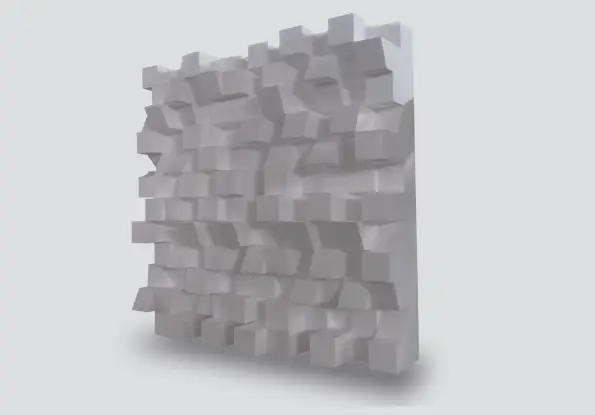
Diffusers disperse sound reflections in a room. This action makes a room appear larger and more vibrant than its actual physical dimensions, read better acoustics The “muffled” sound often heard in small rooms is caused by the direct sound from a speaker or instrument being mixed with an almost identical reflection reflecting off a wall surface. However, the reflection comes only a fraction of a second later. This results in a sound that is highly colored. By refracting and redirecting reflections using a diffuser, they no longer interfere with direct sound. While absorbers can quickly make a room appear unnatural and “dead,” combining them with diffusers helps retain some of the room’s acoustic energy.