
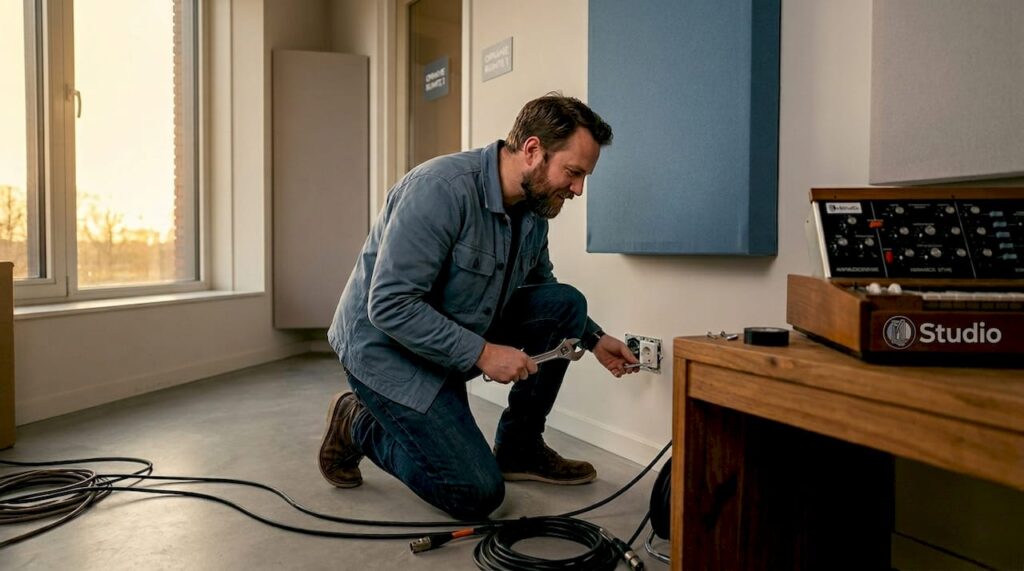
TL;DR:
- A grounded outlet protects both safety and sound quality in the studio. Grounding prevents hum, electrical shock and ensures stable, interference-free recordings. Correct installation and maintenance are essential for optimal audio results and safety.
You know the moment: you turn on your monitors, press record, and there’s that familiar but irritating hum through your headphones. Many studio owners look for the cause in their cables or their interface, when often the problem runs deeper: the grounding of your outlets. The question of why grounded outlet studio is so important affects both your safety and the quality of every recording you make. This guide gives you the technical background, practical solutions and concrete installation tips you need.
Table of contents
- Key insights
- Why grounded outlet in studio is mandatory
- Benefits for audio and video studios
- Common grounding problems and solutions
- Install and maintain grounded outlets
- My vision after years of studio installations
- I4studio helps get your studio safe and sound
- FAQ
Key insights
| Item | Details |
|---|---|
| Earthing is required by law | NEN 1010 prescribes grounded outlets to prevent electrical shock and fire in workplaces. |
| Hum noise has an electrical cause | Ground loops through different power circuits cause audible hum in your audio signal. |
| Grounded outlets protect your equipment | Voltage spikes are dissipated through the ground conductor, keeping sensitive studio electronics intact. |
| Installation requires an electrician | Connecting grounding in accordance with NEN 1010 to the distribution board is legally reserved for certified installers. |
| DI boxes solve ground loops | A DI box with ground elevator interrupts ground loops in the signal path without affecting your safety grounding. |
Why grounded outlet in studio is mandatory
A grounded outlet has three connections: the phase, the neutral and the ground wire. That third wire, the earth ground, connects the metal housing of your appliances to the physical earth through the distribution box. Sounds technical, but the principle is simple: when a defect occurs in an appliance that causes the casing to be energized, that current has a direct path to earth via the ground conductor. Without that path, the current flows through you.
NEN 1010 prescribes that grounding is mandatory in every work space to prevent electrical shock and fire. This also applies to studios, whether it is a professional recording room or a home studio in a converted bedroom. The standard has specific requirements for the grounding conductor: corrosion-resistant materials, proper diameter and a demonstrable connection to the main ground rail in the meter box.
An earth leakage circuit breaker works closely with grounded outlets. An earth leakage circuit breaker trips within 40 ms once it detects a leakage current of 30 mA or more. That sounds small, but 30 mA is more than enough to cause heart fibrillation. The RCD protects you in the situations where a fuse fails.
Note that a ground fault circuit interrupter does not trip in the event of a regular short circuit. For that, the installation circuit breaker or fuse is responsible. Both systems complement each other and work optimally only if the grounding is connected correctly.
- Peripheral earth connects metal enclosures of appliances to the physical earth
- GFCI detects leakage currents and trips within 40 ms
- Circuit breaker protects in case of short circuit, not leakage current
- Main ground rail centralizes all ground connections and prevents potential differences
- NEN 1010 is the applicable standard for low-voltage installations in the Netherlands and Belgium
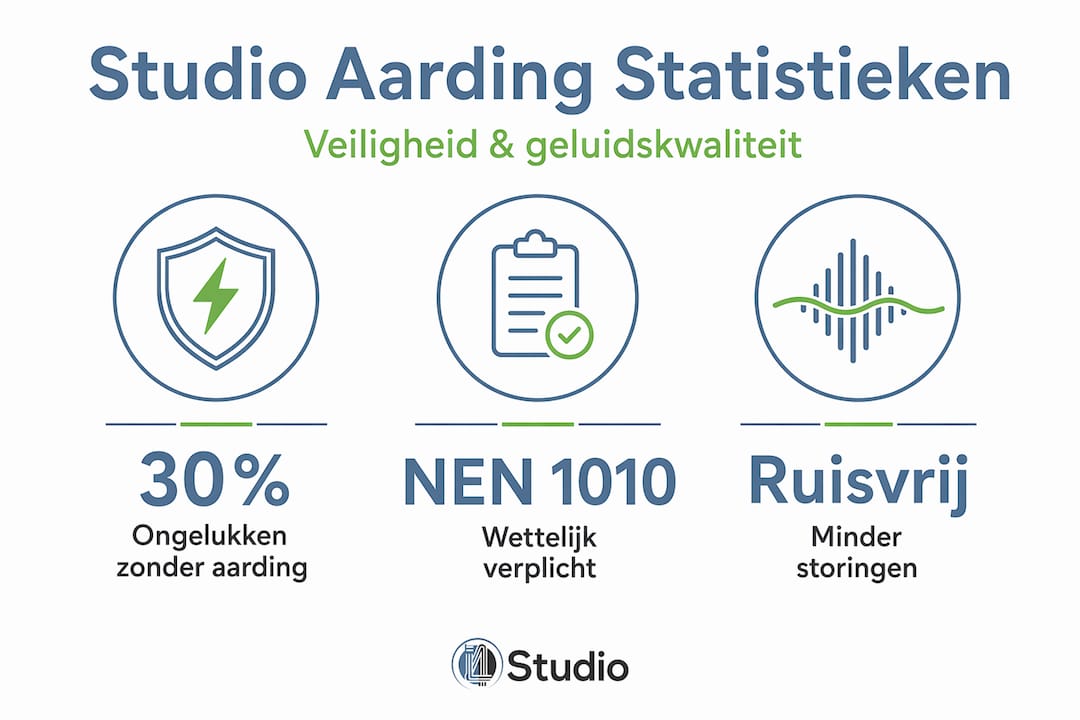
Statistics: More than 30% of electrical accidents in workplaces can be traced to missing or faulty grounding, highlighting why grounding and equalization are a connected system that you should never take for granted.
Benefits for audio and video studios
Safety is the bottom line. But for audio and video professionals, there is an equally compelling reason to install grounded outlets: sound quality. An outlet without grounding in a studio is not only dangerous, it sounds bad.
The most immediate benefits of grounded outlet can be heard in noise and interference prevention. Audio equipment such as preamps, audio interfaces and monitor amplifiers are susceptible to electromagnetic interference. The ground conductor acts as a drain on unwanted leakage currents and static charges that otherwise enter your signal path as audible noise. Grounding is functional for audio equipment to prevent interference and noise, in addition to the legal requirement.
Humming noise and ground loops
Ground loops are the biggest enemy of clean recording. They occur when two or more grounded devices are connected through different circuits, and the ground potentials of those circuits are not equal. The small voltage difference that then occurs drives a current through the shielding of your audio cables. The result is an audible hum at 50 Hz (or 100 Hz if the harmonics are also audible), exactly the frequency of the European power grid.

Ground loops cause equalizing currents that flow through audio cables and generate audible hum. You recognize the problem when your hum disappears as soon as you disconnect a cable, but returns as soon as you reconnect everything. Proper, shared grounding is the structural solution.
Other advantages of grounded outlet in a studio listed:
- Protection against voltage spikes: A sudden spike in mains voltage is dissipated through the ground conductor, rather than through your interface or condenser microphone.
- More stable power supply for sensitive electronics: Audio equipment with internal power supplies works more reliably when the grounding is consistent.
- Less electromagnetic interference: External sources such as light dimmers, neon lights and WiFi routers cause less interference in a properly grounded system.
- Longer equipment life: Ground leaks and small leakage currents corrode capacitors and transformers in power supplies over time.
Pro-tip: Connect all your studio equipment to one shared outlet or one power strip connected to one group in the meter box. All devices on one circuit keep the ground potentials equal and drastically reduce the chance of ground loops.
For more context on professional studio setup, see how grounding is related to other technical choices for optimal sound quality.
Common grounding problems and solutions
Even in studios with grounded outlets, things go wrong. Sometimes the grounding is present but done incorrectly, sometimes there is a combination of factors that together still cause a hum. The equation below shows the typical problems and the most effective solution.
| Problem | Cause | Solution |
|---|---|---|
| Hum at 50 Hz in signal | Ground loop due to multiple circuits | Connect all devices to one group |
| Noise when touching housing | Missing or broken grounding conductor | Check grounding and repair by electrician |
| Shock on touching device | Defective device or no grounding | Switch device off immediately, call electrician |
| Hum disappears when disconnecting cable | Ground loop in signal path | DI box with ground elevator or galvanic isolator |
| Alternating humming sound when dimming light | Dimmer causes interference | Replace or shield light dimmer, check grounding |
A DI box with ground elevator switch is one of the most commonly used tools for hum solution in studios. For persistent hum problems, a DI box or galvanic isolator is the preferred solution because these devices interrupt the ground connection in the audio signal path without affecting the safety ground of the circuit. Note the difference: you interrupt the grounding in the signal path, not in the circuit itself.
A galvanic isolator goes one step further than a ground elevator. It completely galvanically isolates the signal connection via a transformer, eliminating any electrical contact between the two signal sides. This is the solution for the most intractable ground loops, such as between a computer and an external audio screen.
Pro-tip: Always use the ground elevator on a DI box as a temporary diagnostic. If the hum disappears, you know you have a ground loop. Then solve the ground loop structurally by consolidating the circuits, and use the ground elevator only if the structural solution is not feasible.
What you should never do: remove the ground pin from a plug or use an adapter plug that does not jumper the ground conductor. This is creating an outlet without a ground wire via a workaround. It does indeed remove the hum sometimes, but your equipment is no longer protected and you create a real safety hazard.
Install and maintain grounded outlets
Installation of grounded outlets in accordance with NEN 1010 is not a do-it-yourself job. The connection to the distribution board, the choice of the correct wire cross-section and the connection to the main earth rail are legally reserved for certified electricians. That said, as a studio owner, you need to have a good understanding of what needs to be installed and how to keep the installation up to date.
- Check the type of outlet. Grounded outlets have a third connection hole or rim contacts on the sides. If that third contact is missing, you have an ungrounded outlet.
- Have the distribution board inspected. Ask an electrician to verify that all ground conductors are properly connected to the main ground rail and that a ground fault circuit interrupter is present for each group.
- Check the ground electrodes. NEN 1010 requires corrosion-resistant ground electrodes that are interconnected. Aluminum is not permitted as an earth conductor.
- Measure the earth resistance. An electrician can use an earth resistance meter to verify that the earth connection is actually low enough in resistance to be effective.
- Schedule periodic maintenance. Ground connections can become loose due to vibration, corrosion or construction work. When in doubt, have the installation reinspected.
Pro-tip: When installing your studio, specifically ask for a dedicated group for your audio equipment. One separate group in the meter box for all your studio use keeps the potentials equal and separates your studio from other consumers such as refrigerators or air conditioning, which can inject interference into your mains.
For concrete tips on home studio sound recording and how to optimize your electrical setup, find additional practical advice that follows this installation advice.
Maintenance is not limited to wiring. Also regularly inspect your power strips for damage, check that the ground contact in each outlet is securely connected to the plug of your device, and replace power strips that are older than ten years. A good power strip for studio use always has surge protection and jumpered ground contacts.
My vision after years of studio installations
From harold at I4studio:
I’ve guided dozens of studios through their setup and I see the same pattern over and over again: the investment in good microphones and monitors is high, but the electrical basics are overlooked. People buy a five hundred dollar interface and plug it into an ungrounded outlet. Then they complain about noise and think the device is bad.
What I have learned is that grounding is not just a legal formality. It is the foundation on which everything rests. A studio without proper grounding is like a studio without acoustic treatment: it can work, but you always work against invisible problems that color your recordings without knowing exactly why.
The most underrated problem I encounter is the mixed circuit. Studio owners plug their audio equipment into the same group as the refrigerator in the kitchen or the washing machine in the utility room. The interference that such devices inject into the mains is subtle but measurable, and it introduces a kind of fuzzy noise layer into your recordings that you don’t discover until you record at a different location.
My advice: when you start your studio, have an electrician install a dedicated group and optimize electricity for your studio use. That investment of a few hundred euros will pay for itself in cleaner recordings, less debugging and a safe workspace. It’s the most underrated upgrade you can do for your studio.
– harold
I4studio helps get your studio safe and sound
At I4studio, we know that a good studio starts with the basics. Proper grounding, clean power supply and the right equipment combine to form the backbone of any professional recording space. Whether you’re just starting out or want to improve your existing setup, choosing the right gear makes all the difference.

Check out our range of studio gear for beginners if you want to build your studio with equipment that works as it should, including components that benefit from proper electrical setup. For those ready to take the next step, the sE Electronics X1 S Studio Bundle offers a complete recording kit where a clean grounding system makes the most of the microphone and interface. Contact I4studio for customized advice on your studio setup.
FAQ
What is the difference between grounded and ungrounded outlet?
A grounded outlet has a third conductor that connects the metal housings of appliances to the physical ground. An ungrounded outlet does not have that connection, meaning leakage currents have nowhere to go and pose a safety risk.
Why do I hear hum when my outlets are not grounded?
Hum is caused by ground loops or leakage currents that have no drain path and pass through your signal path via audio cables. Grounded outlets give those unwanted currents a direct path to ground, away from your signal.
Can I install grounded outlets myself?
No. Connection to the distribution board and the main ground rail in accordance with NEN 1010 is legally reserved for certified electricians. You can replace outlets yourself if they are already connected to an earthed group, but always have the main installation done professionally.
Will a DI box help if my outlets are not grounded?
A DI box with ground elevator resolves a ground loop in the signal path, but does not replace proper grounding. Without grounding, your equipment remains unprotected against leakage currents and voltage spikes. Use a DI box as a supplement, never as a replacement for proper grounding.
How do I know if my outlets are properly grounded?
Visually, grounded outlets can be identified by the third connection hole or grounding contacts. For a reliable measurement, you can buy a simple socket tester or have an electrician measure the earth resistance with a professional measuring instrument.