
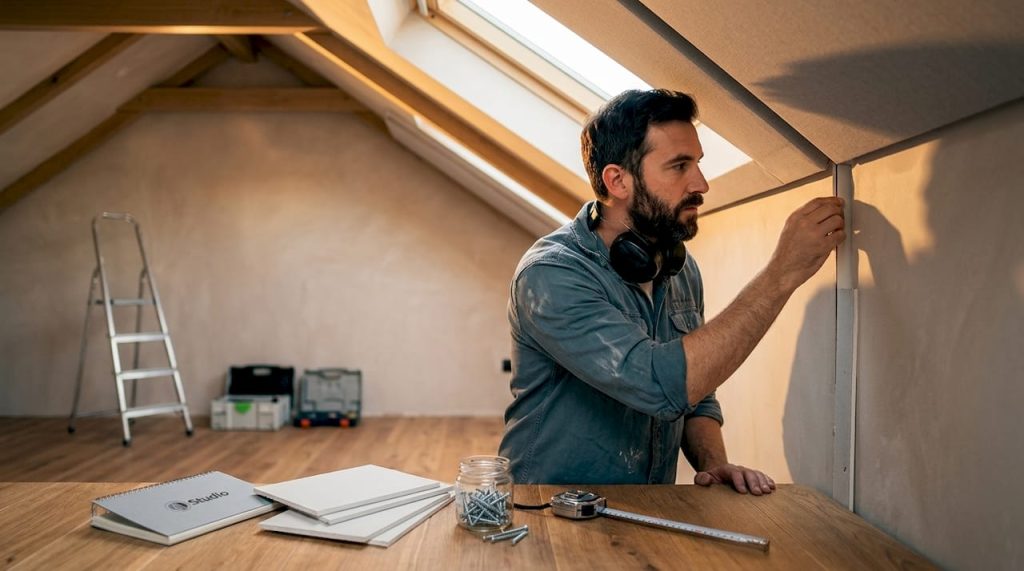
TL;DR:
- Soundproofing requires mass, decoupling, damping and sealing, not just absorbent material. Proper preparation, proper materials and following steps ensure effective insulation. Complete soundproofing is not always feasible, but targeted measures significantly improve absorption quality.
Recordings ruined by traffic blowing from outside, a mooing refrigerator in the background or neighbors who just decide to do odd jobs: recognizable. For musicians and sound engineers who want to make serious recordings at home, this is not a minor annoyance but a fundamental problem. Sticking acoustic foam to the wall doesn’t solve it, because it absorbs sound but doesn’t keep it out. In this guide you will learn step by step how to make a room truly soundproof, what the essential principles are, what materials you need and how to measure whether you have achieved the goal.
Table of contents
- Why soundproofing construction requires more than standard insulation
- Preparation: what do you need for a soundproof room
- Step-by-step plan: building a soundproof room
- Results and testing: when is your room really soundproof?
- Why not every room can be soundproofed (and how to maximize it anyway)
- Optimize studio further? Discover the best tools and materials
- Frequently asked questions about soundproof rooms
Key Insights
| Item | Details |
|---|---|
| Mass and decoupling | Without sufficient mass and decoupled construction, soundproofing is impossible. |
| Step-by-step plan essential | Follow each step carefully from measurement to completion for best results. |
| Test and optimize | Measuring the end result prevents surprises and makes adjustments possible. |
| Small improvements count | Even without complete remodeling, you can increase soundproofing significantly with smart modifications. |
Why soundproofing construction requires more than standard insulation
There is much confusion surrounding soundproofing versus sound absorption, and that confusion costs musicians time and money. Sound absorption refers to reducing reverberation and reflections inside a room. Consider acoustic panels that reduce reverberation time (the time it takes sound to dissipate after the source stops). That improves the sound inside the room itself, but it doesn’t stop sound from outside and also allows sound from inside the room to just pass through the walls.
Sound insulation works on a completely different principle. The goal is to stop sound waves before they travel through a wall, floor or ceiling. To do this, four core principles are essential for a soundproof room: mass, decoupling (decoupling), damping and sealing. Together they form the mass-air-mass principle, in which two heavy layers with an air cavity between them effectively break up vibrations.
The mass-air-mass principle works like this: sound is vibration. When a sound wave hits a wall, it sets the wall to vibrate. If that wall is rigidly connected to the next wall or frame, the vibration continues immediately. By adding a layer of air or flexible decoupling, you interrupt that chain of vibration. That’s when you really start to isolate.
Thick materials or lots of foam on the wall are no substitute for mass plus decoupling. A standard drywall might give you 30-35 STC (Sound Transmission Class: a measure of how well a structure blocks sound). With the right combination of mass, decoupling and damping, you can go to 55-65 STC.
For more background on how vibration conduction works in studio contexts, also check out our explanation of sound attenuation in studio. And if you’re still not sure which acoustic materials are right for your situation, read our guide on choosing sound absorbing materials first.
Here are the four principles in a row:
- Mass: Heavy materials do not vibrate as easily as light ones. Additional layers of gypsum board, MDF or soundproofing mat increase mass and directly reduce sound permeability.
- Decoupling (decoupling): Physically decoupling structures from each other so that vibrations are not transmitted directly. Resilient channels (resilient profiles) and special clips make this possible.
- Damping: The conversion of vibration energy into heat. Viscoelastic compositions such as Green Glue are applied between plasterboard layers to absorb vibrations before they travel further.
- Sealing: Every hole, crack or seam is a sound leak. Acoustic sealant and cuffs around pipes and outlets are crucial for consistent results.
Preparation: what do you need for a soundproof room
Now that you know what a soundproof room should meet, first comes the practical inventory: what all do you need?
Proper preparation prevents costly mistakes later. Those who discover halfway through a construction project that they bought the wrong screws or forgot to plan a ventilation grille not only lose money but also the airtightness that is so desperately needed.
Materials by category
| Category | Material | Target |
|---|---|---|
| Mass | Double plasterboard (2x 12.5 mm) | Increasing wall weight and STC |
| Mass | MDF or solid wood panels | Extra mass in critical areas |
| Decoupling | Resilient channels of clips | Breaking through vibration conduction |
| Filling | Mineral wool or glass wool (60-100 mm) | Infill cavities, secondary absorption |
| Damping | Green Glue compound | Convert vibrations into heat |
| Sealing | Acoustic sealant (butyl or latex) | Sealing seams and cracks |
| Floor | Massless spring or rubber tiles | Impact noise and noise reduction |
| Doors | Solid doors with acoustic strips | Prevent noise leakage at the door |
| Ventilation | Silencer on ductwork | Maintain ventilation without noise transmission |
Putting mineral wool or glass wool in the cavities is useful, but insulation alone gives only 4-8 STC without the combination with mass and decoupling. Insulation material is part of the system, not the solution by itself.
Tools you need
- Sound level meter (SPL meter) or measurement app (e.g. NIOSH SLM)
- Stud finder (wall detector) for locating existing structures
- Screwdriver and drywall screws (do not cut through to the cavity)
- Acoustic sealant and sealant gun
- Flat saw or circular saw for sheets to size
- Spirit level and tape measure
Pro-tip: To detect sound leaks, use an inexpensive smoke generator or a powerful flashlight in the room. Turn off all lights on the outside and see where light is seeping through. Every light leak is a sound leak.
Checklist before you get started
- Room completely emptied and clean
- Existing leaks inventoried (electrical outlets, baseboards, windows, doors)
- Ventilation requirement calculated and silencer selected
- Materials ordered and delivered
- Acoustic panels planned for the post-insulation phase (see installing acoustic panels)
- Budget set including buffer for unforeseen adjustments
- Building permit checked if you modify load-bearing walls
Ventilation is an issue that many hobbyists overlook. A completely enclosed room with no air change is unworkable, but standard vents are direct sound leaks. The solution is a silencer (silencer) that lets air through but blocks sound transmission via a series of bends with sound-absorbing material in them.
Also read our article on improving studio acoustics for tips on how to address room acoustics once the insulation is in place.
Step-by-step plan: building a soundproof room
Once you have all the materials and tools, you can get started. The order of execution is not arbitrary: structural interventions always first, acoustic finishes second. Anyone who reverses this has to redo work.
Step by step
Measure the current noise level. Use an SPL meter to record both the background noise value inside and outside the room. This is your baseline measurement. Without it, you won’t know how much you have improved.
Identify all sound leaks. Check electrical outlets, pipe penetrations, baseboards, windows, doors and the connection surface of walls to ceiling. Mark everything with tape. A leak the size of a coin can bring down your insulation value by 10 STC points.
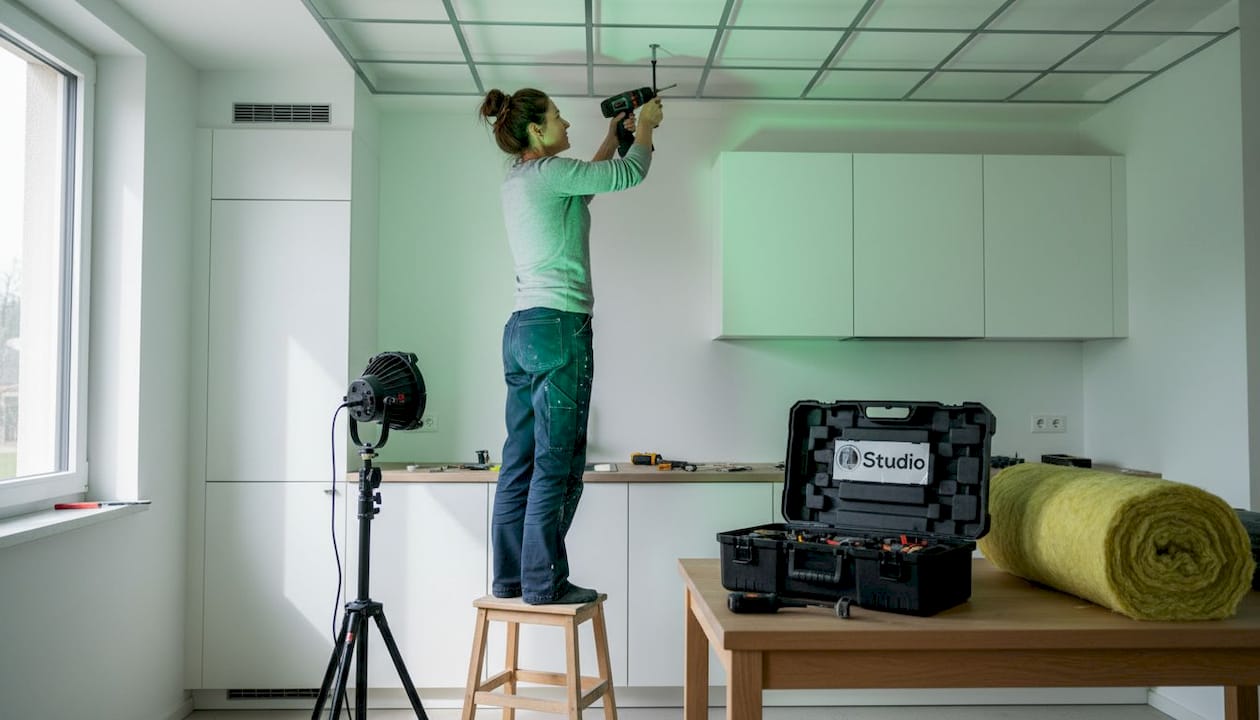
Build a decoupled frame (decoupled frame). Install a new metal stud or wood frame separate from the existing wall, at least 25-50 mm away. Use rubber pads or acoustic strips at the junction with floor and ceiling to prevent vibration conduction through the structure. The core soundproofing principles apply directly here.
Fill the cavity with mineral wool. Completely fill the cavity between the new frame and the existing wall with mineral wool or glass wool. This improves the damping in the air cavity and prevents standing waves in the cavity itself.
Apply mass plus damping layer. Screw the first layer of drywall onto the frame. Then apply Green Glue to the first layer and screw the second layer of drywall directly onto it. The Green Glue is now trapped between the two panels like a viscoelastic layer and effectively converts vibrations into heat.
Seal all seams and connections. Use acoustic sealant on every seam, transition and connection. Don’t forget the edge along the floor and ceiling. Decouple structures with resilient clips to prevent vibration transmission, especially for low frequencies and impact noise.
Test the result. Make another SPL measurement. Compare before and after. If specific frequencies still leak through (low murmurs or thumping bass), look for flanking paths, or detours through which sound bypasses the structure via adjacent structures.
Pro-tip: Always build the ceiling into the system. Sound travels along the path of least resistance. A perfect wall with an uninsulated ceiling is like a waterproof wall with an open skylight.
Comparison: box-in-box versus single shell
| Method | Insulation value (indicative) | Space loss | Cost | Suitable for |
|---|---|---|---|---|
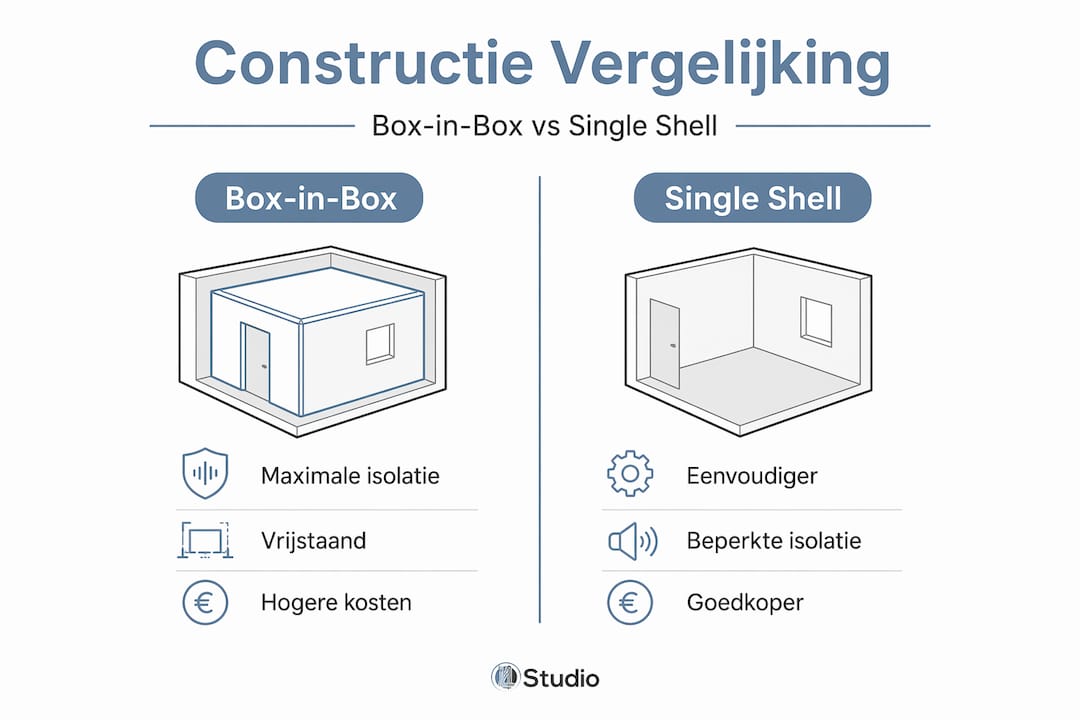
| Single shell (additional layers on existing wall) | +10 to +15 STC | Minimum | Low | Slight improvement, rental housing |
| Decoupled frame (new frame in addition to existing) | +20 to +30 STC | Moderate (8-12 cm per wall) | Medium | Home studio semi-professional |
| Box-in-box (fully freestanding chamber) | +35 to +50 STC | Considerable | High | Professional drums, vocals, VO |
The box-in-box method is the holy grail of studio construction. A completely free-standing room within an existing space has no structural contact point with the surrounding structure, which virtually eliminates vibration transmission. Read our overview on music studio design for inspiration on overall studio layout.
Results and testing: when is your room really soundproof?
After all the effort, you want to be sure that your space is actually adequate. To measure is to know, and in studio construction there are clear benchmarks to orient yourself on.
STC and Rw values as reference
The most commonly used measure of sound insulation is STC (Sound Transmission Class). A higher value means better insulation. Rw (Weighted Sound Reduction Index) is the European equivalent and uses similar scaling. For home studios, STC 50-55 is the minimum, while professional facilities aim for STC 60 or higher. The box-in-box approach yields 40-60 dB reduction in practice.
| Space type | Recommended STC | Typical application |
|---|---|---|
| Living room to living room | 40-45 | Speech not intelligible |
| Home studio (acoustic recordings) | 50-55 | Musical instruments, vocals |
| Semi-professional studio | 55-60 | Drum kit, bass, amplifiers |
| Professional studio | 60+ | All instruments, orchestration |
How do you measure insulation value?
You need two measurement points: source and receiver. Place a speaker at a fixed position in the room and play a pink noise test at a known volume. Measure the noise level on the other side of the structure with an SPL meter. The difference in dB is your indicative reduction.
Professional acoustic measurements require a calibrated setup and specific measurement frequencies. For home studios, a good SPL meter app (such as NIOSH SLM) combined with a suitable test noise is enough to determine if you’re on the right track.
If the insulation value is disappointing, systematically look for flanking paths:
- Vents without silencer
- Shared floor with adjacent room (impact noise)
- Double plasterboard layer that still makes contact with the frame via the screws
- Unfinished connections at the ceiling or baseboards
- Windows without double glazing or acoustic seals
Also see how professional studios handle high-level soundproofing, so you know what’s next if you want to build further.
Another point that is often underestimated: low frequencies (bass sound below 100 Hz) are considerably more difficult to isolate than mid and high frequencies. Mass helps, but real bass attenuation requires a lot of mass and large air cavities. A box-in-box construction with a cavity of at least 10-15 cm also effectively addresses the problematic low frequencies.
Why not every room can be soundproofed (and how to maximize it anyway)
Following this roadmap will get you far. But there’s a reality we can’t get around: not every space will ever be 100% soundproofed, and it doesn’t always have to be.
The biggest limitation is in the building structure itself. In a new home or detached building, you have a lot of freedom. In an apartment, the floor is shared with the neighbors below you, and structural interventions in load-bearing walls or ceilings are often not permit-free or technically feasible. That means that even with perfect box-in-box construction, you may have to deal with impact sound traveling through the concrete core of the building.
That’s not a reason to give up. It’s a reason to smartly prioritize. Ask yourself: what is my biggest noise problem? Traffic noise from outside picks up different measures than a neighbor with a drum kit. High frequencies are easier to isolate than low ones. A floor problem you solve differently than a wall problem.
Practical tricks for situations where really quiet is not feasible:
- Work with recording times that fall outside the busiest hours
- Combine limited isolation with in-ear monitoring to mask external sounds
- Use directional microphones that pick up less ambient noise
- Focus on acoustic treatment after insulation: a properly treated room always sounds better than an untreated one, even with the same insulation value
The post-insulation phase is crucial to your end result as a mixer and producer. Sound insulation keeps disturbing noise out, but acoustic treatment determines how the room sounds. Wideband absorbers in the corners address standing waves. Diffusers on the back wall prevent flutter echo. Together, they determine whether your monitoring is reliable. Check out the studio setup workflow for a complete picture of how insulation and acoustics complement each other.
Many installations are never 100% silent. But a purposeful approach, based on the four core principles and a clear understanding of your limitations, produces a space professional enough for the vast majority of recording and mixing sessions.
Optimize studio further? Discover the best tools and materials
You now know how to insulate your room. Sound insulation is the basics, but what really makes the room ready for professional recording is the acoustic optimization afterwards.

At i4studio, you will find a wide range of acoustic materials and studio hardware that exactly match the stage after isolation. Our studio acoustic diffuser distributes sound evenly in the room and prevents flutter echo that makes recordings unreliable. Combine that with the right PC components for music production and you have a complete workspace that is both acoustically and technically ready for serious sessions. Contact us for personal advice or browse through our assortment for step two of your studio build.
Frequently asked questions about soundproof rooms
What is the difference between sound insulation and sound absorption?
Sound insulation prevents sound from passing through to other rooms, while sound absorption reduces reverberation and reflections within a room. The core principles of soundproofing are mass, decoupling, damping and sealing.
What insulation value do I need for a home studio?
For a home studio, you need at least STC 50-55 or Rw 45-50 dB so as not to disturb nearby residents when recording music. Professional facilities go to STC 60 or higher.
Can I easily soundproof an existing room without remodeling everything?
Full soundproofing often requires interventions such as additional walls or ceilings. Minor improvements are possible with sealing and additional mass, but the core principles of mass and decoupling are decisive even in limited conversions.
How do I prevent impact sound and vibration through the floor and walls?
Decouple floors and walls with resilient clips or an air cavity for best results in low frequencies and impact noise. This is the most effective measure against structure-borne noise.
Does extra wool in the wall make sense as insulation?
Mineral wool helps against reverberation and reflection in the cavity, but wool alone gives only 4-8 STC points. Only in combination with mass and decoupling does it provide serious improvement.
Recommendation
- Studio acoustics: improve sound quality at home in 2026
- Studio Acoustics Improvement: Practical Guide For Professional Sound Spaces – https://i4studio.nl/
- Furnishing Studio Acoustics: From Space Analysis to Perfect Mix – https://i4studio.nl/
- Sound attenuation in Studio: Complete Guide For Optimal Acoustic Management – https://i4studio.nl/