TL;DR:
- Absorption panels reduce reverberation and echo in studios by allowing sound waves to rub into porous materials. They prevent standing waves, flutter echo and disrupt stereo imaging, offering essential improvement for professional and home studios. Choose panels with high absorption coefficients and proper placement for optimal sound quality and reproducibility.
You just bought a new set of monitors, your microphone is top quality, and your audio interface delivers tight and clear signal. And yet your mix doesn’t sound as expected. The recordings sound muddy, the bass is inaccurate, and decisions you make in the studio are nowhere to be seen at home. This problem is familiar to many producers. In fact, the cause is not in your gear, but in your space. Absorption panels are the missing piece of the puzzle in most studios. In this article, we explain what they do, why they work, and how to use them effectively for the best sound results.
Table of contents
- What are absorption panels and how do they work?
- Why absorption panels are essential in every studio
- Important readings: this is how to choose the right panel
- Application and practical tips: using absorption panels optimally
- Our perspective: why absorption panels make a difference for professionals
- Applying absorption panels in your studio? Discover our selection
- Frequently asked questions about absorption panels
Key Insights
| Item | Details |
|---|---|
| Absorption panels improve studios. | Absorption panels prevent distracting reflections and give you control over your sound. |
| Pay attention to measured values | Choose panels with a high absorption coefficient according to ISO 11654 for optimal results. |
| Proper placement is critical | Place absorption panels strategically at reflection points for the best acoustic effect. |
| Practically applicable | With practical knowledge and application, you make an immediate difference in sound quality, at home and in the studio. |
What are absorption panels and how do they work?
Before you can take advantage of absorption panels, it helps to understand exactly what they do. The premise is simple: sound is a wave motion that doesn’t stop at the first wall it encounters. Sound waves reflect, overlap and interfere with each other. The result is a sound space that colors what you hear long before the sound reaches your ears.
There are three ways to control sound in a room:
- Absorption: converting sound energy to heat through porous or fibrous materials. This reduces reverberation and echo amplification in your space.
- Reflection: the reflection of sound waves, leading to sound coloration and resonance in uncontrolled walls.
- Diffusion: the scattering of sound waves over a larger area so that the energy is more evenly distributed without being completely absorbed.
Absorption panels work on the first principle. They typically consist of a porous material, such as acoustic foam, glass wool, rock wool or pressed hemp fiber. The open structure of the material causes the air particles that carry the sound wave to experience friction. That friction converts sound energy into a minimal amount of heat. Practical result: sound is no longer reflected.
The effectiveness of an absorption panel is expressed by its absorption coefficient, denoted by the Greek letter α (alpha). This value ranges from 0 to 1, where 0 represents no absorption and 1 represents complete absorption. The closer to 1, the better the panel performs. According to the ISO 11654 measurement standard, panels are divided into classes, with Class A (αw of 0.90 or higher) providing the best performance for studio applications. A Noise Reduction Coefficient (NRC) value of 0.70 or higher is good, and a value of 0.85 or higher is considered excellent.
| Material type | Typical αw range | Strongest frequency range | Suitable for |
|---|---|---|---|
| Acoustic foam | 0.60 to 0.85 | Middle and high | Wall treatment, corners |
| Rock wool / glass wool | 0.80 to 1.00 | Low, medium and high | Wide treatment, ceiling |
| Bass trap (corner trap) | 0.70 to 0.95 | Low (sub-bass) | Corner stages in space |
| Hemp fiber / textile | 0.65 to 0.90 | Middle and high | Aesthetic wall solutions |
You can use acoustic panels in the studio as broadband absorbers or as targeted treatment for specific problem areas. Panel thickness plays a crucial role here. Thinner panels efficiently absorb high and mid-high frequencies, while thicker panels also address lower frequencies.
Pro-tip: Don’t hang your panels flat against the wall, but 5 to 10 inches away. The air cavity significantly increases the effective thickness of the panel, so even lower frequencies are better absorbed without the need for thicker materials.
Want to know more about smart placement techniques? Then also read our optimal studio acoustics tips for a practical approach by room type.
Why absorption panels are essential in every studio
Now that you know how absorption panels work, it’s time to look at why they really make a difference in real-world situations. Because theory is nice, but practice is more convincing.
Every rectangular space has an Achilles’ heel: standing waves. These are resonances created when the wavelength of a tone corresponds exactly to the distance between two parallel walls. The reflection and the original wave reinforce each other at fixed points, leading to exaggerated bass response in certain areas. Your listening position therefore influences what you hear in a way that has nothing to do with the real mix.
Flutter echo is another common problem. Do you hear a rapid, ringing echo when you clap your hands in a bare room? That’s flutter echo: rapid reflections between parallel walls that obscure the bright transients in your recordings. Overcrowded reverb trails in your recordings are almost always the result of untreated walls.
Here are four concrete audio problems that absorption panels solve directly:
- Inaccurate low-mid response: Standing waves cause false-stacked bass in your mix, making compensatory decisions that don’t make sense elsewhere.
- Cloudy vocal recordings: Room echo on vocal tracks makes post-processing more difficult and sounds less professional.
- Inconsistent stereo imaging: Uncontrolled side reflections interfere with the perception of space and depth in your mix.
- High RT60 values: The RT60 is the time it takes for sound to decrease by 60 dB after the source. Well-treated control rooms aim for an RT60 of 0.2 to 0.4 seconds.
“A studio without acoustic treatment is like a car without a steering wheel. You may have a powerful engine, but you don’t know where you will end up.”
See the concrete impact in the equation below:
| Situation | Without absorption panels | With absorption panels |
|---|---|---|
| Bass response | Irregular, bubbles at resonant frequencies | Flat and controlled |
| Vocal clarity | Room sound visible in recording | Dry and direct signal |
| Stereo placement | Blurred by side reflections | Accurate and stable |
| RT60 control room | 0.6 to 1.2 seconds | 0.2 to 0.4 seconds |
| Confidence in mix decisions | Low, inconsistent | High, reproducible |
| Frequency similarity | ±10 dB variation at listening position | ±3 dB or better |
The indispensable panels in the studio are not a luxury accessory. They are the foundation for all other investments in your studio setup. Without good acoustics, you’ll produce mixes that don’t ring true outside the studio, no matter how good your gear is.
For producers who work from home, the effect is even greater. Home studios typically have less favorable room proportions, more parallel walls and less acoustic attenuation in the furnishings. Good home studio acoustics products can significantly level the playing field. Investing in absorption panels often yields more results in a home studio than upgrading to a more expensive audio interface.
Important readings: this is how to choose the right panel
Now that it is clear what absorption panels provide, it is time to learn how to evaluate panels for quality. There are three key concepts you need to know before making a choice.
NRC (Noise Reduction Coefficient) is an average value across frequencies 250 Hz, 500 Hz, 1000 Hz and 2000 Hz. It gives an overall impression of absorption performance but tells you nothing about low frequency behavior. Good is 0.70 or higher, excellent is 0.85 or higher.
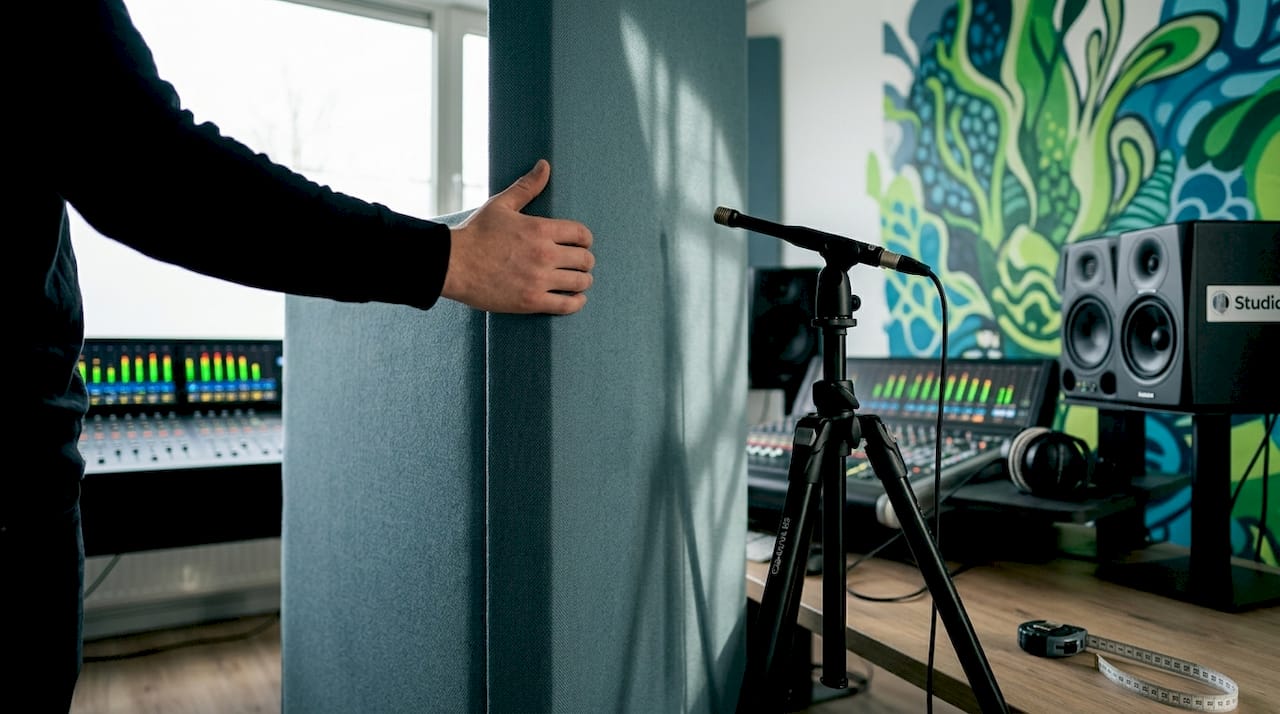
αw (weighted absorption coefficient) is a singular value that describes the average absorption behavior across multiple frequencies, weighted by human hearing. This value is used in the ISO 11654 class classification, with Class A (αw ≥ 0.90) indicating the highest level of performance.
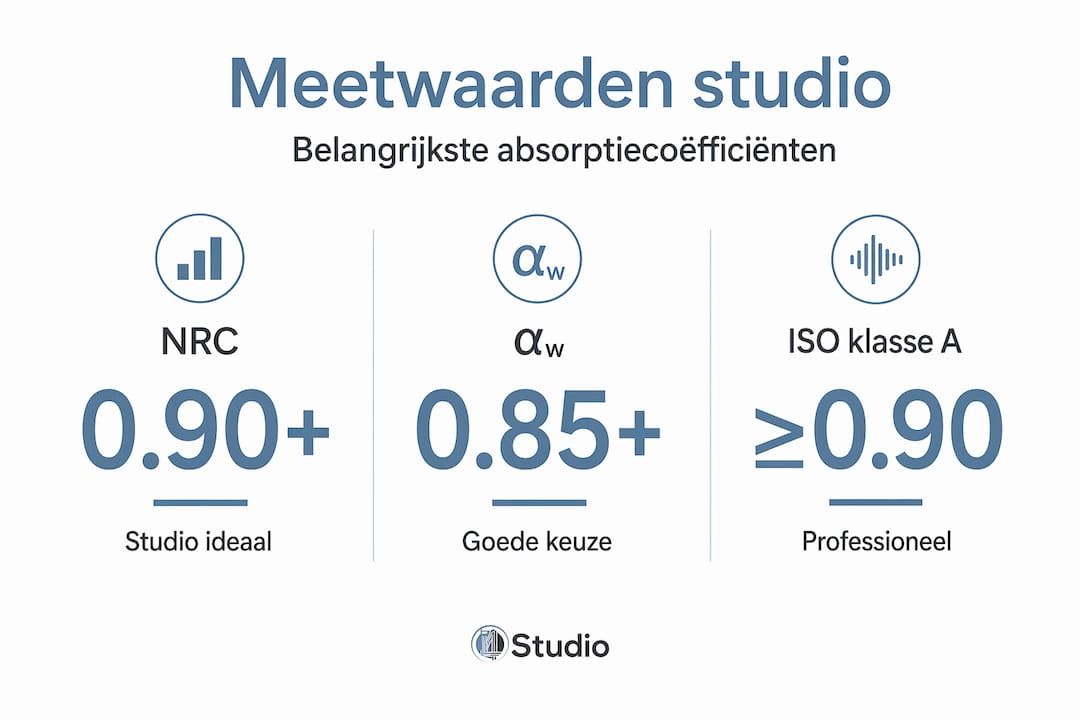
ISO 11654 classes provide a standardized framework for comparison. The classes range from A to E:
| ISO class | αw value | Recommended use |
|---|---|---|
| A | ≥ 0.90 | Professional studio, control room |
| B | 0.80 to 0.90 | Home studio, recording room |
| C | 0.60 to 0.80 | Practice room, podcast studio |
| D | 0.30 to 0.60 | Office, living room |
| E | < 0.30 | Decorative, minimal operation |
For a professional studio, always choose Class A or B. For a home studio, Class B is a solid choice that noticeably improves acoustics without the expense of Class A panels.
When purchasing absorption panels, also consider the following points:
- Frequency response: Does the panel include absorption at low frequencies (125 Hz and below)? This is essential for addressing standing waves.
- Material thickness: Thicker material absorbs lower frequencies. For broadband absorption, at least 10 centimeters for low mids and 20 centimeters for sub-bass.
- Fire safety: Choose materials with a fire rating of B1 or higher, especially for fixed installations.
- Dimensions: Large panels cover more area and are more efficient per euro invested than small panels.
- Mounting method: Check that you can easily hang and, if necessary, move panels.
- Certification: Independent measurement reports from accredited acoustic laboratories provide assurance of the stated values.
Check out our panel instructions for studios for concrete installation guidelines by room type. If you want to go beyond standard wall treatment, you’ll also find information on how to transform your space with wall panels in a way that works both acoustically and visually.
Application and practical tips: using absorption panels optimally
With an understanding of quality standards, you can now start applying this knowledge directly to your own space. But knowing which panel to buy is only half of it. Placement determines at least 50 percent of the final result.
Here is a step-by-step approach for effective placement:
- Start at the first reflection points. These are the points on the side walls and ceiling where the sound from your monitors first bounces back toward your ears. Use a mirror: have someone slide the mirror along the side wall while you are in your listening position. Where you see the monitor is the first reflection point. Those are the priority spots.
- Treat the corners of the room. Low frequencies accumulate in the corners of a room as waves converge from two or three directions. Place thick bass trap absorbers (corner traps) in all four vertical corners for a flatter low-frequency response.
- Edit the back wall behind your monitors. The wall behind your monitors reflects direct energy back toward your listening position. A large panel here reduces the temporary doubling of sound that obscures the transient response.
- Consider ceiling treatment. The ceiling reflection point above your listening position is an often overlooked hot spot. A cloud of absorbent material directly over your head significantly reduces early reflections.
- Also treat the back wall behind your listening position. This prevents reflections from that direction from affecting your ears’ direct sound recording.
- Check the result with a measurement. Use free software such as Room EQ Wizard (REW) in conjunction with a measurement microphone to compare before and after treatment. This allows you to see exactly where further treatment is needed.
Common mistakes you can avoid:
- Too little coverage: one or two small panels are better than nothing, but rarely enough for audible effect.
- Treating only high frequencies: cheap thin panels intervene only on the treble, leaving the bass untouched.
- Sticking panels flat to the wall: this reduces the effective thickness and operation at lower frequencies.
- Too much absorption without diffusion: a completely dead space sounds unnatural and hinders creative decisions. The goal is control, not silence.
Pro-tip: Combine absorption panels with a pair of diffusers on the back wall. The absorbers eliminate harmful reflections, while the diffusers add a sense of space and life to your studio. The result is a neutral but not sterile listening environment. Learn more about proper installation methods at our absorber panel installation guide.
Our perspective: why absorption panels make a difference for professionals
We see it time and again with producers who contact us: they’ve invested in an excellent monitor set, a premium audio interface and maybe even a powerful studio PC. The mixes still don’t add up. Then comes the frustration and the question of whether maybe the monitors aren’t right after all.
Our honest opinion? The room is almost always more guilty than the gear. This is not a controversial position in professional acoustics, but it is consistently under-reported by the market. Manufacturers of monitors, interfaces and plug-ins have a vested interest in you buying more gear. No one is making money directly from your awareness that your space is the problem.
The most impressive example we regularly encounter: a producer working in a small control room of about 12 square meters, untreated, with an RT60 over 0.8 seconds. The mixes sound consistently thick in the bass and fuzzy in the midrange. After installing corner absorbers and first reflection point panels, the RT60 drops to 0.3 seconds. That same weekend, that producer makes a mix that rings true on other systems for the first time. No new gear. Only the space changes.
What also strikes us: many producers are willing to pay 300 euros extra for a better compressor plug-in, but hesitate at 200 euros for absorption panels. While the plug-in does not solve the problem and the panels do. This is purely a matter of priorities.
The “room first” principle has been the standard in professional studio design for decades. Every reputable studio designer starts with the room, not the gear. The exact same applies to home producers, just on a smaller scale. You don’t have to build a perfect room. Even a partially treated room is dramatically better than an untreated one.
Our advice to any producer serious about quality: walk into your studio, clap your hands, listen carefully. Do you hear echo, ringing or reverb? Then you know your next investment. That new monitor can wait.
Applying absorption panels in your studio? Discover our selection
If you want to get started with absorption panels right away, we offer an extensive range and customized advice.
Whether you’re treating a home studio or optimizing a professional control room, we have the right panels for every situation. For example, check out the compact mini acoustic panel Artic for targeted wall treatment, or the studio acoustic diffuser Serious if you want to combine absorption with diffusion for a livelier but controlled sound. Are you also working on your setup outside of acoustics? Then be sure to check out our PC for video editing. Feel free to contact us for personal advice so we can work together to determine the best configuration for your space.
Frequently asked questions about absorption panels
What is the difference between absorption panels and diffusers?
Absorption panels absorb sound energy and convert it into heat, preventing reflections. Diffusers disperse sound waves so that reverberation is broken up without completely absorbing the energy, preserving a livelier sound feel. Both techniques complement each other, and the best studios combine the two.
How do I know where best to place absorption panels?
Prioritizing the first reflection points on side walls and ceiling, the back wall behind your monitors, and the corners of the room yields the most results. The mirror method is an easy way to determine exact locations without measuring equipment. Panels with an αw value of 0.90 or higher perform best at all the positions mentioned.
What absorption coefficient is good for a studio?
Panels with an αw value of at least 0.85 are considered excellent for studios. For a professional control room, ISO Class A, with αw of 0.90 or higher, is the recommended standard.
Are absorption panels also suitable for home studios?
Yes, good absorption panels directly improve acoustics, both in professional studios and home studios. Home studios often have more acoustic problems due to unfavorable room proportions, so the impact of quality panels there can be even greater than in a professionally built space.
Recommendation
- The Best Products for Acoustics in a Home Studio – https://i4studio.nl/
- Acoustic Panels For Studio: Complete Guide For Optimal Recording And Mixing Spaces – https://i4studio.nl/
- Acoustic Panels Tips: Practical Guide For Optimal Studio Acoustics – https://i4studio.nl/
- Narrow Sound Absorption-Diffuse acoustic panel Artic Buy ?