TL;DR:
- Many studio owners think a flat frequency response automatically means perfect sound, but that’s a Misconception. Acoustics, listening position and ears affect how you actually hear, not just measurements on paper. Without an understanding of frequency response and physical treatment, you fall short in the long run.
Many studio owners assume that a flat frequency response automatically means that everything sounds perfect. This is a persistent misconception. In practice, your space, your listening position and even your ears play as big a role as the technical measurement on paper. In this article you will learn what frequency response really means for studio sound, how to measure it correctly in your own space, which solutions really work for home studios as well as professional environments, and why measurement and listening are both indispensable for optimal sound quality.
Table of contents
- What is frequency response and why is it crucial?
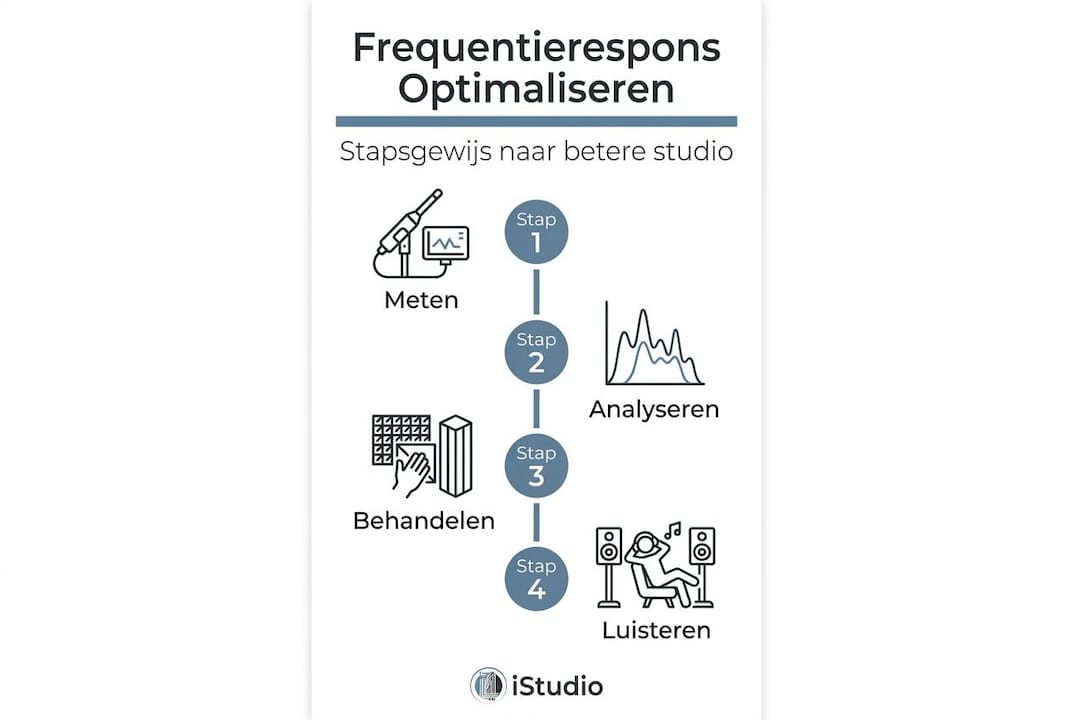
- Here’s how to measure and interpret the frequency response in your studio
- Optimizing frequency response: solutions for every studio type
- From measuring to listening: the human factor in frequency response
- Why measuring is not always enough: our experience
- Getting started yourself? Discover our studio solutions
- Frequently asked questions about frequency response
Key Insights
| Item | Details |
|---|---|
| Understanding frequency response | Different tones must be balanced in any room. |
| Combining measurement and listening | Technical measurements are valuable but your hearing determines the final quality. |
| Smart optimization | Choose solutions that fit your space and always start with the biggest deviations. |
| Getting started | With good advice and the right products, you can structurally improve frequency response in your studio. |
What is frequency response and why is it crucial?
Frequency response describes how a system, speaker, microphone, room, or their combination, responds to different frequencies. Specifically, does the system reproduce all frequencies equally loud and accurate, or are some frequencies stronger or weaker than others? This is represented in a graph with the frequency in Hz on the horizontal axis and the level in dB on the vertical axis.
For a studio, this is crucial. If your monitor speakers are reproducing certain frequencies too strongly, you’re unconsciously mixing them too softly in your production. If you then play that mix on another system, it sounds unbalanced. This is exactly why the basic principles of studio acoustics are so relevant: the room itself affects what you hear, regardless of how good your equipment is.
What does a frequency response table say?
Below is a simplified example of what frequency response looks like in an untreated versus a treated room:
| Frequency | Untreated space | Treated space |
|---|---|---|
| 40 Hz | +8 dB | +1 dB |
| 80 Hz | +6 dB | +1.5 dB |
| 250 Hz | +3 dB | +0.5 dB |
| 1 kHz | 0 dB | 0 dB |
| 4 kHz | +2 dB | +0.5 dB |
| 10 kHz | +1 dB | 0 dB |
The untreated room clearly shows how low frequencies rise due to standing waves and reflections. In the treated room, the response is considerably flatter.
Common misunderstandings
- A flat response = perfect sound. Not always. The listening position, the direction of the speakers and the shape of the room all play a role.
- Expensive speakers compensate for poor space. No. Even the best monitors sound bad in an untreated room.
- EQ solutions are plenty. EQ can help, but does not solve the underlying acoustic problems.
“A flat frequency response on paper is the starting point, not the end point. Space determines what your ear ultimately hears.”
Frequency response is relevant at every stage of your work. In recording, it determines how faithfully your microphone captures the sound. In mixing, it determines whether your reference environment is reliable. In mastering, a neutral environment is literally everything. Without an understanding of frequency response, you’re basically working at random.
Here’s how to measure and interpret the frequency response in your studio
Now that you understand what frequency response is, you’re going to learn how to measure and analyze it yourself in your own studio. This sounds technical, but with the right tools it’s quite doable, even if you’re not an engineer.
Step-by-step measurement
- Choose a measurement microphone. Use a microphone with a known, flat response. Popular options are the Behringer ECM8000 or the miniDSP UMIK-1. An ordinary condenser microphone is less suitable because it already has coloration itself.
- Install measurement software. REW (Room EQ Wizard) is free and the industry standard for room measurement. It generates a frequency sweep, a test tone that runs through all frequencies, and analyzes the response.
- Position the microphone correctly. Place the microphone at your listening position, at ear level. This is the point where you always mix, so this is where you want to know the response.
- Perform the measurement. Have REW play a sweep through your monitors and the microphone records what is coming into the room. Do this several times for reliability.
- Analyze the graph. Look for peaks (too much energy at a frequency), troughs (too little energy) and resonances (frequencies that reverberate for a long time).
Pro-tip: Always measure with the door closed and all equipment on that is also normally on during mixing. Fans, computers and other devices add noise to the measurement, but they are also always there during your work. That way you get a realistic representation of your work environment.
Interpreting graphs
A peak around 80 to 100 Hz almost always indicates a standing wave, a resonance caused by low-frequency waves bouncing back and forth between parallel walls. A valley around 200 Hz may come from destructive interference: two waves canceling each other out. Peaks in the upper midrange, around 2 to 4 kHz, are often the result of early reflections from the desk or side walls.
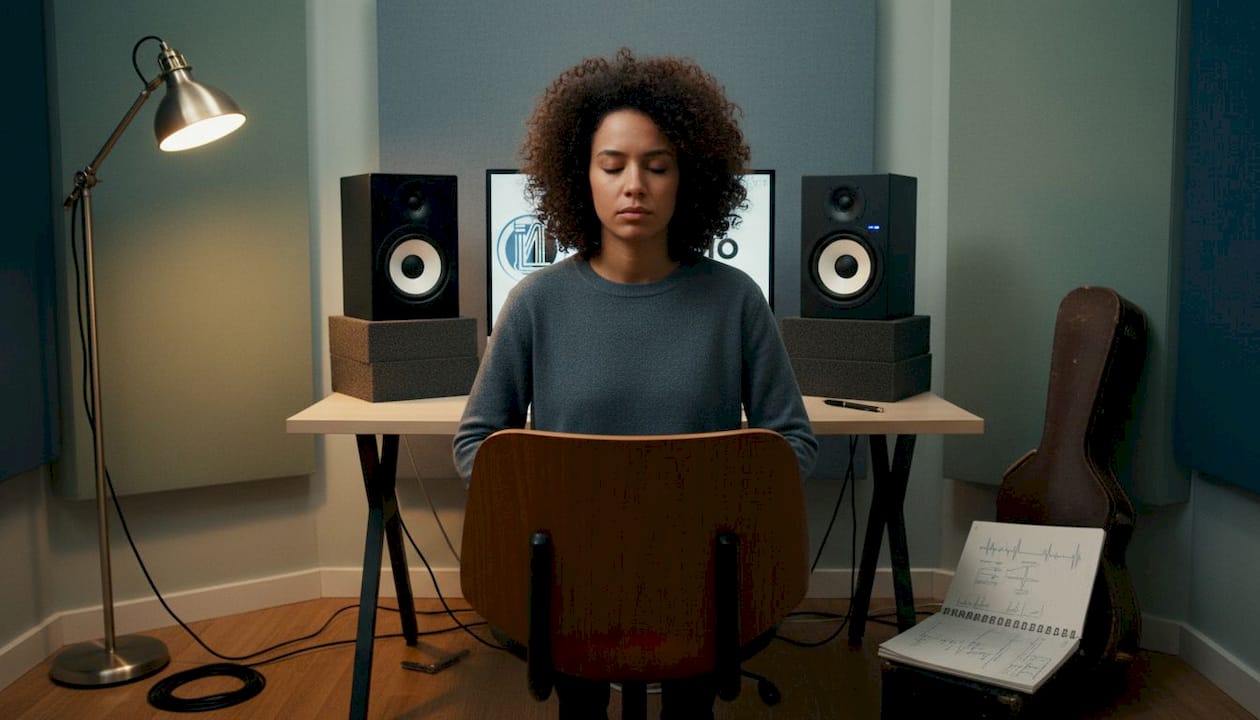
If you want to improve acoustics at home, these charts are your most important tool. They tell you exactly where to intervene.
Pitfalls in measuring
- One measurement is not enough. Take several measurements at different positions and average them.
- Wrong microphone position. If you place the microphone too close to a wall, you measure the reflection, not the direct response.
- Software improperly calibrated. Many measurement microphones come with a calibration file. Load this into REW for accurate results.
- Forgot to compensate for the monitor. Each monitor has its own response. REW lets you measure this separately.
Statistics: Research shows that room reflections in an untreated studio can cause up to 20 dB of deviation in the low frequency range below 200 Hz.
These kinds of anomalies cannot be corrected with EQ alone. They require physical acoustic treatment.
Optimizing frequency response: solutions for every studio type
Measuring is one thing, but optimizing requires a focused approach. Find out which solutions work for your studio, whether you have a small home studio or a larger professional studio.
The three pillars of acoustic treatment
Most frequency response problems in studios fall into three categories, and each category has its own solution:
- Basstraps absorb low frequencies. They are most effective in the corners of a room, where low frequencies accumulate. Without bassstraps, the low frequency response almost always remains uneven.
- Absorbers (also called acoustic panels) attenuate midrange and high frequencies. They reduce early reflections and shorten reverberation time. This makes your mix more accurate.
- Diffusers diffuse sound instead of absorbing it. They provide live but controlled acoustics, ideal for the back wall of a control room.
If you want to know how to approach studio acoustics improvement, the combination of these three elements is always the starting point.
Comparison by studio type
| Solution | Home studio (small space) | Semi-professional studio | Professional studio |
|---|---|---|---|
| Basstraps in corners | Essential | Essential | Essential |
| Wall absorbers | Highly recommended | Recommended | Standard |
| Rear panel diffusers | Optional | Recommended | Standard |
| Ceiling panel | Useful | Recommended | Standard |
| Floating floor | Rarely feasible | Sometimes | Standard |
| Soundproof door | Optional | Recommended | Required |
Every room is different, but the basic order remains the same: always start with the low frequencies. Bass traps in the corners provide the greatest improvement for the least investment. Only then do you move to absorbers and diffusers.
Pro-tip: Don’t start with the details. Many studio owners buy fancy diffusers for the back wall first, while the low frequencies are still completely uncontrolled. That’s money that has little effect. Address the bass traps first, measure again, and then move on.
Considerations for each solution
Bass Straps:
- Thick material (at least 10 cm of rockwool or equivalent) is more effective than thin material.
- Placement in all four vertical corners as well as horizontal corners (wall/ceiling) is ideal.
- Cheap foam bass traps barely work below 200 Hz.
Absorbers:
- Cover a maximum of 30 to 40 percent of the wall surface. Too much absorption makes a room look dead and unnatural.
- The first reflection points (side walls next to the speakers, ceiling above the listening position) are the priority.
Diffusers:
- Work effectively only above a certain frequency, depending on their depth and pattern.
- Are not a replacement for absorbers, but a complement.
Also see how applying soundproofing works in conjunction with proper studio setup tips for a complete picture.
Common optimization mistakes
- Only treat the back wall and forget about the side walls.
- Absorbers placed too high or too low, leaving initial reflection points untreated.
- Thinking that more is always better: an overly muted room sounds unnatural and tiring to work in for a long time.
- Not doing a re-measurement after placing treatment, so you don’t know if it had an effect.
From measuring to listening: the human factor in frequency response
After all the measurements and technical optimizations, we come to the most human aspect: listening and judging. Because no matter how accurate your measurement is, the ear is the final instrument.
The difference between measuring and experiencing
A measurement shows what is physically present in the room. But the ear interprets sound based on context, habituation and expectation. Two people can have different perceptions of the same mix in the same room. This is not a weakness of the system; it is the reality of auditory perception.
“Measuring gives you the facts. Listening gives you the truth. You need both.”
Psychoacoustics: the ear adapts itself
Human hearing is remarkably adaptive. After a few minutes in a room, your brain begins to compensate for the acoustic color of that room. You then hear less the room itself and more the sound. This is useful in everyday life, but dangerous in a studio.
When your ear gets used to a boomy low frequency in your room, you unconsciously start compensating for it in your mix. The result: a mix that sounds good on your system, but is too thin and bright on other systems. This phenomenon is one of the biggest pitfalls for home studio owners.
If you want to avoid this, it helps to regularly apply sound reflection reduction and recalibrate your ears by listening to reference material.
When is good enough really good enough?
Not every studio needs to be perfect. For podcasting or voice-over work, a well-damped room without major resonances is sufficient. For music production and mastering, higher standards are realistic. First determine what the purpose of your studio is, and tune your optimization accordingly.
Practical listening tips
- Use reference material. Listen to songs you know well on your monitors and compare. Does the bass sound too full or too thin? Is there air in the treble?
- Alternate with headphones. Good reference headphones tell you what’s really in the mix, regardless of space.
- Listen at different volumes. Low volumes reveal problems in the mids. High volumes reveal problems in the low frequencies.
- Take breaks. After 90 minutes of listening, your ear begins to compensate. A 10-minute break resets your perception.
- Test on other systems. Play your mix on a car, a phone and a Bluetooth speaker. If it sounds good everywhere, your reference environment is reliable.
Why measuring is not always enough: our experience
We’ve set up and optimized dozens of studios over the years, from small bedroom studios to larger semi-professional control rooms. And again and again, we see the same pattern: studio owners who are completely blinded by the graphics.
They measure, see a peak at 80 Hz, place a bass stage, measure again, see the peak decrease slightly, and are satisfied. But they forget to listen. They forget to test with real music, with reference material they know inside out. And then, weeks later, they find out that their mixes on other systems are still wrong.
The chart is a tool, not a final judgment. A room that looks good on paper can still sound unpleasant due to subtle early reflections or an unfortunate listening position. Conversely, a room with a light-colored response can still sound excellent if the mix engineer knows that color and is intentional about it.
What we always recommend: measure first, treat specifically, and then listen extensively. Use reference material from artists you know how their music sounds on a good system. Compare actively. And then measure again. This iterative process, measure, listen, adjust, measure, produces better results than a one-time round of measurements followed by a big purchase.
Another pitfall we see regularly: investing too much too quickly in one category. Someone buys a full set of diffusers for the back wall, but hasn’t addressed the low frequencies at all. The result is a room that looks professional but still fails acoustically. Always start with the biggest problems. In most spaces, those are the low frequencies.
Finally, trust your ears, but also train them. Listen consciously to reference material. Learn what a good bass sounds like, what a clear treble is, what a well-balanced middle does. That knowledge will make your measurements truly valuable. Find more practical insights for better acoustics at home in our comprehensive guides.
Getting started yourself? Discover our studio solutions
Now that you know exactly what frequency response means and how to optimize it, you can get focused on professional studio solutions. The knowledge from this article is only truly valuable if you can apply it with the right materials and tools.
At i4studio, you’ll find acoustic products specifically selected for studio environments, from home studios to semi-professional control rooms. For example, check out our studio acoustic diffuser for controlled sound diffusion on the back wall. Just getting started with your studio setup? Our guide on studio gear for beginners will help you make the right choices without investing too much in the wrong order. And for a complete overview of everything we offer in acoustics and studio gear, check out i4studio.co.uk.
Frequently asked questions about frequency response
What is a good frequency response for a studio?
Good frequency response is as close as possible to a flat line between 20 Hz and 20 kHz, with deviations of preferably no more than plus or minus 3 dB. Large peaks or valleys, especially in the low frequency range, indicate acoustic problems that require treatment.
How do I measure my studio’s frequency response myself?
Use a calibrated measurement microphone in conjunction with free software such as REW (Room EQ Wizard). Perform a frequency sweep through your monitors, with the microphone at listening position at ear level, and analyze the graph for peaks, valleys and resonances.
Does acoustic treatment help with flat frequency response?
Yes, acoustic treatment is the most effective way to improve the frequency response in a room. Bass traps address low frequency problems, absorbers reduce early reflections and diffusers provide controlled sound dispersion.
Can I rely on measurements alone for the best sound?
No. Measurements give you objective data, but the ear interprets sound in a way that no graph fully represents. Always combine measurement data with critical listening to reference material for the most reliable assessment of your studio acoustics.
Recommendation
- Studio Acoustics Improvement: Practical Guide For Professional Sound Spaces – https://i4studio.nl/
- Studio setup explanation: this is how to build a professional home studio
- Improving studio acoustics: The best home solutions
- Furnishing Studio Acoustics: From Space Analysis to Perfect Mix – https://i4studio.nl/
- Improve your workflow: effectively collect and apply feedback