You’ve finally set up your home studio, but your mixes don’t sound good anywhere else. The problem often lies not with your speakers or interface, but with the acoustics of your space. Poor acoustics cause unreliable mixing decisions due to reflections, standing waves and modal frequencies. Fortunately, with targeted measurements and treatments, you can transform your studio into a neutral listening environment. In this guide, you’ll learn step-by-step how to measure acoustic problems with REW, apply effective treatments, and find the ideal balance between absorption and diffusion for professional results.
Table of contents
- Key points about studio acoustics
- How do acoustics work in a home studio
- Studio measurement: understanding your sound environment with REW
- Effective acoustic treatment: from initial reflection to bass traps
- Ideal reverberation time and balance in small studio spaces
- Optimize your home studio with i4studio
- Frequently asked questions about home studio acoustics
Key Insights
| Item | Details |
|---|---|
| Acoustics determine reliability | A neutral listening environment prevents distortions in your mix and makes decisions consistent. |
| Measure with REW and microphone | Measure reverberation time and frequency response with REW and a calibration microphone to target bottlenecks. |
| Reflections and bass modes first | Treat reflections and bass modes with proper panels first before applying other treatments. |
| Reverberation time 0.2 to 0.4 s | For small rooms, the ideal reverberation time is between 0.2 and 0.4 seconds. |
| Balance absorption diffusion | The right ratio of absorption to diffusion gives a balanced sound and spatial image. |
How do acoustics work in a home studio
Sound waves behave in three ways when they hit surfaces: they reflect back into space, are absorbed by materials or are diffused in different directions. Acoustics in a home studio manages reflections, absorption and diffusion of sound waves to create a neutral listening environment for reliable mixing and recording. Without control over these processes, you get chamber filter effects, standing waves and frequency peaks that completely distort your mixing decisions.
Absorption converts sound energy into heat through porous materials such as mineral wool or glass wool. This reduces reflections that would otherwise bounce back to your listening position and interfere with the direct sound from your monitors. Diffusion, on the other hand, disperses sound waves in multiple directions without completely eliminating them, creating a more natural-sounding room. The basic principles of acoustics revolve around finding the right balance between these two approaches.
Small rooms have specific challenges with modal frequencies, also called room modes. These occur when the dimensions of your room resonate with certain frequencies, resulting in extreme peaks and zeros in the low frequencies. For example, a 4-by-5-meter room has strong modes around 34 Hz, 43 Hz and 68 Hz. These frequencies are amplified or canceled depending on where you sit, making bass reproduction inconsistent.
A neutral listening environment is essential for reliable mixing decisions because only then can you hear what is really happening in your mix. If your room amplifies certain frequencies, you unconsciously compensate by reducing those frequencies in your mix. The result is a mix that sounds good in your studio but is completely out of balance elsewhere. That’s why professionals invest in room treatment first before upgrading to more expensive monitors.
Pro-tip: Use a home studio acoustics primer to understand the fundamental concepts before you spend money on treatment. Many producers randomly buy foam panels without knowing what problems they actually have to solve.
“The best monitor upgrade you can do is not a more expensive pair of speakers, but treating your listening environment. Even budget monitors perform extremely well in a well-treated room.”
Studio measurement: understanding your sound environment with REW
Always measure with REW and a measurement microphone to analyze RT60, frequency response and decay times before buying treatments. This software costs about $100 including a calibration microphone such as the UMIK-1 and gives you objective data on what is wrong in your space. Without measurements, you are treating on guesswork and wasting money on solutions that may not even address your biggest problems.
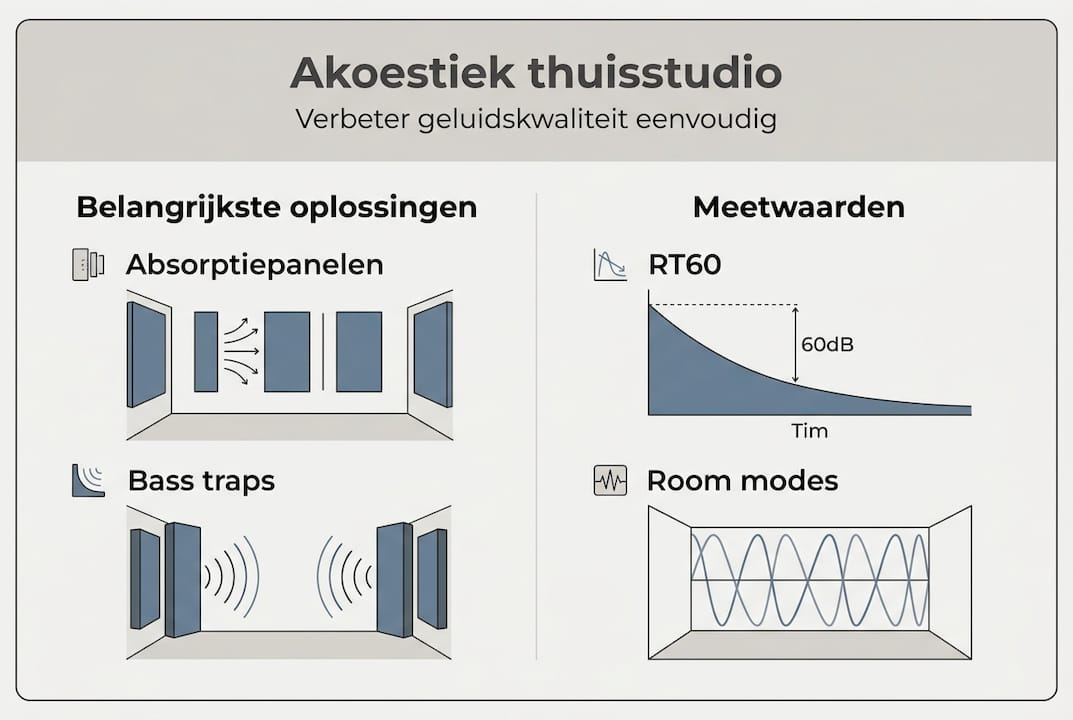
REW shows three crucial aspects of your studio acoustics. First, reverberation time (RT60), which indicates how long it takes for sound to attenuate 60 dB. Second, the frequency response, which reveals peaks and valleys in your listening position. Third, the waterfall plots, which show which frequencies linger after the initial pulse. This data tells you exactly where absorption, bass traps or diffusion are needed.
Basic measurements often show dramatic zeros and peaks caused by room modes in small studios. A typical untreated home studio has zeros of up to 25 dB at modal frequencies such as 70 Hz or 140 Hz, and peaks of 10-15 dB at other points. After targeted treatment with corner stages and absorption panels, the response improves by 6-8 dB, making a huge difference in mix reliability. Check out setup studio acoustics for practical examples.
Measurement results guide your treatment strategy in three ways:
- Identify the strongest room modes from the frequency response graph
- Determine which reflection points cause the most early reflections via impulse response
- Analyze RT60 by frequency band to see where absorption or diffusion is needed
Pro-tip: measure at multiple positions in your studio, not just your listening position. This gives a more complete picture of how the room behaves and helps you understand whether problems are localized or occur throughout the room. A room setup case study shows how professionals interpret this data.
| Measured value | Untreated | After treatment | Difference |
|---|---|---|---|
| RT60 mid-high | 0,8 s | 0,3 s | 0.5 s improvement |
| 70 Hz null | 25 dB dip | 8 dB dip | 17 dB flatter |
| 140 Hz peak | +12 dB | +4 dB | 8 dB reduced |
| Total variation | ±18 dB | ±6 dB | 12 dB more consistent |
Effective acoustic treatment: from initial reflection to bass traps
Use absorption panels of mineral wool or glass wool at least 10 cm thick, not just foam. Foam absorbs only high frequencies and leaves low and mid frequencies unaffected, resulting in an imbalance where your room sounds dull but still has modal problems. Treat initial reflection points with absorbent panels 10-15 cm thick, mounted off-wall, and place bass traps in all corners for standing waves.
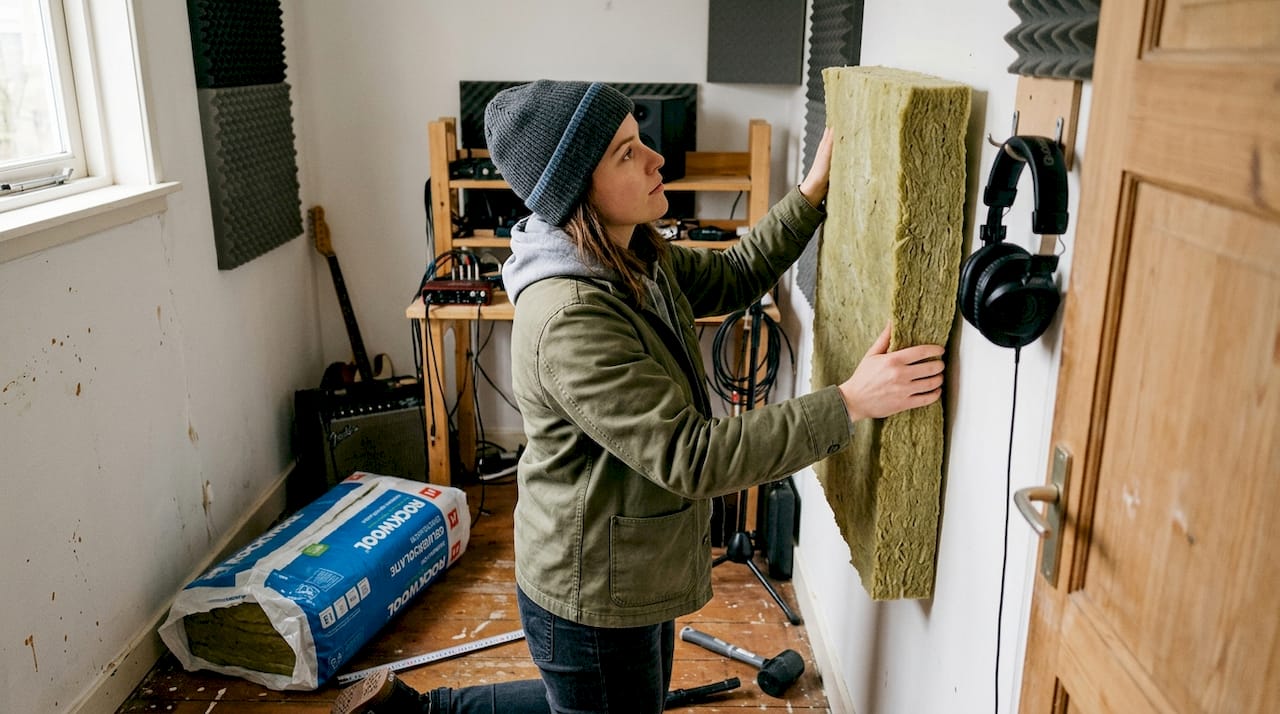
Place panels at first reflection points via the mirror method: put a mirror on the side walls and ceiling while in your listening position. Where you see your monitors in the mirror is where the sound hits the wall before it reaches your ears. These are the critical reflection points that cause early reflections within 15-20 milliseconds of the direct sound. These early reflections distort the stereo image and make frequencies unclear. Check out home studio acoustics products for suitable panels.
Amplify low frequencies with bass traps in all four corners of your studio, from floor to ceiling. Corners are where modal pressure accumulates, so that’s where bass traps are most effective. Use thick traps of at least 30 cm or special designs such as superchunk traps that completely fill the corner. Without adequate bass traps, low frequencies remain problematic, no matter how much mid-high absorption you apply. Read more about bass traps studio acoustics for in-depth explanations.
Avoid too much absorption without bass traps, otherwise your room will sound dead in the high and mid frequencies while low frequencies are still uncontrolled. This is a common mistake where producers cover all the walls with thin foam, resulting in an unbalanced, unnatural sound. The rule is: treat low frequencies with corner stages first, then mid-high reflections with wall panels.
Applying diffusion to the back wall after absorption keeps the room alive and sounding natural. Diffusers diffuse sound without absorbing it, which is especially important in small rooms where too much absorption can quickly feel claustrophobic. Place diffusers on the back wall behind your listening position and possibly on the ceiling above your head. See tips for reducing sound reflection for more strategies.
Pro-tip: Use a room mode calculator to calculate which frequencies are problematic in your specific room dimensions. This will help you choose bass traps that are effective for your modal frequencies.
| Treatment Type | Material | Thickness | Application | Effective range |
|---|---|---|---|---|
| Absorption Panel | Mineral wool | 10-15 cm | First reflections | 500 Hz – 8 kHz |
| Bass stairs | Glass wool/mineral wool | 30+ cm | Corners | 40 Hz – 300 Hz |
| Diffuser | Wood/QRD | Variable | Rear panel | 800 Hz+ |
| Foam (not recommended) | Polyurethane | 5 cm | No | >2 kHz only |
Ideal reverberation time and balance in small studio spaces
Ideal RT60 for small home studios is around 0.2-0.4 seconds; excessive absorption leads to a “dead” room with poor sound that is tiring to work in. This reverberation time promotes clear, neutral playback without making the room feel sterile or unnatural. Larger studios can have slightly longer RT60 (0.4-0.5 s), but in a small home studio of 15-25 sq. ft. shorter is better for precision.
Podcast studios and speech recording rooms often aim for even shorter RT60 of under 0.3 seconds because of the smaller volume and focus on speech clarity. For music production, however, you don’t want to go too short because a certain amount of natural reverb keeps the room alive and makes monitoring less tiring. The difference between 0.25 s and 0.35 s sounds subtle but has a big impact on how long you can mix comfortably.
Overabsorption reduces high and mid frequencies too much while bass modes often go unaddressed. This happens because producers use foam or place too many thin panels without bass traps. The result is a room that sounds muffled in the highs but still booming in the lows. The solution is always: bass traps first, then mid-high absorption until you reach the desired RT60. More info at improving studio acoustics.
Use the 1/3 listening position rule to reduce modal problems: place your listening position at 38% of the room length from the front. This avoids the worst modal zeros that occur at 1/2 and 1/4 positions. Combine this with symmetrical monitor placement and you minimize many problems before you apply any treatment at all. Room placement is as important as the treatment itself.
Small rooms require thoughtful balance to avoid over-damping:
- Measure RT60 after each treatment step to avoid going too far
- Always retain some reflection for natural spaciousness
- Use diffusion on at least one surface to keep the space alive
- Test your mixes regularly on other systems to verify that treatment works
A bedroom studio acoustic fixes article shows practical examples of balanced treatment in small spaces.
| Room type | Ideal RT60 | Absorption focus | Diffusion | Typical challenge |
|---|---|---|---|---|
| Home studio music | 0,3-0,4 s | Mid-high reflections + bass | Rear panel | Modal frequencies |
| Podcast/voice booth | 0,2-0,3 s | Broad spectrum | Minimal | Too dead without balance |
| Mix/master chamber | 0,25-0,35 s | Balanced | Ceiling + rear wall | Consistent response |
| Tracking room | 0,4-0,5 s | Selectively | Multiple surfaces | Too much attenuation |
Optimize your home studio with i4studio
Now that you understand how acoustics work and what your studio needs, the next step is to implement effective solutions. i4studio offers high-quality acoustic products specifically for home studios, from absorption panels to bass traps that really work in small spaces. We combine this with custom studio PCs that are optimized for music production, so you take both your acoustics and workflow to professional levels.
Our expertise in home studio acoustics products helps you make the right choices without wasting money on ineffective solutions. We understand the specific challenges of small Dutch home studios and offer customized advice. Whether you need a complete PC for music production or targeted tips to improve your studio acoustics, we think with you for optimal results within your budget.
Frequently asked questions about home studio acoustics
What is the best material for absorption panel in a home studio?
Mineral wool or glass wool at least 10 cm thick is most effective for broadband absorption. Foam absorbs only high frequencies and leaves the crucial mid and low frequencies unaffected, resulting in imbalance. Choose panels with a density of 30-50 kg/m³ for optimal performance across the frequency spectrum.
How do I determine the ideal spot for a bass staircase?
Always place bass traps in all four corners of your studio, from floor to ceiling, because that is where modal pressure accumulates. Measure with REW to identify which modal frequencies are strongest and choose traps that are effective in that range. Superchunk designs that fill the entire corner are most effective for small spaces.
Can you improve acoustics even without expensive equipment?
Yes, start with REW (free) and an affordable UMIK-1 measurement microphone (€100) for objective data. Build your own absorption panels from mineral wool and wooden frames for a fraction of commercial prices. Focus first on proper placement of your listening position and monitors according to the 1/3 rule, which does not cost money but has impact.
What are the dangers of overtreatment in small rooms?
Too much absorption without adequate bass traps creates an imbalance where high frequencies are attenuated but low frequencies are still problematic. The room then sounds dead, claustrophobic and tiring to work in. Measure RT60 regularly and stop treating once you reach 0.3-0.4 seconds, always retain some natural reflection.
How often should I re-measure and adjust my studio acoustics?
Measure after any significant change in handling or furnishing to verify impact. For a stable setup, an annual check is sufficient to confirm that nothing has shifted. If you notice that mixes sound different or you’re having more trouble with mix decisions, that’s a signal to measure again and adjust if necessary.
Recommendation
- Studio Acoustics Improvement: Practical Guide For Professional Sound Spaces – https://i4studio.nl/
- Home Studio for Content Creators: From Space to Professional Recording – https://i4studio.nl/
- Home Studio Sound Recording Tips: From Space to Mix – https://i4studio.nl/
- Practical Home Studio Setup Ideas For Musicians And Producers – https://i4studio.nl/