
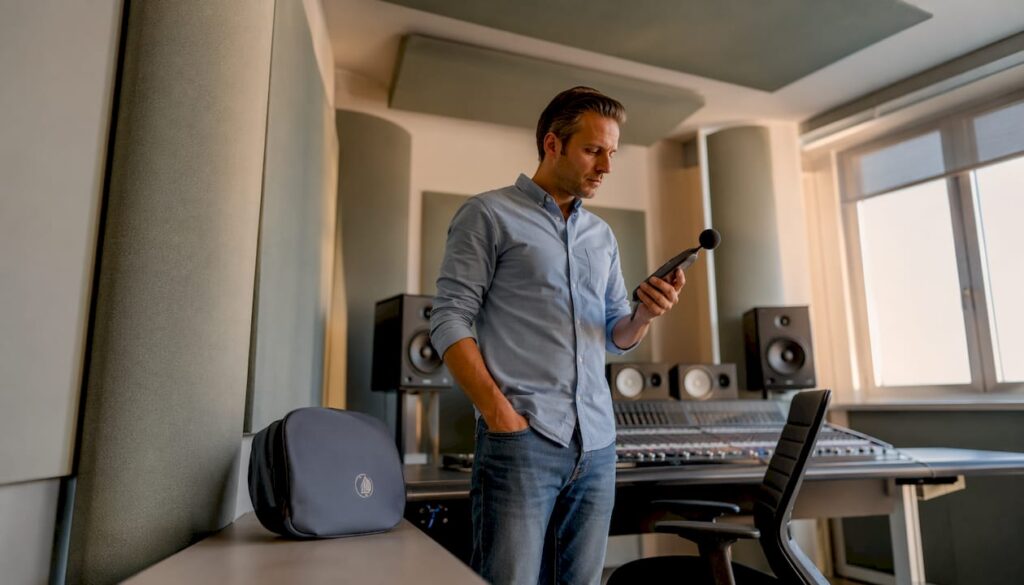
Absorptive material in a studio has one core function: to convert sound energy into heat, thereby eliminating reflections and reverberation. The result is a controlled acoustic environment where your recordings sound clear and your mix is reliable. Without absorption, sound bounces off hard walls, builds up in corners, and colors every recording. This isn’t a matter of taste, but of measurable acoustics.
What sound-absorbing material actually does in a studio:
- Reduces reverberation time by absorbing sound energy rather than reflecting it
- Prevents flutter echoes between parallel walls that render recordings unusable
- Creates a neutral listening environment for reliable mixing and mastering
- Works in tandem with diffusers: absorption removes energy, while diffusion disperses it
- Effectiveness is expressed by the absorption coefficient, where a value close to 1 means that a large portion of the sound energy is absorbed
Table of contents
- How does sound absorption work, and what does the absorption coefficient indicate?
- Why are materials frequency-dependent?
- What types of sound-absorbing materials do you use in a studio?
- How do you choose and install sound-absorbing material to achieve the best results?
- I4studio can help you with studio acoustics
- Frequently Asked Questions
- Key insights
How does sound absorption work, and what does the absorption coefficient indicate?
Sound absorption is the process by which sound waves cause a material to deform, thereby losing energy in the form of heat. The more damping a material provides, the less sound is reflected. Schematically, this works like a mass-spring system with damping: the fiber or foam structure vibrates in response to the sound wave and converts that motion into heat.
The absorption coefficient expresses this as a number between 0 and 1. A value of 0 means complete reflection, and a value of 1 means complete absorption, similar to an open window. Glass wool and rock wool generally achieve a high degree of sound absorption at higher frequencies, while thin foam panels are less effective at low frequencies.
By default, measurements are taken per octave band, from 125 to 4000 Hz. This frequency range covers speech, instruments, and most of the information relevant to the mix. Outside that range—particularly below 125 Hz—materials behave differently, and additional measures are required.
- Absorption coefficient 0: no absorption; all sound is reflected
- An absorption coefficient close to 1 means that most of the sound energy is absorbed
- Measured per octave band within the frequency range typically used for speech and music
- The balance between absorption and reflection determines whether a room sounds dead or lively
Why are materials frequency-dependent?
Not every material performs equally well across the entire frequency spectrum. Thin panels measuring 25–50 mm are effective at absorbing higher frequencies, such as speech and high-pitched sounds above 1000 Hz. Low frequencies, particularly bass below 200 Hz, have a much longer wavelength and are largely unaffected by thin layers of material.
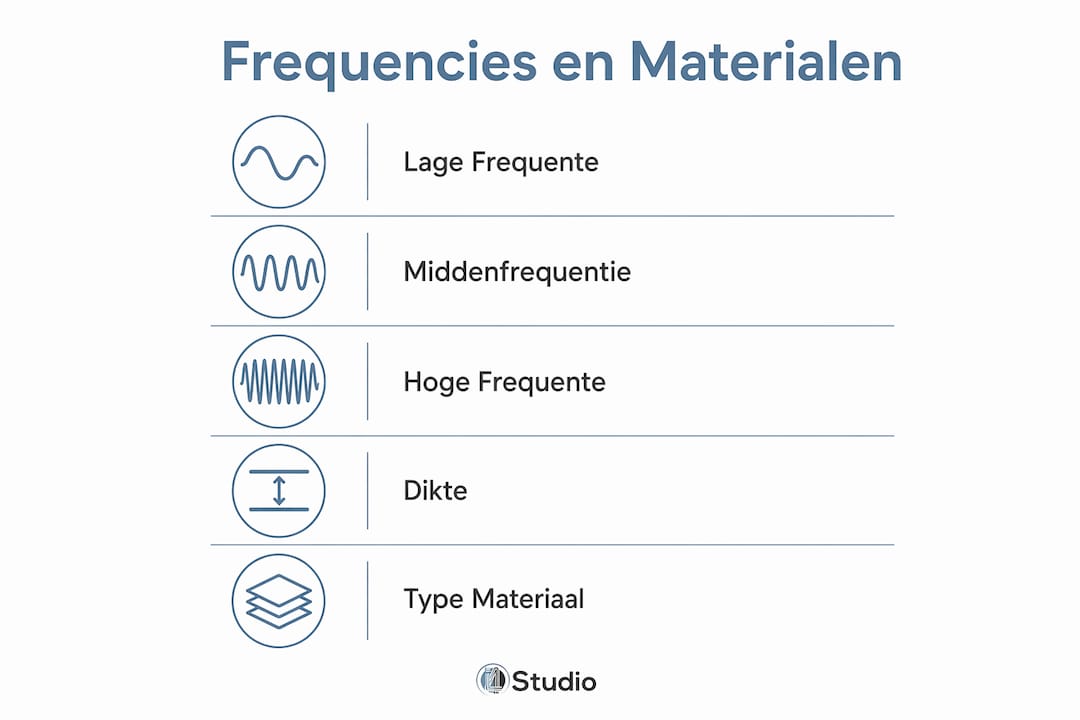
Bass traps are needed for those low frequencies: thick absorbers at least 100–200 mm thick, preferably placed in corners where sound pressure concentrates. From an acoustic standpoint, corners are the weakest spots in a studio, because low frequencies build up there and cause resonances that color your mix.
Special designs such as Helmholtz resonators and flat-plate resonators operate at specific frequencies and are used in professional control rooms where there are high requirements for low-frequency sound. For most studios, a combination of broadband absorbers and directional bass traps is the most practical approach.
- Thin panels measuring just a few centimeters are particularly effective at mid and high frequencies. Thick absorbers and bass traps are necessary for addressing low frequencies. Corners are key locations for placing bass traps due to the concentration of sound pressure. Resonators are used to address specific frequency issues in professional settings. Measuring the frequency response before and after treatment demonstrates the effectiveness of the treatments.
What types of sound-absorbing materials do you use in a studio?
There is a wide range of sound-absorbing materials to choose from, but each type has a specific area of application. Glass wool and rock wool are the most broadband options: they work well at medium to high frequencies and are relatively inexpensive per square meter. They are used in wall panels, ceiling islands, and DIY bass traps.
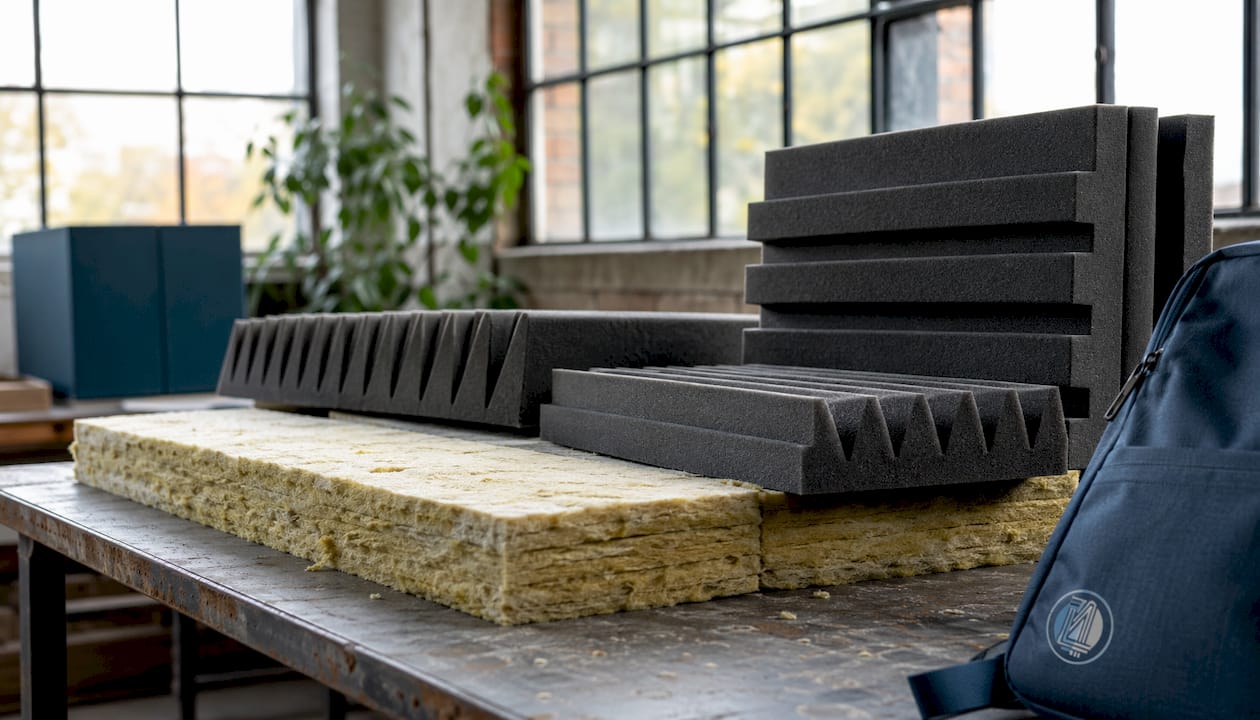
Acoustic foam panels are lighter and easier to install, but they perform less effectively at low frequencies. They are suitable for dampening flutter echoes and treating early reflection points on side walls and the ceiling. They are often sufficient for a recording booth or vocal booth.
Pro-tip: Always combine foam panels for the higher frequencies with rock wool or glass wool bass traps in the corners. Using foam alone will result in a studio that sounds dead in the high frequencies but resonant in the low frequencies, which will mislead your mix.
- Glass wool and rock wool: versatile, high absorption coefficient, suitable for walls and ceilings
- Acoustic foam panels: lightweight, easy to install, effective for mid- to high frequencies
- Bass traps: thick material for corners, designed to address low frequencies and resonances
- Ceiling islands: freestanding panels that reduce reflections from above without covering the entire space
- Diffusers: not absorbers, but devices that scatter sound to create a more lively tone as a complement
Diffusers and absorbers complement each other. A studio completely lined with absorbers sounds unnaturally dead. The right balance depends on the room’s function: a recording studio requires more absorption, while a mixing room benefits from some diffusion to create a more natural listening environment. Check out the best acoustic products for a detailed overview by application.
How do you choose and install sound-absorbing material to achieve the best results?
Start by analyzing the space. Clap your hands and listen: do you hear a sharp echo or a long reverberation? That alone tells you a lot about where the problems lie. Next, measure the reverberation time if you can, or have someone do it for you. A reverberation time that’s too long makes recordings sound muddy; one that’s too short sounds unnatural and tiring.
Effective placement focuses on the reflection points: the side walls at the level of the listening position, the ceiling between the speakers and the listening position, and the corners for bass traps. Walls opposite the speakers are the second priority. Don’t tackle everything at once; instead, work systematically from the most problematic areas to the rest.
Pro-tip: Use the mirror method to find initial reflection points: have someone slide a mirror along the side wall while you’re sitting at the listening position. Place an absorber wherever you see the speaker.
- First, determine the reverberation time and the location of the reflections
- Choose the material thickness based on the frequency issue: thin for high frequencies, thick for bass
- Combine absorption and diffusion for balanced acoustics
- Prioritize corners for bass traps, side walls for panels, and the ceiling for islands
- Consider the room’s function: recording requires more sound absorption than a mixing room
- Professional customization based on an acoustic analysis yields the most reliable results
When it comes to acoustic treatment in professional music studios, placement is just as important as the choice of materials. Excessive absorption is a common mistake: it causes you to lose the sense of space that brings a mix to life.
I4studio can help you with studio acoustics

I4studio specializes in studio acoustics and provides both the materials and the expertise needed to properly treat your space. Whether you’re treating a home studio or setting up a professional recording space, the product range includes everything from acoustic wall panels and diffusers to complete starter kits. No generic advice—just an approach tailored to your space and workflow.
Check out the full selection in the studio acoustics guide, or get started right away with the studio gear guide for beginners if you’re still setting up your studio.
Frequently Asked Questions
What is the purpose of acoustic absorption material in a studio?
Absorptive material converts sound energy into heat, reducing reflections and reverberation. This creates a controlled acoustic environment that enables clear recordings and reliable mixing.
What does an absorption coefficient of 0.9 mean?
A material with an absorption coefficient of 0.9 absorbs 90% of the incident sound energy. The coefficient is measured per octave band between 125 and 4000 Hz.
Why don’t thin panels work for low frequencies?
Low frequencies have a long wavelength and require thick materials of at least 100–200 mm or special bass traps. Thin foam panels are effective above 500–1000 Hz, but hardly at all for bass.
Where is the best place to put bass traps?
Bass traps belong in the corners of the studio, where low frequencies are concentrated and the sound pressure is highest. That is where they have the greatest effect on resonances and reverberation in the low-frequency range.
What is the difference between absorbers and diffusers?
Absorbers remove sound energy from the room by converting it into heat. Diffusers scatter sound without absorbing it, resulting in a more lively sound. A good studio combines both to achieve balanced acoustics.
Key insights
Absorptive material reduces reverberation time and reflections by converting sound energy into heat. The absorption coefficient and frequency response determine which material you need where.
| Item | Details |
|---|---|
| Absorption Coefficient | A value of 0.9 means that 90% of the sound energy is absorbed; measured from 125 to 4000 Hz. |
| Frequency Dependence | Thin panels work above 500–1000 Hz; low frequencies require thick bass traps of at least 100–200 mm. |
| Placement Is Key | Prioritize corners for bass traps and first reflection points on side walls and the ceiling for absorbers. |
| Absorption and Diffusion | Absorbers alone produce a dull sound; combine them with diffusers for balanced studio acoustics. |
| I4studio as a specialist | I4studio provides acoustic panels, diffusers, and customized advice for home studios and professional recording spaces. |