Room modes are the resonance frequencies that occur when standing waves travel back and forth between two or more walls of your studio. If you calculate these modes, you’ll get a specific list of problematic frequencies—usually below 300 Hz—that require targeted treatment. The workflow is simple: measure your room, calculate the modal frequencies, verify them with a measurement, and treat the most problematic modes first.
Briefly:
- Room modes are particularly relevant below the Schroeder frequency, where they affect the timbre and must be specifically addressed in small rooms.
- Calculating axial modes using the formula f = n·c/(2·dimension) yields the first natural frequencies, but measurements remain essential for accuracy.
- In practice, the first axial modes and their clusters are particularly important for targeted acoustic treatment, typically up to about 300 Hz.
- For effective treatment, antinodes in corners and along walls must be addressed, depending on the modal frequencies and room shape.
- Request advice and measurement data from specialized firms such as I4studio for guidance on selecting and installing acoustic panels.
Table of contents
- When should you use a comprehensive approach to calculating room modes in a studio?
- Formulas and quick calculation rules for axial, tangential, and oblique modes
- Calculation example: from measuring tape to modal table
- Verifying measurements with REW: sweep, waterfall, and impulse response
- From calculation to implementation: which panel goes where
- Checklist: From Measurement to Order
- Why calculation models rarely tell the whole story
- Acoustic consulting and ordering panels from I4studio
- Sources
- Frequently Asked Questions
When should you take a comprehensive approach to calculating room modes?
Modal analysis isn’t a luxury for every room. In small rooms, which usually have a modest volume, the first axial modes are so low that they color almost every bass note. That’s precisely the volume range where most home studios and small monitoring rooms fall, and where near-field monitors and heavy bass traps make the difference between a mix that sounds right and one that sounds different at home than anywhere else.
Modes influence your decisions in two ways. During recording, they determine where a source signal sounds unnaturally boomy or is actually missing. During mixing, they determine whether you trust your bass decisions or are constantly compensating for a room that’s misleading.
The Schroeder frequency is the threshold above which the sound field exhibits statistical behavior and individual modes become less relevant. Below that threshold, distinct, individually identifiable modes dominate your sound image, and that is where you focus your calculations and analysis.
- Small rooms have fewer modes, but those modes are more pronounced and can be felt more broadly.
- Above the Schroeder frequency, treatment becomes broader and less mode-specific.
- Any recording or mixing decision below that threshold is sensitive to the placement of the sound source and the listening position.
Formulas and rules of thumb for axial, tangential, and oblique modes
The complete formula for each modal frequency is f(n1, n2, n3) = (c/2) × √((n1/L)² + (n2/W)² + (n3/H)²), where L, W, and H are the length, width, and height of the room in meters, and n1, n2, n3 are integers (0, 1, 2, 3…) that indicate the mode order. This general modal formula covers all three mode types in a single calculation.
For most practical cases, the simpler axial formula is sufficient: f = n·c/(2·dimension). Simply substitute one of the three chamber dimensions for “dimension,” and you’ll immediately get the axial modes along that axis.
Statistics: The speed of sound, c, is approximately 343 m/s at 20 °C. In cooler studios—for example, at 15 °C—c decreases slightly, which shifts your modal frequencies a fraction lower than at room temperature.
Not every mode carries the same weight. Axial modes are energetically dominant: they arise between two parallel planes and cause the strongest antinodes at the walls. Tangential modes, between four planes, are approximately 3 dB lower in energy. Oblique modes, which occur between all six planes, are about 6 dB weaker and are generally less critical for treatment.
- First, calculate the axial modes for n = 1 through 3 per dimension.
- Add tangential modes once you know the most important axial clusters.
- Only calculate oblique modes if you have the budget and time left for fine-tuning.
- Do not go beyond approximately 300 Hz: above that, the modal density increases rapidly, and individual calculations become less useful.
Calculation example: from measuring tape to modal table
Consider a control room that is 4.20 meters long, 3.10 meters wide, and 2.50 meters high. Use a laser rangefinder to measure with an accuracy of within a few centimeters, because a deviation of 10 centimeters in length will already shift your lowest mode by a few hertz.
- Calculate the first axial mode along the length: f = 1 × 343 / (2 × 4.20) ≈ 40.8 Hz.
- Calculate the second axial mode along the same axis: f = 2 × 343 / (2 × 4.20) ≈ 81.7 Hz.
- Repeat for the width: first mode f = 343 / (2 × 3.10) ≈ 55.3 Hz, second mode ≈ 110.6 Hz.
- Repeat for the height: first mode f = 343 / (2 × 2.50) ≈ 68.6 Hz, second mode ≈ 137.2 Hz.
- Compare the results side by side and look for clusters: here, 55.3 Hz and 68.6 Hz are relatively close together, which points to a broad, difficult-to-treat dual problem in that band.
Such coincidences indicate where you need to pay extra attention to panel thickness and placement. Two modes that are within 10 to 15 Hz of each other audibly reinforce one another and often require broadband absorption rather than a narrowly tuned resonator.
Verifying Measurements with REW: Sweep, Waterfall, and Impulse Response
A calculation is a prediction, not a measurement. REW uses a logarithmic swept-sine signal for fast and accurate impulse response measurement, which is more reliable than random noise or MLS methods for detecting modal peaks.
For a proper measurement setup, place the microphone at the listening position, at ear level, and the speaker where your monitor will eventually be placed. Keep the level well below clipping and measure multiple positions using averaging to rule out random peaks.
- Place the microphone exactly at the intended listening position, not just somewhere in the middle of the room.
- Avoid clipping by setting the output level low at first and then gradually increasing it.
- Measure at least three positions around the main listening point to get a representative picture.
- Repeat the measurement after every change to panels or furniture.
In the waterfall plot, look for high, slowly fading ridges: these are the modes with the longest reverberation time and, therefore, the greatest audible impact. A short, rapidly fading peak in the impulse response is usually less problematic than a low, broadly spread ridge that lingers for minutes.
Pro tip: Compare your calculated axial frequencies directly with the peaks in the waterfall. If a measured peak deviates by more than 10 Hz from your calculation, furniture or a non-rectangular wall is likely playing a role, and you should continue your calculations using the measured value.
From Calculation to Treatment: Which Panel for Which Situation
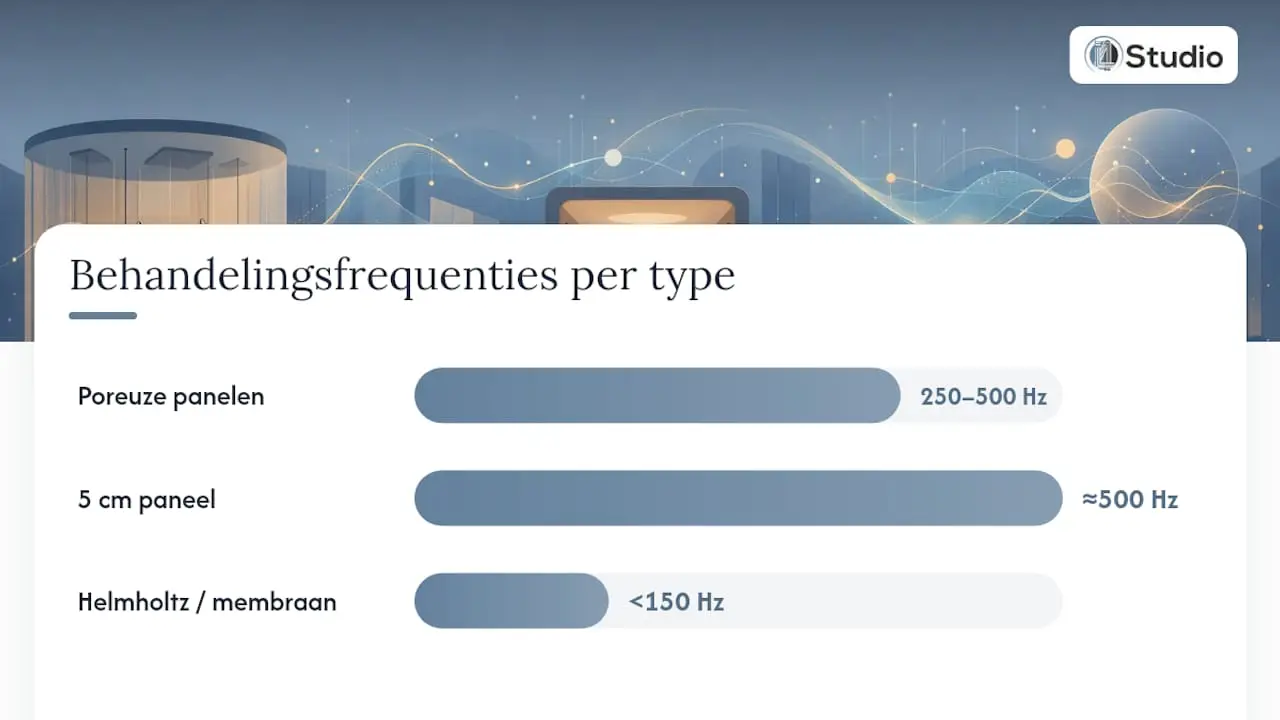
A calculated modal list is only useful if you know which type of absorption belongs where. For broad, high-energy problems in the low-frequency range, porous panels are often insufficient: tuned resonators or Helmholtz solutions work better in such cases, because they remove energy at a specific frequency without completely deadening the entire room.
Placement follows the physics of modes. Axial modes have their antinodes—the points of highest pressure—in the corners and against the walls. This makes placing bass traps in the corners more effective than placing a single panel in the middle of the room, and it explains why bass traps in the corners generally yield better results than the same amount of material spread across flat walls.
As a rule of thumb: the lower the frequency, the thicker or deeper your absorption material needs to be to remain effective. A 5-centimeter panel works well starting at around 500 Hz, but below 100 Hz, you’ll likely need a depth of 20 to 30 centimeters or a resonator to cover the same frequency range.
Design rule: When designing a new room, it is better to choose a ratio such as 1:1.28:1.54 rather than a cube or a simple 1:2 ratio. Classic Bolt-area ratios distribute the modal frequencies more evenly, which makes post-processing less burdensome.
Your listening position affects how much of a mode you hear, regardless of the treatment. If you’re standing exactly at an antinode, you’ll hear a loud sound. If you move your monitor or listening chair a few tens of centimeters, you can already end up in a quieter pressure zone. See also the guide on studio monitor setup for specific placement principles.
- Porous panels: suitable for frequencies ranging from approximately 250 to 500 Hz, depending on thickness.
- Helmholtz or membrane resonators: suitable for narrow, persistent peaks below 150 Hz.
- Corner placement: a priority for axial modes with their antinodes against the wall.
- Shifting the listening position: a free first step before ordering materials.
Checklist: From Measurement to Order
A modal calculation is only complete if it leads to concrete action, not to a spreadsheet that ends up in a drawer.
- Accurately measure the length, width, and height of the room, including any deviations caused by slanted walls or dropped ceilings.
- Calculate the axial modes for n = 1 to 3 per dimension using the quick calculation rule.
- Verify the most important modes with an REW measurement at the actual listening position.
- Prioritize the modes with the highest energy and the longest reverberation time in the waterfall plot.
- Order targeted treatment or seek advice from a supplier such as I4studio.
To ensure a meaningful assignment for an acoustics consultant, you should provide at least the three room dimensions, photos of the space including furniture, and, if possible, an REW measurement file. This allows the consultant to verify the calculations against the actual situation rather than making assumptions based on an empty room.
| Step | What You’ll Need | Result |
|---|---|---|
| Measuring | Laser distance measurer or measuring tape | Exact L, W, H |
| Calculate | Formula f = n·c/(2·dimension) | List of modal frequencies |
| Verify | REW, microphone, speaker | Measured peaks and waterfall |
| Treatment | Panels, resonators, installation | Smoother bass response |
Why Mathematical Models Rarely Tell the Whole Story
A formula assumes an empty, perfectly rectangular box. Your studio is never like that. Racks, a couch, a slanted wall, or a doorway can sometimes shift the actual resonance by a few hertz compared to your calculation, and practical studies confirm that calculated and measured peaks differ, especially above 120 Hz and in rooms that aren’t perfectly rectangular.
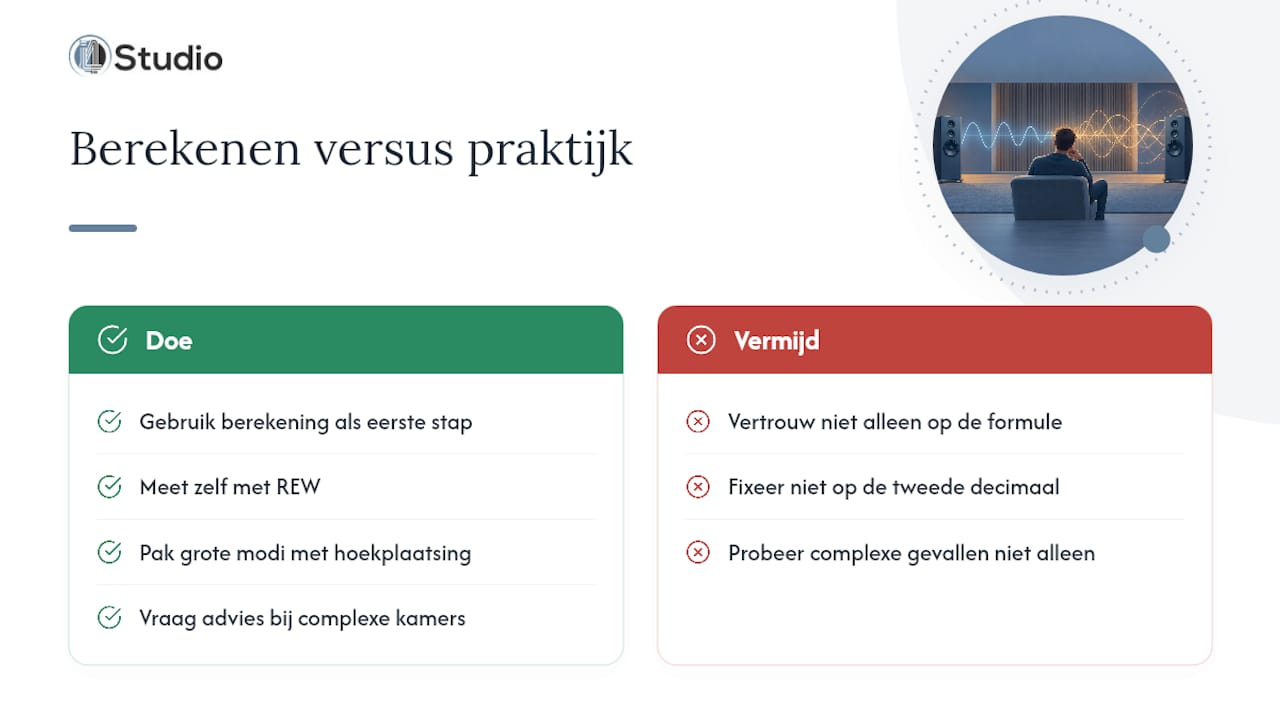
That’s not an argument against performing calculations. It’s an argument for viewing calculations as the first step, not the end goal. As long as you take your own measurements, verify them with REW, and address the largest modes using simple angle placement, you can get quite far without outside help.
Things get more complicated when dealing with irregularly shaped rooms, open connections to other spaces, or when your budget determines exactly how many panels you need. In those cases, practical experience with real materials and real rooms carries more weight than a second decimal place in your formula, and consulting with a service like I4studio’s acoustic panels is often faster than trying to figure it out on your own.
– harold
Acoustic Consulting and Ordering Panels from I4studio
Doing your own calculations and measurements with REW gives you a solid starting point, but determining the right panel, the right thickness, and the right location remains the most challenging part. I4studio combines expertise in high-quality equipment with hands-on advice on acoustics, ensuring that your calculated modal design is actually implemented.
Do you have your room measurements, a photo of the space, and—ideally—a REW measurement file? Include them when you request advice on acoustic panels, and you’ll receive tailored suggestions instead of generic tips. If you’d like to get started right away, browse our selection of acoustic panels or request advice through our website. If you’d rather build a complete recording studio, I4studio also offers Studio PCs starting at €1,099, custom-built for audio and video, along with audio interfaces and studio monitors to complete your setup.
Sources
For your own measurements, REW is the standard choice: free, accurate, and with built-in waterfall analysis. To quickly check formulas, use a room mode calculator based on Bolt-area ratios. For technical justification and validation of the limits of the calculation, consult the AES study on small spaces.
- REW Help (REWhelp.pdf)
- AcousPlan — Recording Studio Acoustic Design
- Room mode calculator & explanation (sengpielaudio)
- AES paper — Small rooms: room response analysis for acoustic design
Frequently Asked Questions
What exactly are room modes?
Room modes are standing waves that form between the walls, floor, and ceiling of a room and that either reinforce or cancel out certain low-frequency sounds. Axial modes between two surfaces are the strongest, followed by tangential and oblique modes, which are weaker, respectively.
How do I calculate room modes for my studio?
Measure the length, width, and height, and plug those values into the formula f = n·c/(2·dimension), where c is approximately 343 m/s. Repeat this for each dimension and for n = 1, 2, and 3 to find the first axial modes.
What is the Schroeder frequency, and why is it important?
The Schroeder frequency is the threshold above which modal peaks merge into a statistical sound field. Below that threshold, discrete, individually calculable modes dominate your sound image, and that is where you focus your treatment.
Why doesn’t my calculated mode match my measurement?
Furniture, sloped walls, and non-rectangular geometry shift the actual resonance relative to the theoretical formula. Research on small spaces confirms that deviations occur primarily above 120 Hz, which makes measurement with REW necessary in addition to the calculation.
Can I4studio help me choose the right panels?
Yes, I4studio provides recommendations on acoustic panels based on your room dimensions and measurements. You can find the current prices and product range on the acoustic panels page.