Room modes are resonances in your room that cause sound to build up at specific frequencies, resulting in bass coloration and an uneven frequency response. They occur when sound waves bounce back and forth between walls, reinforcing or canceling each other out at specific locations. Especially in small to medium-sized home studios, they result in bass that booms in one spot and virtually disappears in another.
Briefly:
- Room modes cause resonances that amplify bass in one area and attenuate it in another, especially at low frequencies below 100 Hz.
- Axial modes are usually the strongest and therefore the most disruptive in rectangular rooms with parallel walls, while tangential and oblique modes are less noticeable.
- The most effective way to detect problematic modes is to use long sine-wave sweeps and a measurement microphone, looking for frequencies that exhibit peaks or dips in multiple locations.
- Bass traps in the corners provide the most direct and noticeable improvement because they absorb the pressure peaks of axial modes, whereas EQ works effectively at only one measurement point.
- Small rooms with uniform proportions can be more challenging because modal peaks coincide, whereas the use of diffusers and the strategic placement of absorbers can make the response more even.
Table of Contents
- Causes and Types of Room Modes: Axial, Tangential, and Oblique
- How room modes sound and how they affect your mix
- Identifying room modes yourself using listening tests and measurement equipment
- The formula for modal frequencies and a calculation example
- Treatment options: bass traps, placement, and the limits of EQ
- Checklist: Measure, Locate, Treat, Verify
- How We Help Home Studios with Measurement Data and Acoustic Solutions
- Room dimensions and proportions: why they influence room modes
- Graphs and measurement visualizations that provide insight into room modes
- Room modes in a home studio versus a listening room or concert hall
- Advanced measurement methods for those who want to measure more thoroughly
- Interpreting Measurement Results and Identifying Problematic Frequencies
- The Effect of Furniture and Obstacles on Room Modes
- Brand Perspective: Room Design Is Often More Important Than Hardware
- Getting Started with Acoustic Consulting and Panels
- Frequently Asked Questions
- Sources
Causes and Types of Room Modes: Axial, Tangential, and Oblique
When a sound wave hits a wall, it bounces back and meets the next wave that is just starting to travel. At certain frequencies, these waves reinforce each other at exactly the same spot—an antinode—while at other spots, the nodes, they cancel each other out. We call this pattern a standing wave, and the room itself determines at which frequencies this occurs.
Acousticians distinguish three types of modes, depending on how many surfaces are involved:
- Axial modes occur between two opposing surfaces, such as the front and rear walls.
- Tangential modes involve four surfaces, such as the floor, ceiling, and two side walls.
- Oblique modes run diagonally and touch all six surfaces of the room.
Of these three, axial modes are usually the most audible, because they lose the least energy and resonate most strongly in a rectangular room with parallel walls. According to Inside Audio, axial modes are often considered the main problem in practice, while tangential and oblique modes are less pronounced and require less attention.
How room modes sound and what they do to your mix
A room with pronounced room modes rarely sounds neutral at the listening position. You can recognize this by a few typical symptoms:
- A bass that sounds “boomy” or bloated in some places, while it almost disappears a meter away.
- Low frequencies that linger longer than the rest of the mix, causing bass notes to bleed into one another.
- Instruments such as the kick drum and bass guitar that sound inconsistent from different listening positions within the same room.
This is closely related to a room’s reverberation time, the RT60. For small rehearsal and recording rooms, acoustic studies recommend an RT60 of approximately 200 to 400 milliseconds, but room modes fall outside that general guideline because they specifically affect low frequencies that are more difficult to control with standard acoustic panels. That’s exactly why low frequencies require their own approach, separate from the rest of your acoustic treatment.
Identify room modes yourself using listening tests and measuring equipment
You don’t need a professional lab to identify your own room modes. With just a few simple steps, you can already pinpoint the biggest problem areas.
- Play a slow sine wave sweep ranging from about 20 to 200 Hz and walk around the room, or move your head at the listening position: you’ll hear peaks where the bass swells and dips where it fades away.
- Use white noise in combination with a real-time analyzer (RTA) to get a broader picture of which frequencies are consistently too loud or too soft.
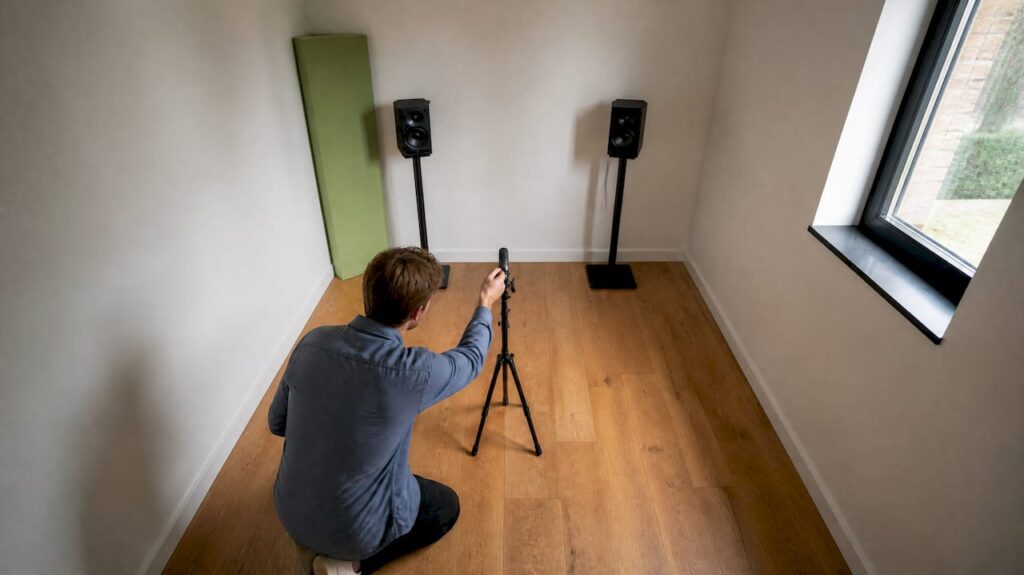
- Take measurements at multiple points, not just at your mixing position: three to six measurement locations provide a much more reliable picture of how modes propagate throughout the room.
- Compare the results side by side and look for frequencies that appear at virtually every measurement point: those are your dominant modes.
Free software such as REW (Room EQ Wizard), when used with a measurement microphone, provides a much more accurate picture than a smartphone app, whose built-in microphone often has an uneven frequency response and underestimates low frequencies.
Pro tip: Always measure with the monitors in their final positions and in the final room configuration, because any movement of furniture or speakers shifts the modal peaks.
The formula for modal frequencies and a calculation example
If you want to know exactly which frequencies will cause problems, you can calculate them using the classic modal formula that is also used in MIT’s acoustics courses:
fn = (c/2) × √((nx/Lx)² + (ny/Ly)² + (nz/Lz)²)
Here, c is the speed of sound (approximately 343 meters per second), Lx, Ly, and Lz are the length, width, and height of the room in meters, and nx, ny, nz are integers indicating the order of the mode. For a first axial mode along one axis, simply enter n=1 for that axis and n=0 for the other two.
Take, for example, a typical home studio measuring 4.0 × 3.5 × 2.5 meters, where modal frequencies can be calculated using the modal formula, which may show deviations in practice.
These first-order modes (n=1) are usually the most important ones to measure and address, because they carry the most energy and are the easiest to hear. For everyday use, rounding to a whole number is more than accurate enough.
Treatment Options: Bass Traps, Placement, and the Limits of EQ
A good approach always starts at the corners of your room. That’s where the peak pressure levels of most axial modes converge, which explains why bass traps placed in the corners typically provide the fastest and most noticeable improvement, as Dr. Russell’s acoustic animations also demonstrate.
- Start by placing porous absorbers at least 10 to 15 centimeters thick in the vertical corners, where one wall meets another.
- Experiment with the placement of your monitors and subwoofer: shifting them by just a few centimeters can significantly reduce a peak.
- Consider placing multiple subwoofers in strategic locations: research on multiple subwoofers shows that they can reduce differences between listening positions through destructive interference, although this does not automatically eliminate the very lowest modes.
- Do not install diffusion on the rear and side walls until the low-frequency issues have been addressed with absorption, because diffusion does not resolve modal resonances.
EQ may seem like a quick fix, but it only corrects the sound at the specific listening position you set it for. If you move even a step to the side, the problem often reappears or becomes even more pronounced, simply because EQ doesn’t eliminate the physical wave interference.
Pro tip: Combine two or three thinner absorbers in a corner instead of a single thick panel: this will capture a wider frequency range than a single layer.
Checklist: Measure, Locate, Treat, Verify
A structured approach prevents you from hanging panels at random without achieving any results.
- Measure: Perform a sine sweep and an RTA measurement at three to six points in the room, using the same settings for each measurement.
- Locate: Note the frequencies at which peaks and dips recur, and move your speaker or listening position to find the most sensitive areas.
- Treat: Start by placing bass traps in the corners, adjust the placement of your monitors and subwoofer, and only then add additional absorption or diffusion.
- Verify: Repeat the same sweep and compare the new measurement with the old one to see if the peak has actually been smoothed out.
Repeating this process after every change prevents you from investing in materials that won’t be very effective in your specific room.
How We Help Home Studios with Measurement Data and Acoustic Solutions
When it comes to questions about acoustic panels, we prefer to work with specific measurement data: a sweep measurement, room dimensions, and ideally a photo of the space provide us with enough information to offer targeted advice on acoustic panels. Often, room treatment turns out to be the most cost-effective improvement—even before considering new equipment. If you’re just starting to plan the layout of a room, you’ll find practical ideas in our home studio design tips.
Room Dimensions and Proportions: Why They Affect Room Modes
The dimensions of your room directly determine which frequencies become problematic, and the ratio between length, width, and height plays a major role in this. If two or three dimensions are (nearly) equal, multiple modes coincide at the same frequency. This is called modal degeneration, and it greatly amplifies the problem at that specific frequency instead of dispersing the energy.
A square room measuring, for example, 4 by 4 meters is therefore acoustically more challenging than a rectangular room with unequal proportions, simply because the axial modes of length and width coincide exactly. Acousticians have therefore been using aspect ratios (such as 1 : 1.28 : 1.54) for decades as a rule of thumb to distribute modes more evenly across the frequency spectrum, so that no single frequency becomes extremely dominant.
In practice, you can rarely adjust the room itself, but it’s helpful to know why two rooms with similar floor areas can sound completely different. For example, a low ceiling height often results in an audible mode around 60 to 90 Hz, while a longer room shifts that mode to a lower, less intrusive frequency. If you know your room has unfavorable proportions, that’s a sign to invest a little more in targeted bass traps rather than hoping that standard solutions will suffice.
Charts and measurement displays that provide insight into room modes
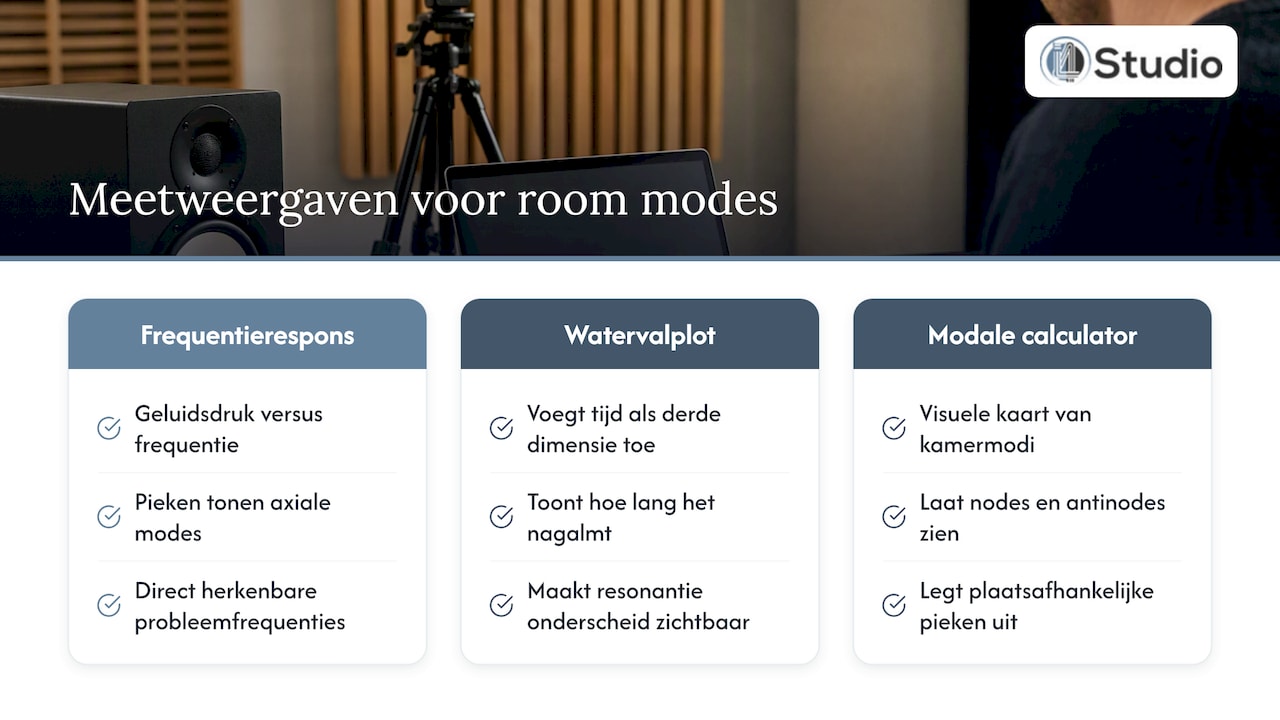
A frequency response graph is the most direct tool for understanding room modes. On such a graph, you can see the measured sound pressure plotted against frequency, and a peak of a few decibels around, say, 45 Hz immediately stands out as an axial mode.
A waterfall plot adds a third dimension: time. This allows you to see not only which frequencies are too loud, but also how long they continue to reverberate after the signal has already stopped. This distinguishes between a frequency that is simply too loud and one that is actually resonating and reverberating—which is precisely the problem with room modes.
Modal analysis tools, such as online calculators that automatically apply the formula from the previous section, often provide a visual map of the room showing the locations of nodes and antinodes for each mode. This helps explain why a measurement at one location shows a peak, while a measurement half a meter away shows a dip.
For those who work with REW, combining a frequency response graph with a waterfall plot is the most practical way to see at a glance which modes require attention and which ones disappear on their own as soon as you adjust the placement.
Room modes in a home studio versus a listening room or concert hall
The physics behind room modes do not change depending on the type of room, but their impact does. In a home studio measuring perhaps 15 to 20 square meters, the first axial modes often fall right in the middle of the musically relevant bass range—between 40 and 100 Hz—exactly where kick drums and bass guitars live. That makes small rooms acoustically vulnerable.
A larger listening room, ranging from 25 to 40 square meters, shifts those same modes to lower frequencies—often below 40 Hz—where they interfere less with musical information and are less likely to be perceived as distracting. The density of modes per frequency band also increases as the room gets larger, which makes the response smoother and more even above a certain threshold frequency.
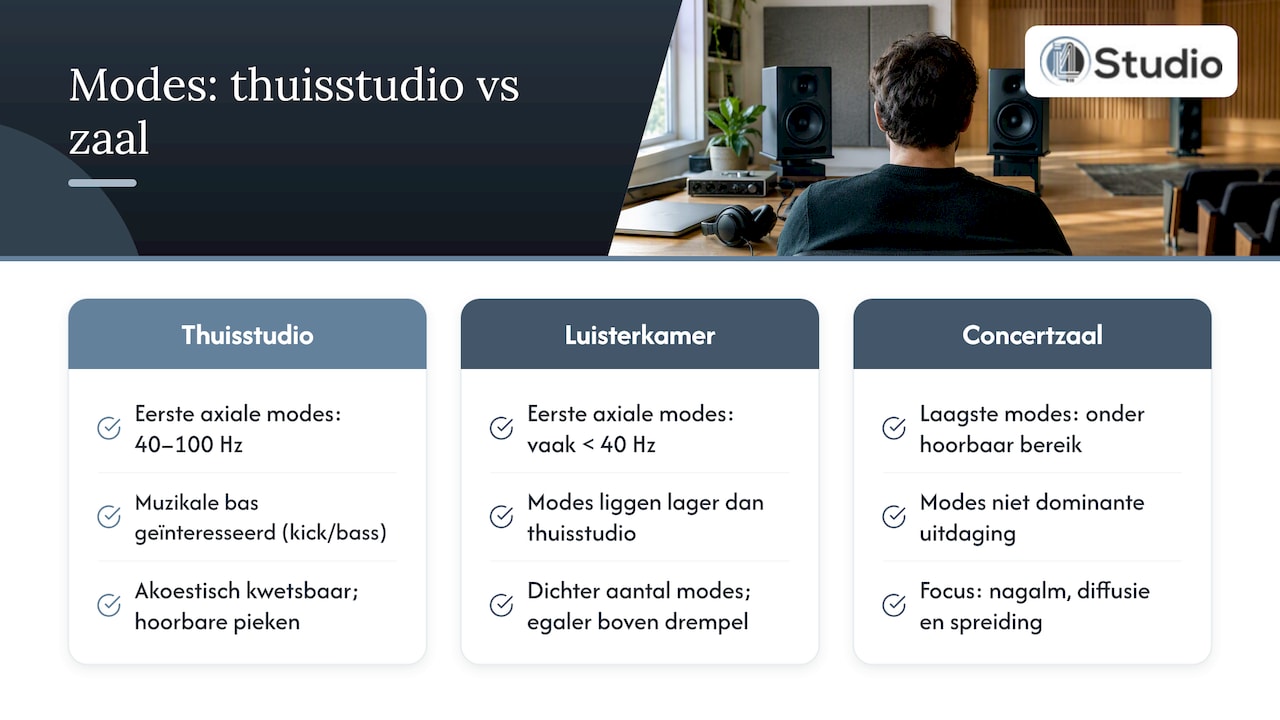
A concert hall is in a completely different category: due to its enormous size, the lowest axial modes lie well below the audible range, and the acoustic challenge shifts to reverberation, diffusion, and the distribution of sound across a large audience rather than individual modal peaks. If you compare this to a home studio, it becomes clear exactly why small spaces are so sensitive: there is simply not enough volume to push the lowest modes outside the audible range.
Advanced measurement methods for those who want to measure more thoroughly
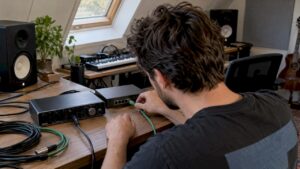
For those who want to go beyond a simple sweep with a smartphone, a calibrated measurement microphone is the next logical step. When combined with an audio interface and measurement software such as REW, this provides a much flatter and more reliable recording of what’s actually happening in the room, without the distortion that a built-in phone microphone often introduces in the low-frequency range.
Professional analysis typically combines multiple measurements: a sine sweep for an accurate frequency response, an impulse response measurement to assess reverberation and decay, and measurements at multiple positions to map seat-to-seat variance. Averaging these measurements provides a more realistic picture than a single measurement taken at the mixing position.
If you’re using your own audio interface, you can use the same equipment you already have in your studio: a suitable audio interface combined with a measurement microphone is sufficient for most home studio measurements. For those who regularly perform acoustic analysis, it’s worth sticking to a consistent measurement routine so that results from before and after an adjustment can be fairly compared.
Interpreting Measurement Results and Identifying Problematic Frequencies
A raw frequency graph doesn’t tell you much without context. The first thing to look for are peaks of about 6 decibels or more above the average level: those are the frequencies that your ear will perceive as disruptive or overpowering. A dip is harder to correct than a peak, because you can’t simply absorb a missing frequency.
Next, note how long a frequency continues to ring out after the test signal has stopped. A peak that decays quickly is less disruptive than one that lingers for seconds, even if both are equally loud at the moment of the measurement itself. The latter indicates a strong modal resonance that requires physical correction.
Also compare your different measurement locations with one another. If the same peak reappears at every point in the room, you’re dealing with a dominant axial mode that affects virtually the entire space. If a peak appears in only one spot, it’s more likely a local reflection that you can correct with targeted absorption at that specific spot, without having to address the rest of the room.
The Effect of Furniture and Obstacles on Room Modes
Furniture never changes the fundamental natural frequencies of a room, because those are determined by the room’s dimensions. However, it does influence how strongly a mode manifests itself at a specific listening position, and that makes furniture an underrated tool for controlling bass.
A bookshelf filled to capacity against a wall acts as an irregular surface that partially scatters and absorbs low-frequency energy, especially when it is filled with books of varying thicknesses. An empty room with bare walls and a hard floor, on the other hand, amplifies virtually every mode, because there is nowhere for the energy to be dissipated.
Furthermore, a sofa or desk placed directly in a corner blocks the space where a bass trap would be most effective, so when planning an acoustic treatment, it’s wise to first determine which corners are open enough to accommodate a panel. A heavy carpet with a backing helps control higher frequencies and early reflections, but has little effect on the low modal frequencies, which require thicker, porous absorbers.
Brand Perspective: Room Design Is Often More Important Than Hardware
A more expensive monitor won’t fix a modal peak. Acoustic treatment, guided by actual measurements, typically yields a more audible improvement than a hardware upgrade in an untreated room.
– harold
Getting Started with Acoustic Consulting and Panels
If you recognize the symptoms described in this article in your own room, then it’s time to look beyond EQ and rearranging furniture. For tailored advice on acoustic panels, we prefer to work with your sweep measurement, room dimensions, and a photo of the space, so we can propose a solution that matches your specific modal profile rather than a standard package.
If you’re still unsure about which panels you need or would like to have your entire setup evaluated first, check out our full selection on I4studio and contact us for a personalized consultation.
Frequently Asked Questions
What exactly are room modes, in simple terms?
Room modes are standing waves that occur when sound bounces back and forth between walls and amplifies itself at specific frequencies. They cause bass to rumble in one spot and virtually disappear in another.
Can I completely eliminate room modes with EQ?
No, EQ only corrects the frequency response at a single measurement point and does not resolve the underlying wave interference. If you move just one step, the problem often returns, which is why physical treatment with bass traps is more effective than EQ alone.
Which frequencies are typically most affected by room modes?
In an average home studio, the first axial modes usually fall between 40 and 100 Hz, calculated using the modal formula fn = (c/2) × √((nx/Lx)² + (ny/Ly)² + (nz/Lz)²) from the MIT lecture notes. This is precisely the range where kick drums and bass guitars are most active.
Do multiple subwoofers help counteract room modes?
Multiple subwoofers placed in strategic locations can reduce differences between listening positions in the room through destructive interference, as research on multiple subwoofers shows. However, this does not completely eliminate the lowest modes, which often still require physical absorption.
Where should I start if I want to tackle room modes on my own?
Start by taking a sweep measurement at multiple points in the room to pinpoint the problematic frequencies, and then place bass traps in the vertical corners where the modes are strongest. Russell](https://www.acs.psu.edu/drussell/Demos/RoomModes/driving.html) is usually the quickest and most effective first step.
Sources
- How Sound Works in Your Room — insideaudio
- MIT 21M.380 Room Acoustics and Reverberation (session notes)
- Driving Room Modes — Dr. Russell’s Acoustics Animations
- WhyMultipleSubs? (Welti)
- Room Acoustics for Small-Scale Rehearsal Rooms for Pop and Rock Music