
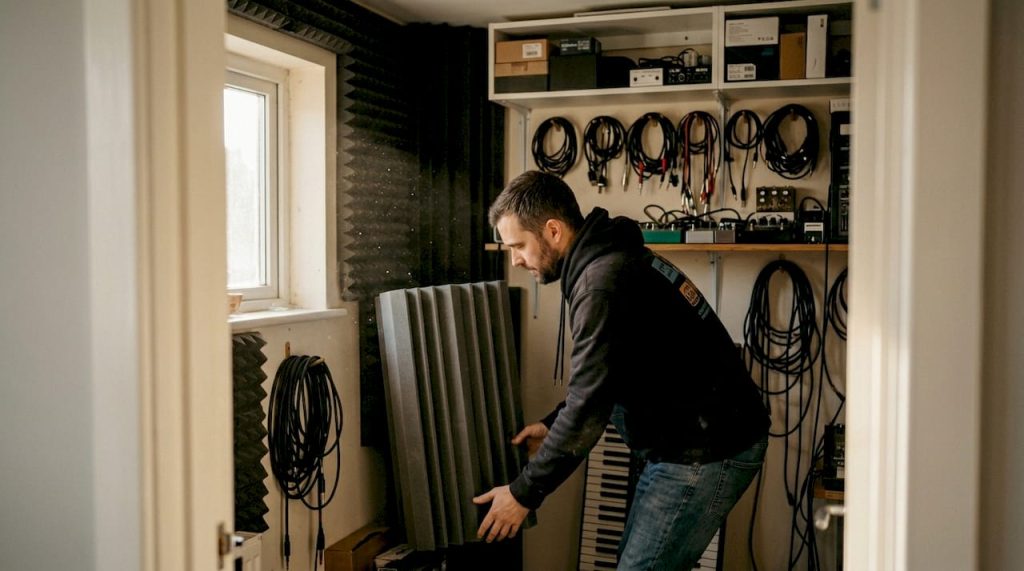
Many producers think acoustic panels are enough for a professional studio, but forget the biggest problem: low-frequency resonances. These standing waves distort your bass, make accurate mixing impossible and cause tracks that sound perfect at home to be completely out of balance elsewhere. Bass traps absorb low-frequency sound and are the only effective solution to these problems. This article explains why bass traps are essential, how they work technically, what mistakes to avoid and how to place them optimally for a studio that finally sounds honest.
Table of contents
- Key takeaways
- What are bass traps and why are they important
- How bass traps work in your studio: technical explanations and effects
- Common mistakes and how to avoid them when using bass traps
- Practical tips for choosing and placing bass traps in your studio
- Enhance your studio with professional bass traps from i4studio
- Frequently asked questions about bass traps
Key Insights
| Item | Details |
|---|---|
| Bass traps essential | Low-frequency resonances cause standing waves and distorted bass, making mixes sound inaccurate. |
| How bass traps work. | They convert sound energy into heat through friction between air and fibers to better attenuate low frequencies. |
| Placement in corners | Corners are the most efficient locations because pressure zones converge and a single stage in a corner is often more effective than multiple panels scattered along a wall. |
| Measure space first | Before purchasing bass traps measure space with software such as REW to determine which low frequencies are problematic and how much absorption is needed. |
| Thickness determines effect | For about 100 Hz, you need at least 10 to 15 cm of thickness and lower frequencies require 20 to 30 cm or more. |
What are bass traps and why are they important
Bass traps are specialized acoustic elements that specifically absorb low-frequency sound, usually below 300 Hz. Normal acoustic panels work fine for mid-high and high frequencies, but low frequencies have much longer wavelengths and require thicker, denser materials to be effectively attenuated. Without bass traps, low frequencies accumulate in corners and along walls, create standing waves and make certain notes much louder or quieter than others.
Low-frequency problems manifest themselves in different ways. You may hear thumping bass in certain areas of the room, while that same bass is barely audible in other areas. This is due to modal resonances, where specific frequencies are amplified or cancelled out by the dimensions of your space. The result is that you make decisions based on a distorted picture, leading to mixes that sound completely different on other systems. Basic principles of acoustics explain how these phenomena occur.
There are several types of bass traps, each with specific characteristics:
- Porous absorbers such as mineral wool or acoustic foam work by air friction and convert sound energy to heat
- Resonant absorbers use air cavities and membranes to target specific frequencies
- Pressure-based traps place material at points where air pressure is maximum, usually in corners
- Hybrid designs combine multiple principles for broadband absorption
Pro-tip: always measure your space with software such as REW (Room EQ Wizard) before purchasing bass traps. This will show exactly which frequencies are problematic and how much absorption you need, saving you money and maximizing effectiveness.
The thickness of bass traps largely determines their effectiveness. For frequencies around 100 Hz, you need at least 10-15 cm thickness, while even lower frequencies require 20-30 cm or more. Thin panels of 5 cm that claim to absorb bass are usually marketing without substance. The density of the material also plays a role: too light and it does not absorb enough, too heavy and it reflects rather than absorbs.
How bass traps work in your studio: technical explanations and effects
The physics behind bass traps revolve around converting sound energy. When a sound wave moves through porous material, air molecules rub along the fibers. This friction converts kinetic energy to heat, weakening the wave. For low frequencies with their long wavelengths, the wave must be able to penetrate deep enough into the material to experience sufficient friction, hence the need for thick traps.
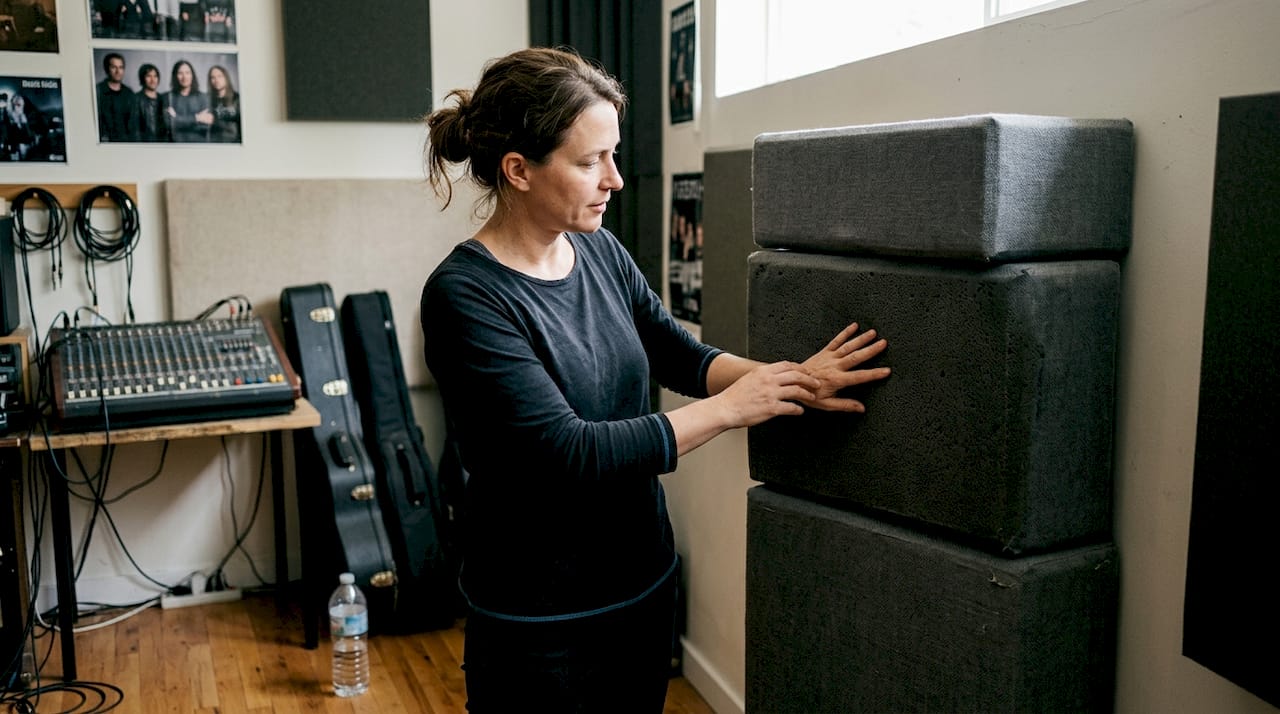
Corners are the most effective locations because pressure zones converge there. Standing waves create points of maximum pressure (nodes) and minimum pressure (antinodes). In rectangular spaces, pressure nodes always coincide in corners, making one bass trap in a corner much more effective than that same trap in the middle of a wall. Bass traps improve your studio acoustics offers visual examples of this placement.
The impact on your sound quality is measurable and audible:
- Reduction of resonance time: low frequencies do not persist indefinitely, making bass tighter and more defined
- Flatter frequency response: problematic peaks and valleys are equalized so that each note has equal energy
- Improved stereo image: less reflections means you can better distinguish left and right
- Reliable mix decisions: what you hear matches what’s actually in your track
“Placing enough bass traps prevents you from suffering from unbalanced bass and poor mix results. Many engineers underestimate how much absorption is really needed and end up with half-hearted results that barely make a difference.
”
To determine the optimal amount, follow these steps:
- Measure your space with a microphone and analysis software to identify problematic frequencies
- Calculate the total volume of your space and aim for 15-25% acoustic treatment for low frequencies
- Start with all corners, then first reflection points on walls behind speakers
- Re-measure after each addition to verify progress
- Stop when the frequency response remains within 10 dB variation across the spectrum
The mistake many make is placing too few traps for fear of making the room too dead. In reality, it is almost impossible to overpower a small to medium-sized studio with bass traps because low frequencies contain so much energy. You would have to fill the entire room with absorption material before it becomes problematic.
Common mistakes and how to avoid them when using bass traps
Indeed, the most common mistake is using too few bass traps. Producers often buy two or four traps, place them in corners and expect miraculous results. One of the most common mistakes is using too few bass traps, which exacerbates the sound problem by giving you a false sense of improvement while fundamental problems persist. For an average bedroom studio, you need at least 8-12 substantial bass traps to make a noticeable difference.
Improper placement sabotages even quality traps. Many people hang bass traps flat against walls like normal panels, but this is ineffective for low frequencies. Bass traps should be mounted in corners where pressure is maximum, or away from walls to create absorption behind the panel as well. A stage hanging 5 cm from the wall absorbs lower frequencies than the same stage flat against the wall.
Other critical errors:
- Buy thin traps that physically do not have enough mass to absorb bass
- Letting aesthetics alone determine where traps come instead of acoustic necessity
- Expect bass traps to also provide sound insulation, which are two completely different concepts
- Ignoring sound attenuation in studio and focusing only on absorption
- Not measuring after installation, so you don’t know if your investment is having an effect
Quality of materials makes a huge difference. Cheap acoustic foams compress over time and lose effectiveness. Mineral wool such as rock wool or glass wool retains its structure for decades and offers superior absorption per inch of thickness. Dutch suppliers such as i4studio and Perfect Acoustic offer products specifically tested for our climate conditions and meet fire safety requirements.
Pro-tip: always measure your room acoustics with free software before you start buying and installing traps. A measurement will cost you an hour but will save you hundreds of dollars in wrong purchases. You’ll see exactly which frequencies are problematic, how bad the problems are and can track progress objectively.
A subtle but important mistake is forcing symmetrical placement. Many people want their studio to look neat with identical treatment on the left and right. But if your space is asymmetrical or furniture is unevenly spaced, effective acoustics often require asymmetrical placement. Function should always take precedence over form.
Practical tips for choosing and placing bass traps in your studio
When selecting bass traps, there are several materials and designs to choose from, each with specific advantages and disadvantages:
| Bass trap type | Advantages | Disadvantages | Best for |
|---|---|---|---|
| Mineral wool (rockwool) | Excellent absorption, durable, affordable | Heavy, dust on installation | Corners, behind speakers |
| Acoustic foam | Light, easy to assemble | Limited low frequency absorption, degrades | Complements other traps |
| Resonant absorbers | Target specific frequencies effectively | Expensive, complex construction | Persistent modal problems |
| Hybrid panels | Wide frequency range | Higher cost | Small areas with limited space |
For placement, corners are always priority number one. Start with all four vertical corners from floor to ceiling. If budget is limited, focus on the corners behind your speakers and behind your listening position. These six points (four corners plus walls directly behind speakers) make 70-80% of the difference.
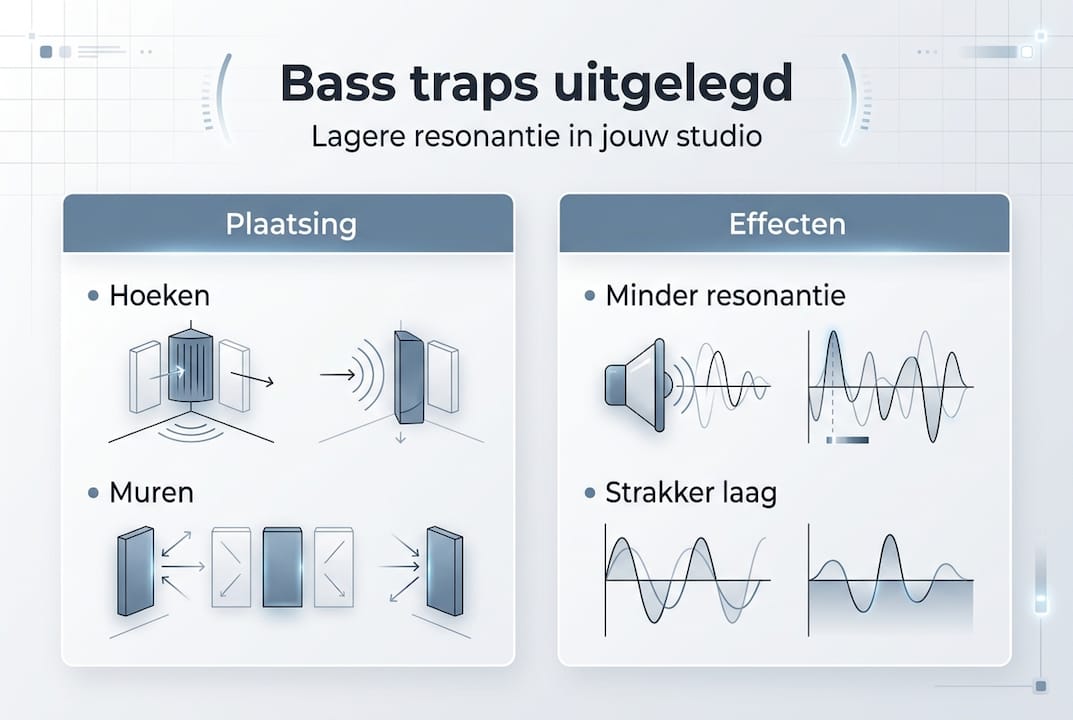
The thickness and distance from the wall determine which frequencies are absorbed. A rule of thumb: to effectively absorb a frequency, the stage must be at least a quarter wavelength thick. For 100 Hz (wavelength 3.4 meters), this means 85 cm, which is impractical. Therefore, you work with thicker materials (20-30 cm) away from the wall, increasing the effective thickness.
Checklist for purchase and installation:
- Determine your budget and prioritize corners over wall treatment
- Choose materials with at least 60 kg/m³ density for effective бас absorption
- Check fire safety ratings, especially for commercial studios
- Measure available space in corners and plan stairway dimensions accordingly
- Ensure sturdy mounting, heavy bass traps require robust mounting
- Schedule ventilation, full corner treatment can affect airflow
- Measure before and after installation to verify effectiveness
Local suppliers like i4studio offer quality bass traps appropriate for Dutch studios, with advice on optimal configurations for your specific space. They understand the acoustic challenges of typical Dutch homes with concrete floors and drywall walls.
For home studios in rental properties where permanent installation is not possible, consider:
- Freestanding corner stairs that stand on their own weight
- Modular systems you take with you when you move
- Temporary mounting with strong double-sided tape or clamps
- Furniture such as bookcases filled with absorption material in strategic corners
Best products for home studio acoustics offers specific product recommendations for different budgets and spaces. Remember that setup studio acoustics encompasses more than just bass traps, but bass traps are the foundation upon which other treatment builds.
Enhance your studio with professional bass traps from i4studio
Now that you understand how crucial bass traps are for reliable mixes, the next step is to implement this knowledge in your studio. i4studio offers complete solutions for studio acoustics, from individual bass traps to complete acoustic packages perfectly suited to Dutch production studios.

Whether you’re setting up a compact home studio or optimizing a professional production space, i4studio’s expertise in studio set and recording bundle ensures you get the right combination of bass traps, acoustic panels and diffusers. Their specialists will help you determine what do I need to improve studio acoustics based on your space dimensions, budget and production goals. Check out home studio acoustics products for concrete options that deliver immediate results.
Frequently asked questions about bass traps
What exactly do bass traps do in a studio?
Bass traps absorb low-frequency sound below 300 Hz to eliminate standing waves and modal resonances that otherwise distort your bass reproduction. They ensure that every note has equal energy and that your mixing decisions are reliable on all playback systems.
Where do you best place bass traps for maximum effect?
Always start with the four vertical corners of your room from floor to ceiling because that’s where pressure zones converge. Then treat the walls directly behind your speakers and behind your listening position for the greatest impact on sound quality.
Can I make bass traps myself or should I buy them?
You can make effective bass traps yourself with rock wool, wooden frames and acoustic cloth. This saves 40-60% cost compared to ready-made products. Just make sure you have correct density (at least 60 kg/m³) and sufficient thickness (20-30 cm) for real бас absorption.
What are the most common mistakes made with bass traps?
Placing too few traps is mistake number one, followed by choosing materials that are too thin and do not physically have enough mass. Other mistakes include flat wall mounting instead of corner placement and not measuring after installation to verify effectiveness.
How do I know how many bass traps I need?
Measure your space with software such as REW to identify problematic frequencies. As a rule of thumb, aim for 15-25% of your floor area to be басabsorbed. For a 4×4 meter space, this means 2.4-4 square meters of bass traps, usually 8-12 corner traps.
Do bass traps make my studio too dead or lifeless?
No, it is almost impossible to overpower a small to medium-sized studio with bass traps. Low frequencies contain so much energy that you would have to fill the entire room before it becomes problematic. Bass traps actually make your space brighter and more defined.
Recommendation
- How Bass Traps Improve Your Studio Acoustics – https://i4studio.nl/
- The Best Products for Acoustics in a Home Studio – https://i4studio.nl/
- Studio Acoustics Improvement: Practical Guide For Professional Sound Spaces – https://i4studio.nl/
- Noise Reflection Reducing Tips: Practical Strategies For A Professional Studio – https://i4studio.nl/