The switch from an Intel Core i9-14900K to an Intel Core Ultra 9 (such as the Ultra 9 285K on the Arrow Lake platform) offers a number of fundamental advantages for a DAW (Digital Audio Workstation). Although both processors have 24 cores (8 Performance cores and 16 Efficiency cores), the underlying architecture has changed significantly.
The main advantages of the Ultra 9 over the 14900K for music production are:
1. Drastically lower power consumption and less heat (Studio Silence)
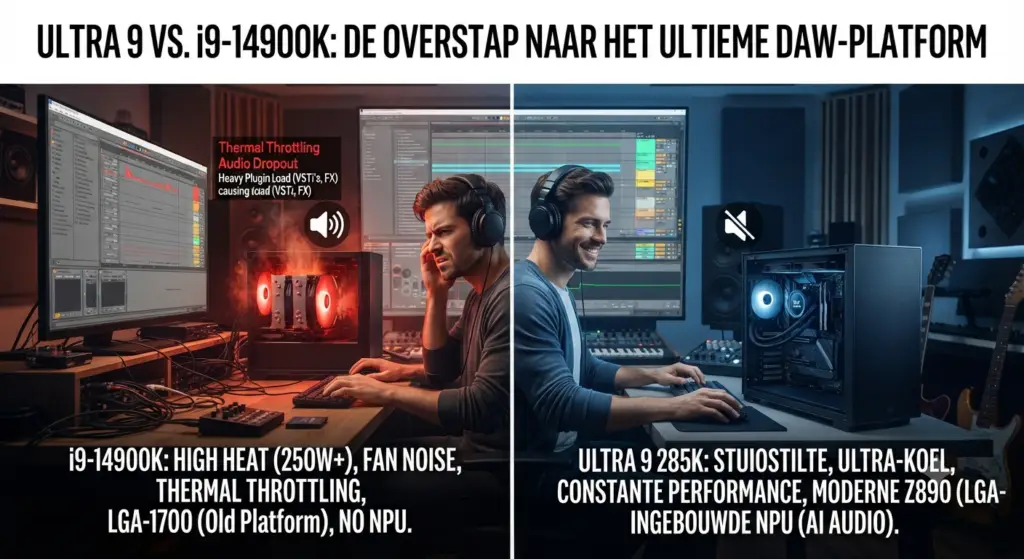
The problem with the 14900K: This processor is known for consuming an enormous amount of power (often well over 250W under full load) and getting red-hot as a result. This forces your cooling system to run at high speeds, causing disruptive fan noise in the studio.
The advantage of the Ultra 9:Thanks to the more efficient 3nm process, the Ultra 9 consumes significantly less power while delivering comparable or better performance. As a result, the processor stays much cooler, your coolers don’t have to work as hard, and you’ll enjoy a much quieter DAW PC while recording and mixing.
2. More stable performance under sustained load (No Thermal Throttling)
Because the 14900K gets so hot, during prolonged, (such as rendering large tracks or loading your project with heavy VSTi’s and convolution reverbs), thermal throttling occurs more quickly, causing the processor to slow itself down to cool off.
The Ultra 9 maintains its clock speeds and performance much more consistently during long, intensive sessions because its thermal management is better optimized.
3. A modern and future-proof platform (LGA-1851)
The i9-14900K uses the older LGA-1700 socket, a dead-end platform for which no new processor generations are being released.
The Ultra 9 uses the LGA-1851 platform (Z890 chipset). This motherboard platform offers better support for faster DDR5 memory configurations, higher memory bandwidth, and improved I/O capabilities (such as more and faster M.2 NVMe slots for all your massive instrument and sample libraries).
4. Built-in NPU for AI audio tools
The Core Ultra series features an integrated NPU (Neural Processing Unit). More and more modern plugins (for intelligent noise reduction, vocal separation, automatic EQ, and advanced mastering assistants, for example) use machine learning. The NPU can take these specific tasks off your CPU, leaving it with more processing power for your regular audio tracks and virtual instruments.
5. Low-Latency Audio Performance
Thanks to the improved IPC (Instructions Per Clock) and the more efficient task distribution between the P and E cores, the Ultra 9 performs exceptionally well with tight buffer settings (such as 32 or 64 samples). This is crucial when playing virtual instruments live via a MIDI keyboard or monitoring audio in real time through your audio interface without audible latency or audio glitches (dropouts).
Conclusion
If you look purely at raw computing power for audio, the 14900K and the Ultra 9 are very close. But the Ultra 9 comes out on top in areas that are incredibly important in a music studio: lower power consumption, significantly less heat generation (meaning a quieter PC), a more modern platform with better memory options, and better support for modern AI audio plugins.