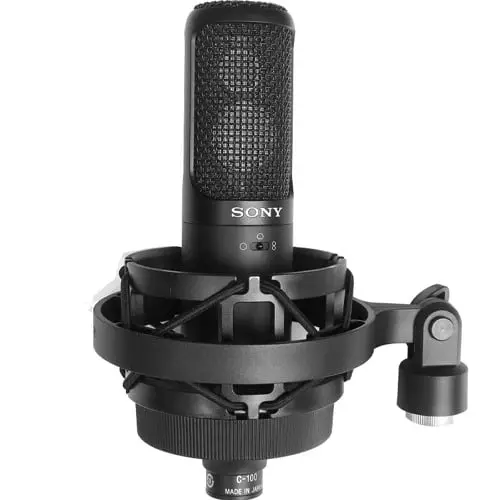
Sony C-100 Condenser Microphone
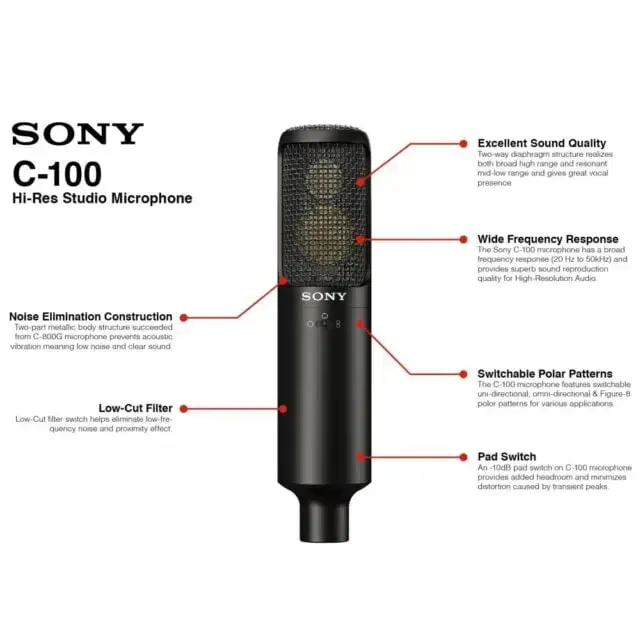
However, the Sony C-100 studio microphone is not just a budget C-800G, but a completely new microphone design, with its own technological advancements and a staggering frequency response up to 50 kHz.
To achieve this, Sony equipped the C-100 with two capsules, placed one above the other, in the same manner as the design of the woofer and tweeter of a standard two-way speaker.
The large-diaphragm primary capsule is configured to do most of the work, capturing audio from 20Hz-25kHz, while the secondary capsule, a small-diaphragm design with rear electret, captures the ultrasonic audio from 25kHz-50kHz.
By pushing the crossover to 25 kHz, the Sony C-100 ensures that the higher noise floor of the small-diaphragm capsule is limited to just the very high frequency range, while most of the work is done by the quieter, large-diaphragm capsule. diaphragm.
In addition, pushing the crossover frequency into the ultrasonic range pushes any artifacts caused by the crossover into this range as well.
That said, the value of capturing audio so far beyond the reach of human hearing is up for debate, especially if that audio is then stored in a digital file with a sample rate of 44.1 kHz that, even with ideal filters , can’t represent audio past the Nyquist value (22.05 kHz).
The primary capsule of the Sony C-100 can be switched from cardioid to omni or eight, while the secondary capsule is always in cardioid. This isn’t too much of a problem, though, as frequencies in this range are quickly absorbed into the air, meaning only direct signals from the source will likely reach the capsule.
- Sony C-100 Condenser Microphone Specs
- Double capsule design
- 20Hz-50kHz Frequency Response
- Cardioid, Omnidirectional and Eight-to-Eight Patterns
- Switchable high-pass filter
- Switchable -10dB pad