
A reliable studio equipment cost estimate starts with a clear picture of exactly what the studio is supposed to do: record, mix, film or live broadcast. For audio professionals, musicians and content creators, it’s essential to look not only at acquisition costs, but also at performance, compatibility and future expansion options. This guide provides a step-by-step approach, realistic price indications, real-world examples and smart savings strategies so that one can make an educated investment decision.
Why a Detailed Cost Estimate Is Essential
A cost estimate prevents surprises. Without a solid budget, unforeseen expenses such as additional cabling, acoustic treatment or licensing fees are quickly around the corner. One does not want costly delays during a recording project because an important interface proved incompatible, or because the workstation CPU could not handle a heavy plugin or render load.
A good cost estimate also provides direction on priorities: which items to request immediately, and which can be deferred? For professionals who want to spend money where it pays the most – think latency-free monitoring or stable real-time performance – a well-founded cost estimate is the foundation of any studio approach.
What Does “Studio Equipment” Cover?
The term studio equipment includes much more than microphones and speakers. Concrete categories include:
- Audio hardware: microphones, preamps, audio interfaces, monitors, headphones, DI boxes.
- Computers and servers: DAW workstations, render and broadcast machines, storage servers.
- Software: DAW licenses, plugins, virtual instruments, video editing software.
- Acoustics and handling: absorbers, diffusers, bass traps, mounting and measurements.
- Video & lighting: cameras, capture cards, lighting, switchers for livestreams.
- Furniture and infrastructure: desks, chairs, racks, cable management, power supply and UPS systems.
- Installation and support: professional installation, calibration, network configuration, training and service contracts.
Step-by-Step Creating a Realistic Studio Equipment Cost Estimate
A practical cost estimate is created in clear steps. One goes through functionality, priorities and technical requirements before concrete products are chosen.
Step 1: Define Purpose, Workflow and Priorities
Questions to answer first:
- Is the studio used primarily for recording, mixing, mastering, video production or live streaming?
- How many people are recording at the same time?
- Is mobility important (project studio that goes with you to locations) or is it a permanent setup?
- What sample rates and buffer settings are required for latency-free monitoring?
The answers define margins for equipment – for example, more I/O channels for bands versus a simple 2-in/2-out interface for a singer-songwriter.
Step 2: Space and Acoustics Inventory.
Acoustics are often the best place to invest in. A poor listening environment masks even expensive monitors, while a simple budget monitor in a calibrated room often sounds better than high-end speakers in a bad room.
- Measure room dimensions and reflection points.
- Plan bass traps in corners and absorbers in first reflection points.
- Consider ventilation and power connections.
In addition to hardware, I4studio also provides advice and solutions for acoustic treatment, which can save a lot of time and mistakes in setup.
Step 3: Basic equipment – Monitoring, Interface and Microphones
For audio, this is the core. A cost estimate includes different levels of quality for each component:
- Monitors: nearfield, midfield and possibly main/room monitors. Prices vary widely from affordable studio monitors to high-end models with DSP correction.
- Audio interfaces: important parameters are I/O number, preamps, AD/DA quality and drivers. For low latency, Thunderbolt or high-end USB-C interfaces are recommended.
- Microphones: condenser, dynamic and ribbon; also budget for stereo sets and room mics.
- Headphone monitoring: good closed-back and open-back options for tracking and mixing.
Step 4: Computers and Render/Broadcast Rigs
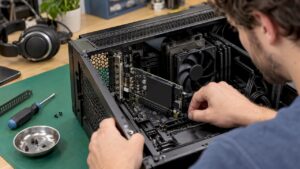
Computers are often a substantial part of the cost and determine workflow efficiency. For DAW and video editing work, CPU, RAM, and storage have priority, followed by a reliable audio IO and GPU for video/rendering acceleration.
I4studio specializes in custom audio, video and broadcast computers. Examples of considerations in cost estimation:
- Workstation CPU: more cores help with large mixes and renders; single-core performance remains important for DAW plug-ins.
- RAM: 32GB is often minimum for serious projects, 64-128GB for heavy sample and orchestral libraries.
- Storage: NVMe SSDs for OS/DAW, separate NVMe/SATA for projects, and high-capacity HDD or NAS for archiving.
- Redundancy and backups: RAID, remote backup solutions and cloud archiving.
With a cost estimate comes support: warranties, on-site service options and remote monitoring. I4studio offers advice on choosing the right balance between performance and budget, and delivers machines optimized for audio and video workflows.
Step 5: Video, Lighting and Cameras
For video or livestreaming projects, include capture cards, switchers, cameras and lighting in the budget. Also consider compatibility with the chosen hardware and software (e.g., OBS, vMix, Wirecast).
- Capture cards (SDI/HDMI), or network-based NDI solutions.
- Cameras with clean HDMI/SDI output for direct streaming.
- LED panels and DMX controllers for consistent lighting.
Step 6: Furniture, Cables and Power Supply.
These items are often underestimated. A solid desk, rack enclosures, cable management and a good power supply with surge protection and UPS can prevent a lot of downtime.
- Professional racks, demountable consoles or ergonomic desks.
- Certified cables and connectors (including reserves)
- UPS systems and supply filters for sensitive equipment
Step 7: Software, Licenses and Subscriptions.
DAW licenses, plugin packages, virtual instruments, and subscriptions (sound libraries, cloud backup) are recurring costs. One must consider updates and migration costs when changing platforms.
Step 8: Installation, Integration and Training
Professional installation and system integration ensure that equipment works together optimally. In addition, training and documentation save time in the long run:
- Monitor calibration and room correction.
- Network configuration for low-latency audio over IP or Dante.
- Documentation of signal flow and backup schedules.
Detailed Cost Overview (Price Indications)
The following are price categories with reasonable ranges. Prices vary based on brands, features and market fluctuations. All amounts are indicative.
Starter/Home Studio (Budget-oriented)
- Audio interface: €150 – €600
- 2x Studio monitors: €200 – €800
- Condenser microphone: €100 – €400
- Headphones: €80 – €250
- Mid-range laptop/pc: €800 – €1,800
- Basic DAW software: €0 – €300 (there are free or low-cost options)
- Basic acoustic set (panels, bass traps): €300 – €1,000
- Furniture & cables: €200 – €600
Total indicative: €2,000 – €5,000
Project Studio (Serious hobbyist / small professional)
- Audio interface (8-16 I/O): €600 – €2,500
- Monitors (nearfield + midfield): €800 – €4.000
- Microphone set (dynamic, condenser, room): €600 – €3,000
- Workstation (custom, 32GB+): €1,500 – €4,500
- Plugin packages and sample libraries: €500 – €2,500
- Acoustic treatment and calibration: €1,000 – €6,000
- Backups, NAS storage: €500 – €2,000
- Installation & support: €500 – €2,000
Total indicative: €7,000 – €25,000
Professional Studio / Broadcast Setup
- High-end audio consoles / control surfaces: €10,000 – €100,000+
- Monitors + room-correction: €5,000 – €50,000
- Microphone collections and outboard gear: €5,000 – €50,000
- Server and rendering infrastructure: €5,000 – €50,000+
- Redundant storage and archiving (SAN/NAS): €10,000 – €100,000+
- Full acoustic treatment and building modifications: €10,000 – €150,000
- Video & broadcast equipment: €10,000 – €75,000
- Installation, integration and certification: €5,000 – €50,000+
Total indicative: €50,000 – €500,000+ depending on scale and redundancy requirements.
Hidden Costs and Common Mistakes
Some costs are not immediately apparent at the time of purchase. They can place a significant burden on a project budget if not taken into account:
- Network infrastructure: Dante, AVB or MADI networks require investment in switches and cabling.
- License migrations: updates or change of DAW/hardware may require plugins to be repurchased or updated.
- Calibration and measurements: professional room-tuning is costly but pays off in sound transparency.
- Power and cooling capacity: additional groups or air conditioning units for larger rigs.
- Depreciation and replacement: hardware ages; include reserve budget prevents unforeseen replacement costs.
A common mistake is looking only at unit prices without checking if the ecosystem fits. A cheap interface with poor drivers can cost more time and frustration than a slightly more expensive, reliable unit. One should prioritize stability and support – there are often savings to be made there by carefully selecting brand experience and service contracts.
Smart Saving Without Concessions
There are smart strategies to still get high-quality performance within budget:
- Invest in monitoring and acoustics rather than exotic microphones. A good listening environment makes a lot of difference.
- Choose affordable, reliable computers with secure upgrade paths; I4studio provides workstations optimized for audio and video, so one does not give away performance through poor component choices.
- Rent specialized equipment for occasional needs (e.g., high-end preamps or room mics) rather than purchase.
- Buy modular: start with a solid interface and monitor setup, expand later with more I/O or outboard gear.
- Negotiate service and support in offers – longer warranty or on-site support can save a lot of misery.
Case Studies: Three Cost Estimates
Three example cases make it concrete. These examples are more realistic than general ranges because they take workflow and priorities into account.
Case A – Singer-Songwriter Home Studio
- Purpose: demos and home recordings, 1-2 tracks at a time
- Essentials: 2-monitor setup (€400), compact audio interface 4-in/4-out (€300), condenser microphone (€250), laptop €1,000, DAW €200, acoustic panels €500, headphones €150
Total: about €2,800. Main focus: low latency and comfortable workflow.
Case B – Project Studio For Bands & Producers
- Purpose: recording full bands, mixing and mastering for clients
- Essentials: interface 16-in/16-out (€1,500), monitors (nearfield+midfield) €3,500, microphone collection €4,000, recording PC (I4studio custom) €3,000, plugins & libraries €2,000, acoustic treatment €6,000, UPS + rack €1,200
Total: about €21,200. Emphasis on reliable I/O and sufficient CPU/RAM for heavy sessions.
Case C – Broadcast/Small Studio Facility
- Purpose: livestreams and short productions, redundancy needed
- Essentials: dual broadcast workstations €10,000, Dante network €5,000, video switcher + 3 cameras €12,000, monitors & room treatment €8,000, storage SAN €15,000, installation & certification €10,000
Total: about €60,000. Important: redundant systems and professional support contract.
How I4studio Can Help
I4studio specializes in providing audio, video, rendering and broadcast computers and offers custom solutions for studio environments. For anyone looking to create a reliable studio equipment cost estimate, the following services may come in handy:
- Consultations: intake to identify workflow, budget and future needs.
- Custom Workstations: machines configured for DAW stability, low latency and rendering performance.
- Acoustic solutions: design and supply of absorbers, diffusers and bass traps with placement advice.
- Installation & support: on-site configuration, network and storage integration and long-term support packages.
By approaching equipment and space as one system, I4studio helps minimize surprises in benefits and costs. One gets not only hardware, but also expertise that ensures that investments pay off.
Checklist For A Request For Proposal
When looking to approach suppliers for quotes, it helps to come up with a clear briefing. The following items should be on a request for proposal:
- Description of primary tasks and workflow (recording, mix, livestream, video)
- Number of tracks/simultaneous users
- Desired sample rates and buffering requirements
- Room dimensions and photos of the setup area
- Budget range and priorities (performance vs. savings)
- Support and warranty requirements
- Timing and delivery deadline
This information expedites accurate and comparable quotes – and avoids incurring additional costs later.
Conclusion
A solid studio equipment cost estimate requires time, knowledge and realistic expectations. One must start with workflow and space, invest in monitoring and acoustics, choose reliable computers and interfaces, and consider hidden costs such as network, power and support. By planning and prioritizing modularly, one can invest efficiently and expand later.
Those seeking help with cost estimation or hardware selection will find expertise and customization at I4studio. With advice on both equipment and acoustics, and custom workstations, they help achieve a stable, future-proof studio faster.
Frequently Asked Questions
What is the best way to begin a home studio cost estimate?
Start by defining the primary workflow: recording, mixing or streaming. Determine how much I/O is needed, what monitors and what computer performance is required. Invest in monitoring and acoustics first – that gives the most bang for buck. Use sample cases in this guide for reference and request quotes based on actual specifications.
How much should one charge for acoustic treatment?
For a small control room, a basic treatment with panels and bass traps is often between €1,000 and €6,000. For full studio renovations or commercial control rooms, this amount is between €10,000 and €150,000, depending on construction modifications and the desired level of performance.
Are custom workstations worth the extra investment?
Yes – especially for professionals who need stable performance, low latency and reliable real-time processing. Custom workstations, such as those from I4studio, are optimized for audio/video workflows and save time and frustration by minimizing compatibility issues and crashes.
For recording, should one invest more in microphones or in preamps and interface?
A good balance is important, but if one has to choose: invest first in a decent audio interface with quality preamps and stable drivers. Microphones can be built out later and specific microphones can be rented for special projects.
How does one keep costs manageable when expanding the studio?
Work with a multi-year budget and plan expansions on a modular basis. Reserve a percentage of the annual budget for replacement and upgrades (e.g., 10-20%). Document current equipment, licenses and compatibility requirements so that future decisions can be made based on facts.