
This guide offers studio design tips for audio professionals, musicians and content creators who want to build a functional, comfortable and acoustically balanced workspace. The emphasis is on practical solutions: from space planning and soundproofing to monitor placement and hardware selection. I4studio’s experience with dedicated computers for audio, video and broadcast is cited in relevant places to help with choices for performance and reliability.
Starting with proper planning
Good design starts with clarity about purpose and workflow. Not every studio has the same requirements: a podcast studio requires different priorities than a music production studio or a broadcast reception room. Sharply defining the purpose up front saves a lot of time and money later.
Capture purpose and workflow
- Define primary tasks: recording, mixing, livestreaming, video editing.
- Determine how many people are typically in the space and whether visitors (such as musicians) need to be flexible.
- Describe the workflow: tracking in the same room as mixing, or separate control rooms and live rooms?
Measuring and evaluating space
Before buying equipment or installing walls, one should take a good look at the space:
- Measure length, width and height – noting is crucial.
- Examine windows, doorways and ventilation ducts; these are often sound leaks.
- Check existing reflective surfaces: hard floors, glass and concrete greatly affect sound.
A brief technical tip: the frequencies of standing waves (axial modes) along one dimension can be estimated using the formula f = c / (2 * L) * n, where c is the speed of sound (~343 m/s), L is the length in meters and n is the mode number (1,2,3…). This helps in predicting where low-frequency problems occur.
Acoustics: basic principles and practical approach
Acoustics largely determine how reliable a mix sounds. A bad listening room will not be corrected with better monitors or plug-ins – first the room, then the gear.
Reflection, absorption and diffusion
Three elements are central:
- Reflection: hard surfaces give rapid rebound, causing flutter echoes and unclear stereo imaging.
- Absorption: materials such as rock wool or foam reduce mid- and high-frequency reflections.
- Diffusion: diffusers disperse sound in multiple directions and maintain a sense of space without harsh reflections.
Start by addressing the initial reflection points (sides and ceiling) and then apply bass treatment. Many studios work by the 1/3 rule: divide absorption and diffusion in such a way that the room does not become too “dead,” which can sound unnatural.
Bass insulation and RT60
RT60 is the time it takes sound to drop 60 dB and is crucial for mix work. For mix rooms, one often aims for a controlled RT60 of 0.3-0.5 seconds in the middle of the hearing range (125 Hz-4 kHz), with a slightly longer time in higher frequencies for a natural sound.
Bass problems most often cause frustration. Practical solutions:
- Use bass traps in corners (floor-to-ceiling if possible).
- Challenge standards like Rockwool or Owens Corning 703 to be placed at corners for lower frequency absorption.
- Consider membrane traps or Helmholtz resonators for specific low-frequency problems.
Materials and placement
- Absorbent panels of 50-100 mm work well for mid/high frequencies.
- Diffusers (QRD or skyline) behind the listening position or at the back of the room give depth without taking away clarity.
- Hard floors can be partially offset with thick carpets or platforms.
Listening position and monitor setup
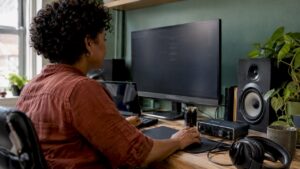
The position of monitors and listening position can make or break a mix. A symmetrical arrangement and good view of the speakers make for reliable references.
Equilateral triangle and distance rules
- Listening position and both speakers ideally form an isosceles triangle: distance monitor-monitor = monitor-listener.
- For nearfield monitors, a distance of 0.8-1.2 meters is often ideal; for larger control rooms, this can become 1.5-3 meters.
- Monitor height: tweeter at ear level in listening position.
- Toe-in: slight toe-in gives a sharp stereo image; experiment with few degrees to full toe-in where drivers point toward the ears.
Subwoofer integration
Subwoofers can greatly improve low-frequency reproduction if properly placed and adjusted:
- Start with sub on the front of the room and experiment with placement in increments.
- Use a low-pass filter and set crossover around 80-100 Hz (depending on monitors)
- Adjust phase to avoid cancellation – listen for mono bass while setting.
Sound insulation and structure
Keeping sound from outside is one challenge; preventing the studio from “living” (leaking) the building is another. Work on both massing, decoupling and sealing.
Mass-Loaded and decoupling
- Heavy materials (drywall, cement board) increase mass and decrease transmission.
- Double wall construction with air cavity and decoupling (spring hinges, insulation strips) helps a lot.
- Flooring: floating floors (floating floor) reduce structural transfer.
Sound leaks and HVAC
Seal gaps and seams with elastic sealants, use door sills with seals, and consider special sound attenuating ventilation ducts or heat exchangers to ensure quiet air supply. HVAC noise is one of the most common issues; a quiet ventilation system with duct silencers is often a wise investment.
Electronics, computers and cable management
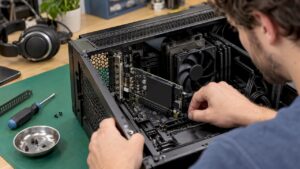
Professionals demand reliable systems with low latency and consistent performance. I4studio provides specialized audio and video workstations tailored to such workflows. Below is what to look for in equipment and rack setup.
Computer specs for audio and video
Key components and why they matter:
- CPU: many cores with high single-thread performance help with plugin-dense sessions and rendering video.
- RAM: 32-64 GB is common for serious audio projects; for large sample libraries, 64+ GB is recommended.
- Storage: NVMe SSDs for OS and project files; fast RAID or NAS for archives and collaboration.
- Audio interface: low-latency drivers, stable clocking and sufficient I/O (ADAT, AES/EBU) for recording needs.
I4studio delivers systems pre-optimized for DAW performance, real-time audio and video rendering-handy in avoiding configuration problems and driver conflicts.
Power, isolation and UPS
- Clean power supply and grounded circuits reduce hum and interference; use power conditioners where necessary.
- UPS for critical systems prevents audio or live broadcasts from stopping abruptly during power outages.
Cable Management
Quick solutions and neat routing make maintenance faster and reduce noise problems:
- Use bundled cable runs and label both ends – this saves time in debugging.
- Keep analog and digital cables separate whenever possible to reduce interference.
- Patchbays in the rack help flexibility and prevent continuous plugging and unplugging of equipment.
Furniture, ergonomics and workflow optimization
A studio is a workspace: comfort and efficiency increase creativity and productivity. Ergonomics goes beyond a good chair.
Desk and rack design
- Choose a desk where monitors are at the right height and where there is room for a keyboard and control surfaces.
- Racks should be ventilated; place heavy servers or computers at the bottom for stability.
- Don’t forget storage space: cables, adapters and accessories should be readily accessible but out of sight.
Chair, lighting and temperature
- Invest in a comfortable, adjustable studio chair with good back support.
- Provide dimmable, color-adjustable lighting – cool white for precise image editing, warm light for creative work.
- Temperature control is important: electronics do not like high temperatures and people also produce heat during long sessions.
Video, lighting and broadcast considerations
Content creators and video editors have additional requirements: quiet lighting, background finishing, and reliable capture hardware.
Silent lighting and background
- Use LED panels with silent coolers or active coolers outside the recording area.
- A well-kept background (shelves, plants, acoustic panels) works better than a cluttered studio; a folding green screen can provide flexibility.
Capture and streaming
- Capture cards with low latency and stable drivers are essential for livestreaming; I4studio can provide systems that are directly compatible with broadcast workflows.
- Provide redundancy for live broadcasts: backup encoder, Internet connection and power supply.
Budgeting: what to look out for first
Budgets vary widely. Most studios get the biggest gains by prioritizing resources that directly improve workability and sound.
Recommended order of expenditure
- Room treatment (bassstraps + first reflection panels)
- Monitors and calibration
- Reliable computer and audio interface
- Sound insulation and door/window solutions
- Lighting, furniture and accessories
Examples:
- Home studio (entry): €2,000-6,000 – basic absorption, nearfield monitors, entry-level PC or laptop.
- Project studio (semi-pro): €10,000-30,000 – extensive acoustic treatment, subwoofer, professional audio interface, dedicated workstation (e.g. I4studio).
- Broadcast/professional: €50,000+ – dual control rooms, advanced isolation, redundant systems and specialized hardware.
Practical examples and setup suggestions
Three compact case studies show how studio design tips work in practice.
1) Small home studio (attic room 3.5 x 4.0 m)
- Purpose: songwriting, recording of vocals and guitar, light mixing.
- Recommendations: nearfield monitors on stands, bass traps in three corners, first reflection panels on sides and ceiling, thick carpet under mix position, USB audio interface and laptop or compact I4studio desktop for lower delay.
- Budget priority: absorption + monitors > microphones > expensive isolation.
2) Project studio (room 5.5 x 4.0 m with separate live booth)
- Purpose: tape recording, mixing for local artists.
- Recommendations: double bearing wall between control room and live room, good bass treatment, screens and diffusers behind listening position, rack with I4studio workstation for real-time tracking and heavy plugin instances.
- Additional: ADAT or MADI I/O for expansion, dedicated NAS for backups.
3) Control room for livestreaming/broadcast
- Purpose: multi-camera livestreams, news or talk show productions.
- Recommendations: isolated room with soundproof ventilation, redundant capture and encode hardware, logging and playout servers, and mobile microphone solutions for guests.
- I4studio can provide turnkey workstations optimized for encoding and multi-track recording.
Maintenance and future-proofing
A well-built studio continues to perform with relatively little maintenance. Some points of interest:
- Calibrate monitors annually and update drivers/firmware of audio equipment.
- Check HVAC filters for noise and dust control; dust is a disturbance to gear.
- Document patching and system configurations – this speeds up troubleshooting.
- Plan expansion space: empty rack spots, additional network ports and power circuits give flexibility for future upgrades.
Checklist For The Final Studio Design
- Purpose and workflow documented
- Space measurements taken and problem frequencies identified
- Basstraps and initial reflection points planned
- Symmetrical monitor setup with proper height and toe-in
- Soundproof doors and ventilation solution
- Computer and audio specifications matched to workloads (consider I4studio for purpose-built workstations)
- Cable management and power management system including UPS
- Ergonomics: chair, desk height, lighting
- Backup plan and documentation
Common mistakes and how to avoid them
- Immediately spend a lot of money on expensive monitors without treating the room first – good speakers in a bad room don’t help much.
- No attention to HVAC noise – a quiet fan can render a recording unusable.
- Overabsorption making the room sound numb and unnatural – balance is key.
- No redundancy in live productions – always have backup plan for connection and power.
Final words
Good studio design combines technical knowledge with practical choices: proper acoustic treatment, reliable equipment and an ergonomic workstation combine to create consistent results. Professionals and serious hobbyists gain much by investing in space and computer systems designed for audio and video workflows. For example, I4studio provides workstations and advice that offer just that: performance and stability tailored to studio environments, allowing one to focus on creativity rather than troubleshooting.
With these studio design tips, you can step-by-step build a space that is efficient, comfortable and soundproof. Whether it’s a small home studio or a commercial recording space, planning, measuring and prioritizing will prevent costly repairs and production problems later.
Frequently Asked Questions
What is the first investment for a reliable home studio?
The first smart investment is always acoustic treatment of the listening position and reliable nearfield monitors. Next comes a decent audio interface and a stable computer. Without good monitoring and space, one is at a disadvantage in every mix.
How important is sound insulation for a vocal booth?
Sound insulation is crucial if recordings are to be made without disturbing ambient noise. How much insulation is needed depends on the environment; urban locations often require double walls and a sprung floor. For project work, smaller, well-sealed booths with panels and a quiet ventilation solution are sometimes sufficient.
What computer specifications are essential for audio and video?
A fast CPU with multiple cores, sufficient RAM (at least 32 GB for serious audio workflows), NVMe storage for fast project files, and a reliable audio interface with low-latency drivers. Heavy video workflows often require additional GPU power and large storage arrays. I4studio can provide systems tailored to these requirements.
How do you best solve low-frequency problems in small rooms?
Bass traps in the corners, smart placement of monitors and listening position, and resonators or diaphragms where needed. Sometimes moving listening position a few decimeters helps significantly. Measurement tools and room correction can support, but physical treatment is always more effective.
Should one hire a professional acoustician?
For complex spaces, broadcast studios or when maximum performance is required, advice from a professional acoustician is very helpful. For smaller setups and hobby studios, many of the basics are applicable with practical solutions as described in this guide.