The Ultimate Guide: Build the Perfect AI Computer for Offline AI and LLMs in 2026
The world of artificial intelligence is changing at lightning speed. Whereas just a few years ago we were completely dependent on the cloud, now we run powerful Large Language Models (LLMs) simply locally on our own hardware. But note that a standard gaming PC is not necessarily a good AI computer.
Want to get serious about offline AI? Then there are specific components you need to prioritize. In this blog, we explain what a modern AI workstation should meet and how we can help you put together the perfect configuration ( ai computer).
1. The Video Card (GPU): the beating heart
For AI, the video card is more important than the processor. LLMs are all about VRAM (Video RAM). The more memory your video card has, the larger the model you can load.
Why NVIDIA? We almost always recommend NVIDIA because of its CUDA support, the global standard for AI calculations.
Our recommendations for 2026:
Entry-level (7B models): RTX 4060 Ti (16GB) or the new RTX 5070 (12GB).
Mid-range (13B-30B models): RTX 5080 (16GB). A powerful all-rounder.
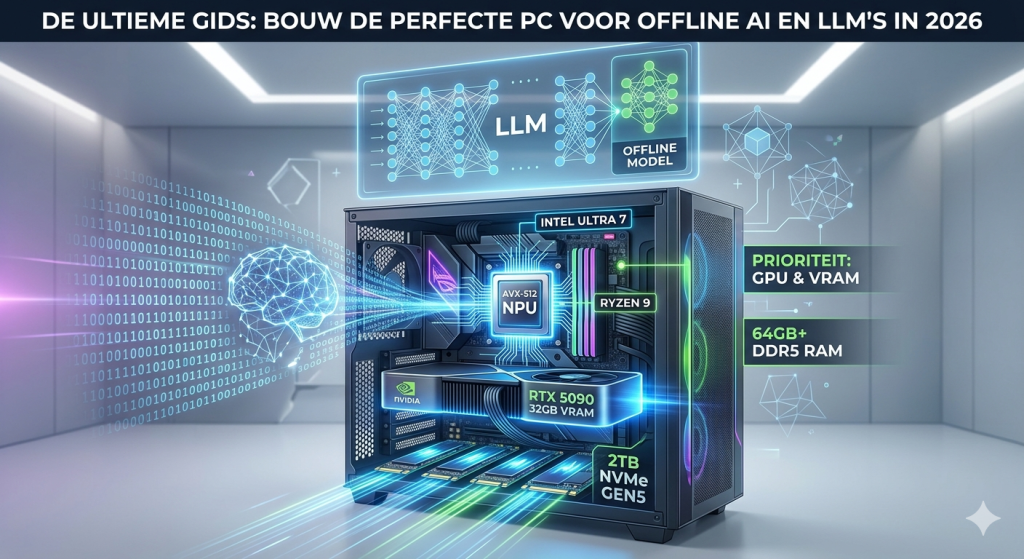
High-end (70B models): The RTX 5090 (32GB). With 32GB VRAM, even the most complex models run smoothly on your own desk.
2. Working memory (RAM): The indispensable buffer
Although the GPU does the heavy lifting, you need system memory to buffer models. If a model is just too big for your video card, the system can “offload” to your RAM.
Minimum: 32GB DDR5.
Our standard: We recommend 64GB or 128GB DDR5 for serious AI users. This will prevent your system from crashing when switching between large data sets.
3. The Processor (CPU): Intel Ultra or AMD?
There has been much to do about processors, but in 2026 there are two excellent camps:
Intel Core Ultra (Series 2)
The new Intel Ultra series (like the Ultra 7 265K) is a game changer. Why?
Built-in NPU: A dedicated chip for light AI tasks (such as background noise suppression), allowing your GPU to focus 100% on the LLM.
Efficiency: They get much less hot than the infamous 13th and 14th generation, which improves stability.
Future-proof: The new platform (LGA 1851) will last for years.
AMD Ryzen 9000 series
AMD remains the favorite for brute processing power per watt. With support for AVX-512 instructions, these processors are extremely fast in specific CPU-level AI calculations.
4. Storage and Feeding
AI models are large (5GB to 50GB each). 1TB fills up faster than you think. We equip our AI Computer as standard with:
2TB or 4TB NVMe SSDs (Gen 4/5): This reduces model load time from minutes to seconds.
850W – 1000W Power Supply: High-end GPUs need stable power. We use only Gold or Platinum certified power supplies for maximum reliability.
Summary: What do you need for your AI Computer?
| Component | Specification | Why. |
| GPU | NVIDIA RTX 5090 (32GB VRAM) | Determines the size and speed of the AI model. |
| RAM | 64GB+ DDR5 | Necessary for multitasking and large data sets. |
| Storage | 2TB+ NVMe Gen5 SSD | Speed in booting and storage models. |
| CPU | Intel Ultra 7 or Ryzen 9 | Stability and smart control of your hardware. |
FAQ:
What are : LLMs ?
LLM stands for Large Language Model. It is a form of artificial intelligence (AI) trained to understand, generate and predict human language.
You can think of it as an extremely advanced version of the “autocorrect” on your phone, but with the knowledge of almost the entire Internet.
Simply put, how does it work?
An LLM works on the basis of probability. When you type a sentence, the model “calculates” what the most logical next word (or character) is.
L (Large): These models are trained on gigantic amounts of data: books, articles, programming code and conversations. They have billions of parameters (adjustable controls).
L (Language): They specialize in language, but that broadly defined: this includes computer languages (code), mathematics and even musical notation.
M (Model): It is a complex mathematical program (a neural network) that recognizes patterns in how we communicate.
What do those numbers stand for (e.g., “70B”)?
In your previous question, you mentioned a 70B model. That B stands for Billion.
The number indicates how many parameters the model has.
Parameters are the “connections” in the AI’s digital brain.
Rule of thumb: The higher the number, the smarter, more nuanced and factual the model is. An 8B model is fast but makes mistakes more often; a 70B model can reason complexly and has vast ready knowledge.
Well-known examples of LLMs
You have probably already worked with LLMs without realizing it:
GPT-4: The model behind the paid version of ChatGPT (from OpenAI).
Llama 3/4: The Meta (Facebook) model, which many people run locally on the computers we just discussed.
Claude: Anthropic’s model, known for his natural writing style.
Gemini: Google’s model.
What can you do with it?
LLMs are the “engine” behind modern AI applications. They can:
Text writing: From emails to poems.
Summarize: Reduce a 400-page book to 5 main points.
Programming: Writing complete software codes or extracting errors.
Translation: Converting text between hundreds of languages with an eye for culture and context.
Reasoning: Solving logical problems or thinking along about a strategy.
Why do you want to run this “locally”?
People who build €3,000 computers for LLMs usually do so because they:
Wanting privacy (your data is not sent to a cloud).
Not wanting censorship (local models you can ask anything without filters).
Not wanting to pay a subscription fee.
Want to make your own adjustments to the model (fine tuning).
What isAVX-512 ?
AVX-512 stands for Advanced Vector Extensions 512. In understandable language, it is a set of instructions that allows the processor (CPU) to process huge amounts of data simultaneously.
Where a normal processor calculates step by step, you can think of AVX-512 as a wide highway with 512 lanes, making the CPU much more efficient at handling complex calculations.
Why is this important for AI?
AI models (such as LLMs) work with huge lists of numbers, also called vectors or matrices. To generate an answer, the computer must multiply billions of these numbers.
SIMD (Single Instruction, Multiple Data): AVX-512 allows the CPU to process 512 bits of data with a single command. This is twice as much as the previous standard (AVX2, which can handle 256 bits).
Speed without the GPU: Although the video card (GPU) is still the king of AI, AVX-512 helps the CPU perform tasks that linger on the processor (such as preparing data or running smaller models) much faster.
VNNI (Vector Neural Network Instructions): AVX-512 includes specific additional commands designed to speed up neural networks. This makes the CPU a lot more “intelligent” when handling AI workloads.
Who uses it?
AMD: Since the Ryzen 7000 and 9000 series, AMD fully supports AVX-512. This is one of the reasons why AMD is currently very popular among AI developers; they offer this enormous computing power without the chip getting extremely hot.
Intel: Intel invented AVX-512 for their business servers (Xeon). In consumer chips (such as the 12th to 14th generation Core i9), support was intermittent or even disabled to reduce heat. In the latest Core Ultra chips, support for AI instructions is back, but in a different way (often through the NPU).
The “Heat Warning”
AVX-512 is a tough task for a processor. In the past, enabling these instructions caused the CPU to consume huge amounts of power and get very hot. Today, modern processors (especially the new AMD Ryzen chips) can handle this much more efficiently, giving you the speed gain without melting your computer.
In short, AVX-512 is your processor’s turbo button for heavy math and AI calculations. If you are serious about AI, a CPU that supports it well is a big plus.
Get your AI Computer put together by experts
Building an AI workstation requires a precise balance between cooling, power supply, and bandwidth. We make sure the hardware is optimized for your specific use, whether you are a developer, a data scientist, or an AI enthusiast.
Want a custom configuration for your AI computer? Contact us and we will put together a system ready for the future of AI.