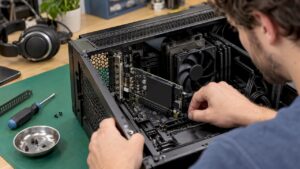

Anyone looking to compare the best audio interfaces must first have a clear understanding of what tasks the interface will primarily perform: recording a single microphone, a full band, live streaming, or audio post-production with dozens of tracks. This guide helps make that consideration by clearly outlining what to look for, what specifications are really important, and which models are worthwhile in different price ranges.
What is an audio interface and why is it important?
An audio interface is the device that connects microphones, instruments and monitors to the computer. It replaces the often weaker sound card from consumer devices and provides professional features such as microphone preamps, analog-to-digital converters, low-latency drivers and sync capabilities. For serious audio recording and mixing, a good interface is crucial: poor preamps or converters can take tension, detail and dynamics out of the signal, which cannot be regained later.
Important features to compare
Comparing audio interfaces is not just about the number of inputs and outputs. Below are the key features that affect the chosen interface on a daily basis.
I/O and channel requirements
- Inputs: How many microphones or instruments need to be recorded simultaneously? A singer-songwriter often only needs 2 inputs, while a band or larger recording session needs 8-16+ inputs.
- Outputs: Outside of studio monitors, there are often headphone outputs, monitor controllers and possibly additional line-outs for outboard gear.
- Digital I/O: ADAT and S/PDIF offer expansion options. AES/EBU is of interest for broadcast and high-end setups.
Preamplifiers and sound quality
The quality of the mic preamps determines much of the final sound. Characteristics to watch out for:
- Gain range: Enough headroom for quiet sources as well as loud sources.
- Noise and dynamic range: Low noise and high dynamic range are important for transparent recordings.
- Character: Some preamps color the sound (warmth, saturation), others are neutral. Which one prefers depends on taste and application.
Converters, sample rates and bit depths
ADC/DAC quality is crucial. Higher sample rates (48/96/192 kHz) and 24-bit resolution offer more headroom and detail, but also require more CPU and disk space. For most project studios, 24-bit/48-96 kHz is a good balance.
Latency and drivers
Latency (delay) is the delay between the incoming signal and playback through the computer. Low latency is essential in live instrument recording and monitoring. Good drivers (ASIO on Windows, Core Audio on macOS) and connectivity like Thunderbolt provide dramatically lower latency than older USB standards.
Connectivity: USB, Thunderbolt, PCIe and Dante
- USB-C / USB 3.0: Widely compatible and affordable; sufficient for most home and project studios.
- Thunderbolt: Lower latency and higher bandwidth-ideal for multiple channels and professional workflows.
- PCIe: Internal cards offer the best performance but require a desktop and installation.
- Network Audio (Dante/AVB): For large studio, live and broadcast workflows with tens to hundreds of channels over Ethernet.
Monitoring and workflow features
Real-time monitoring (direct monitoring), talkback, built-in DSP (for zero-latency effects), and easy monitor routing make working more pleasant. Some interfaces have integrated monitor controllers or multi-headphone outputs-handy for podcasting and tape recording.
Expandability and synchronization
ADAT inputs for additional preamps, digital I/O for clocks and external converters, and word clock for accurate synchronization are important for growing rigs and professional setups.
Software and drivers
A stable driver is often more important than specs on paper. Bundling plugins and DAW software can add extra value, but driver reliability and regular firmware updates are critical to long-term enjoyment.
Which interface suits which user?
Not every user has the same priorities. Here are some common scenarios with concrete recommendations for features and types of interfaces.
Home/project studio for singer-songwriters
- Focus: 1-4 inputs, good preamps, easy operation.
- Featured features: instrument and mic inputs with good DI, 1-2 headphone outputs, USB-C.
- Typical models: Focusrite Scarlett 2i2, Audient EVO 4, Universal Audio Volt 2.
Producer/beatmaker with MIDI and outboard gear
- Focus: low latency, stable drivers, MIDI I/O, multiple outputs for outboard processors.
- Featured features: multiple line-outs, MIDI, DSP for plugins as desired.
- Typical models: MOTU M4, Native Instruments Komplete Audio, RME Babyface (for reliability).
Band recordings and small studios
- Focus: 8+ inputs, expandability via ADAT, talkback, multiple headphones.
- Featured features: multiple mic preamps, ADAT expansion, stable drivers and monitor routing.
- Typical models: Focusrite Clarett 8Pre, PreSonus Studio 1824c, Universal Audio Apollo x8.
Professional studio, broadcast and post production
- Focus: top converters, low jitter, large numbers of I/O, Dante/AES/word clock, RAID-ready systems.
- Featured features: Thunderbolt/PCIe, extended digital I/O, DSP, redundant clocking.
- Typical models: RME Fireface/UCX, Antelope Orion, Prism Sound, Apogee Symphony, Dante-enabled interfaces.
Concrete models and comparisons by price range
A brief, practical comparison of popular models helps with orientation. The following selection highlights strengths and limitations – suitable for a wide audience from musicians to audio professionals.
Entry-level class (up to ~€250)
- Focusrite Scarlett 2i2: Very easy to use, good preamps for the price, many commissioned artists. Perfect for singer-songwriters and podcasting.
- Audient EVO 4: Convenient automatic gain functions and a compact, smart workflow. Preamp quality surprisingly good for the price.
- Behringer U-Phoria (UMC series): Very affordable, acceptable performance for beginners, but drivers and build quality vary.
Mid-range (€300-€900).
- MOTU M4: Excellent converters, low latency, and very stable USB implementation. Good metering screens and latency performance.
- Focusrite Clarett 4Pre: More professional preamps than Scarlett, low-latency drivers, ideal for project studios looking to scale up.
- Universal Audio Apollo Twin X: UAD DSP and high-quality converters; ideal for those who want to use UAD plugins in real-time. More expensive, but loved for color and workflow.
High-end and professional options (€1000+)
- RME Babyface Pro FS / Fireface: Industry standard for reliability and extremely low latency. Very stable drivers and extensive routing via TotalMix.
- Antelope Audio Orion Studio: High quality converters, excellent clock, and lots of I/O. Suitable for broadcast and mastering.
- Prism Sound Lyra / Orpheus: Top quality converters and extremely transparent preamps – widely used in mastering and high-end recording environments.
Large-scale solutions and networked audio
- Dante-enabled interfaces (Focusrite RedNet, Yamaha Rio): Scalable networked audio for live and broadcast, easily expandable.
- Symphony/Apogee/Prism Sound systems: For high-end studios with the highest demands on conversion and synchronization.
Practical test: how to try out an audio interface
A short test can clarify a lot. The following checklist helps when evaluating an interface in the store or during a test run.
- Plug in a known microphone and test gain structure: is there enough headroom without noise?
- Check drivers: install them (if possible) and test stability with the DAW and intensive playback/recording sessions.
- Measure latency at low buffer sizes and play live instruments. Test both USB and possibly Thunderbolt.
- Listen critically to converters: play reference material that is familiar and pay attention to clarity, stage and low-end reproduction.
- Test monitoring features: direct monitoring, headphone mixes and routing options.
- Check build quality and connectors: solid XLR/TRS, good knobs and solid power supply are important for years of use.
Common mistakes and how to avoid them
- Too few channels: A common mistake is buying based on current needs without factoring in future growth. ADAT expansion or additional digital I/O can help.
- Attention to drivers: Quickly choosing the cheapest model without checking for stable drivers and firmware updates. Instability costs a lot of time later.
- Confusion between spec names: Higher sample rates often sound better on paper, but without good converters or proper workflow, they provide little real gain.
- No attention to monitor routing: Clumsy monitor control can slow down workflows, especially for mixes and voice recordings.
- Ground loops and noise: Not paying attention to grounding and cable quality can lead to hum and noise. Good cables and possibly isolation transformers help.
How I4studio can help choose and decorate
I4studio not only provides hardware, but also offers specialized support for studio and broadcast environments. For many users, it is difficult to translate the technical options into concrete choices that fit their workflow. I4studio helps in those areas as follows:
- Custom consulting: Technical intake to determine which type of audio interface best suits recording needs, DAW, and workflow.
- Custom-built audio and video computers: Machines configured for low latency, sufficient I/O, and stable drivers – essential in professional use.
- Acoustical solutions: The right interface is only one part of the story; I4studio also advises on monitoring setups, room acoustics and signal routing.
- Installation and Support: Help with hardware setup, driver installation and troubleshooting, allowing the user to work quickly without lengthy configuration problems.
Checklist: How one should compare the best audio interface
- Determine the number of inputs/outputs needed now and in 2-5 years.
- Decide which connectivity is most important (USB-C, Thunderbolt, PCIe, Dante).
- Check preamp and converter quality through reviews and listening tests.
- Read about driver stability and firmware updates.
- Consider features such as DSP, talkback, ADAT, and monitor capabilities.
- Check warranty and technical support (local support can be worth a lot).
- Make a real budget and compare models within that range on usage scenario, not just specs.
Practical tips for optimal performance
- Use ASIO on Windows for low latency and stable performance.
- Keep buffer sizes as low as possible during tracking and higher during mixing for CPU efficiency.
- Use short, quality cables and pay attention to grounding to minimize noise.
- Save projects and audio in 24-bit and choose a sample rate appropriate for deliverables (48 kHz is standard for video).
- For multi-device setups: choose one master clock or use word clock and put other devices in slave mode.
Conclusion
Choosing the best audio interfaces to compare is all about matching needs with technical qualities. For singer-songwriters and podcasters, convenience and good preamps are often more important than huge channel numbers. For professional studios, converter quality, stable drivers and expandability are crucial factors. Thunderbolt and PCIe offer the best performance, but modern USB-C interfaces often offer excellent value and flexibility.
Practical advice and a suitable computer are at least as important as the interface itself. I4studio supports customers with customized advice, special audio/video computers and studio equipment that ensures that the chosen interface functions optimally within the workflow. By pre-testing, paying attention to drivers and incorporating the right expansion options, one can choose an interface that will not only suffice today, but also tomorrow.
Frequently Asked Questions
Which connectivity is best: USB or Thunderbolt?
Thunderbolt typically offers lower latency and higher bandwidth, which is useful for many channels or high sample rates. For most home and project studios, however, USB-C is sufficient and more economical. The choice depends on channel needs and hardware compatibility.
How many inputs are really needed for a project studio?
It depends on the workflow: solo artists often get by with 2-4 inputs. For band recording, 8-16 inputs are common, possibly with ADAT expansion to add additional preamps without a full hardware swap.
Which is more important: preamp or converter?
Both preamp and converter are important. A good preamp provides a clean, dynamic signal before conversion; a high-quality converter preserves that signal digitally. With budget constraints, the preamp often deserves extra attention, as distortion and noise have a big impact there.
Are interfaces with built-in DSP worthwhile?
Yes, if one likes to record in real-time with heavy plugins (e.g. UAD or onboard effects) without CPU load. They are extremely useful for tracking and monitoring, but add cost and are only relevant if that workflow is desired.
How does I4studio help you choose an audio interface?
I4studio offers technical advice, compatibility checks with DAW and computers, and can provide audio and video PCs optimized for low latency and maximum I/O usage. They also help with installation, configuration and acoustic setup to ensure the chosen interface performs optimally.