TL;DR:
- A customized PC perfectly matches the specific workload and environment of creative professionals.
- Quiet systems reduce noise and improve concentration during long work hours and recordings.
As a self-employed professional or creative entrepreneur, you know how frustrating it is when your computer gets in the way of your workflow. A standard off-the-shelf PC seems attractive, but rarely delivers what you really need. The benefits of a customized PC only become clear once you see how well a custom-built system fits your specific workload, work environment and future plans. In this article, we take you through the key benefits of custom PCs, from silent cooling to modular expansions.
Table of contents
- Key insights
- 1. The benefits custom PC starts with your workload
- 2. Criteria that determine when a custom PC makes sense
- 3. Why a silent PC is a game changer for creative workflows
- 4. Adaptability and customization: components that really suit you
- 5. Compact systems: powerful and space-saving
- 6. Self-build versus off-the-shelf: which suits you?
- My take on custom PCs for creative professionals
- I4studio helps you find the right studio PC
- FAQ
Key insights
| Item | Details |
|---|---|
| Customization increases productivity | A custom-built PC connects directly to your software and workload without concessions. |
| Silence improves concentration | Ambient noise of 30-40 dB negatively affects cognitive performance; a quiet PC avoids this. |
| Modular design saves costs | A customized PC grows with your needs, allowing full replacement to be delayed longer. |
| Compact systems offer flexibility | Mini PCs combine powerful performance with minimal space and low power consumption. |
| Professional service reduces risk | Combining customization with warranty and expert advice gives security without the learning curve of DIY. |
1. The benefits custom PC starts with your workload
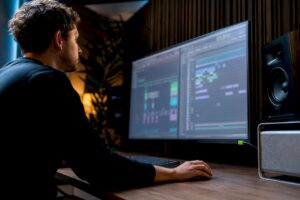
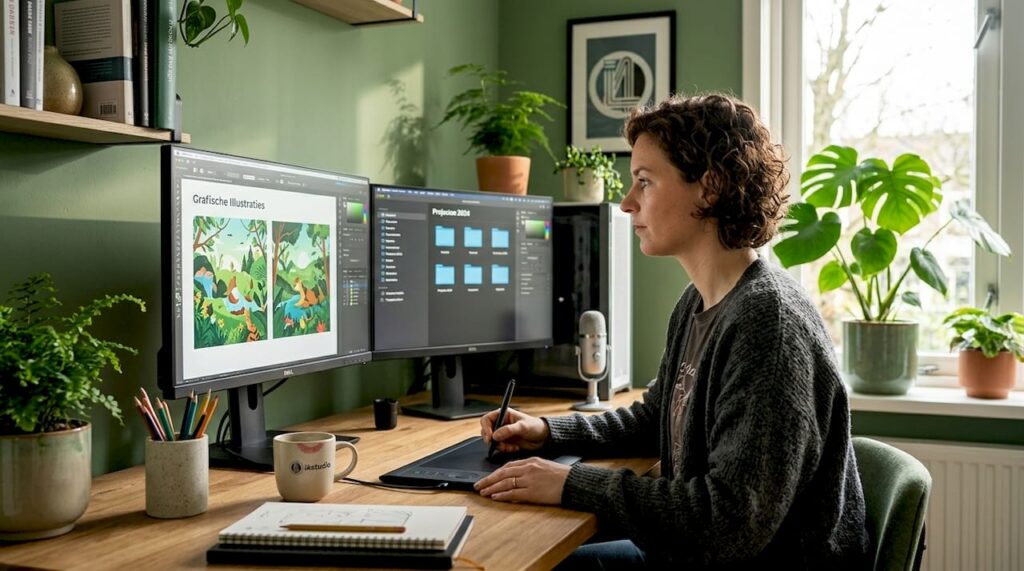
No two creative professionals work the same way. A video engineer has different needs than a music producer or a graphic designer.
With a standard PC, you pay for an average system that isn’t really perfect for anyone. With a custom PC, you decide which components get priority. Do you work primarily with video editing in Premiere Pro? Then invest more in GPU power and fast NVMe storage. Are you producing music in a DAW? Then latency and a quiet environment count more heavily than raw graphics performance.
That is the essence of a custom PC: every part has a reason to be there. Nothing is wasted, nothing is missing.
2. Criteria that determine when a custom PC makes sense
Before you choose, it’s good to know what your criteria are. These are the factors that most determine professionals:
- Workload and applications: Heavy software such as After Effects, Ableton Live or DaVinci Resolve requires specific hardware that off-the-shelf systems rarely offer optimally.
- Noise emissions and work environment: Do you work in a studio space or at home? Then fan noise is a real problem for concentration and recording.
- Modular architecture and future-proofing: Want to upgrade in two years without replacing everything? Then the basic architecture of your PC should have already supported it.
- Energy efficiency and heat generation: Professional systems run long and intensively. Proper heat management prevents loss of performance and extends service life.
- Budget and priorities: Customization doesn’t have to be more expensive. You spend money where it counts, and save on features you never use.
Do you see yourself in several of these points? Then a custom PC is almost certainly the better choice for your situation.
3. Why a silent PC is a game changer for creative workflows
This is systematically underestimated. Fan noise sounds like a minor inconvenience, but ambient noise around 30-40 dB has been shown to negatively affect your stress levels and cognitive performance.
For music producers and audio engineers, this is especially relevant. If your PC is audible in your recording room, you have a practical problem. For designers and engineers, the other aspect counts: concentration. A constantly buzzing PC is a subtle but constant distraction.
The benefits silent PC go beyond comfort alone:
- No fan noise at light load: Modern power supplies with Zero RPM mode only turn on the fan from 30-40% load. During e-mail, video conferencing or light browsing, the PC is completely silent.
- Less dust accumulation: Fanless designs and closed cooling systems attract less dust, extending component life.
- Better air circulation: A well-designed enclosure with directed airflow cools more effectively without producing more noise.
- Long-term use without performance degradation: A balanced hardware combination with adequate cooling prevents processor underperformance due to overheating, even after hours of intensive work.
Pro-tip: Don’t forget the power supply as a noise source. Many professionals choose expensive CPU coolers but leave a cheap, noisy power supply in place. A power supply with 80+ Gold certification and a large, slow rotating fan is often quieter and more efficient than you think. I4studio helps you make the right choice.
4. Adaptability and customization: components that really suit you
A custom-built computer is more than a list of individual components. It’s about the balance between those parts and the choices that make that system future-proof.
Here’s how to do it:
- Determine your CPU-GPU balance: A music producer needs a powerful multi-core CPU; a 3D animator needs a heavy GPU. Set the budget where your software will benefit the most.
- Choose RAM based on your DAW or editing software: 32 GB is a good base for most creative workflows. With 64 GB or more, you work without paging, even for large sessions.
- Invest in high-quality storage: A fast NVMe SSD as a system drive and a large secondary drive for projects gives the best balance of speed and storage capacity.
- Pay attention to power supply quality: Japanese capacitors in high-quality power supplies provide more stable power, less electrical noise and longer life. This is a detail that cheap off-the-shelf systems almost always lack.
- Choose a motherboard with room for growth: More RAM slots, PCIe expansions and USB ports than you need now, so your system can be easily expanded later.
Modularity and future-proofing are standard part of the decision with a custom PC. You are not buying a system for today, but for the next five years.
Pro-tip: When compiling, always ask which components are the bottleneck for your particular software. A fast GPU won’t help you anything if your DAW runs primarily on the CPU. The right balance is always software specific. I4studio gives concrete advice on this based on your workflow.

5. Compact systems: powerful and space-saving
Not everyone has room for a big tower under the desk. Compact systems, such as XPC Slim mini-PCs, prove that being small and being powerful go together just fine.
| Feature | Traditional desktop | Compact mini-PC |
|---|---|---|
| Dimensions | 40-50 cm high | Several centimeters thick |
| Placement options | On or beside desk | Behind monitor or under desk |
| Energy consumption | High | Low |
| Noise level | Cooling dependent | Fanless options available |
| Multi-monitor support | Yes | Yes |
| Suitable for 24/7 use | Yes | Yes, often better due to lower heat |
Fanless mini-PC designs avoid spinning fans completely. That means perfect silence, less dust and lower energy costs. They are suitable for 24/7 use and fit into any workspace, even the smallest.
For creative professionals working with multiple monitors, compact XPC Slim systems are a serious option. They fit behind a monitor, take up no desk space, and still deliver the performance you need for entry-level to mid-level graphic work, music production or video editing.
Learn more about how to make the right choice between a desktop or laptop for audio and video production in our comprehensive comparison.
6. DIY versus off-the-shelf: which suits you?
This is a question many professionals put off in the decision-making process. Both approaches have distinct advantages and disadvantages.
| Aspect | DIY | Ready-made customized |
|---|---|---|
| Control over components | Full | Largely |
| Required knowledge | High | Low to none |
| Time investment | High | Minimum |
| Warranty | Per part | On complete system |
| Cost | Low to medium | Average to higher |
| Risk of error | Present | Low |
Composing yourself gives maximum control and is a learning experience in itself, but it requires knowledge, time and a willingness to make mistakes. For busy self-employed people, this is not always the smartest investment of their hours.
Off-the-shelf systems with customization, such as those from specialized studio PC providers, give you the best of both worlds. You get a system tailored to your needs, with a warranty on the complete system and support if something goes wrong.
For most creative professionals, the combination of professional custom selection with expert service is the most practical choice. You gain time, you gain security, and the system is ready to use immediately.
My take on custom PCs for creative professionals
I regularly hear from self-employed people who worked with a slow or noisy PC for years simply because they thought it was “good enough.” Until they switched to a system that really caters to their workflow. The difference is always greater than they expected.
What I see in practice is that standard PCs fall short on exactly the points that matter most to creative professionals: silence, reliability under sustained load, and the right balance of components. A manufacturer building thousands of the same systems has not considered your DAW, your recording space, or your workflow.
My advice is always the same: start with your software and your operating environment, not with the specifications on the box. What components does your primary application need? How quiet does the PC need to be? Where is it located? The answers to those questions naturally lead to the right choices.
And don’t underestimate the power supply. It’s the part most professionals skip, but a high-quality, quiet power supply with good capacitors makes a demonstrable difference in both noise levels and system stability in the long run.
A good studio PC choice requires knowledge of your specific situation. That’s exactly where customization proves its value.
– harold
I4studio helps you find the right studio PC
I4studio is all about studio PCs that truly suit creative professionals. Whether you produce music, edit video or work as a graphic designer, I4studio’s offerings focus on systems that are quiet, reliable and customized.
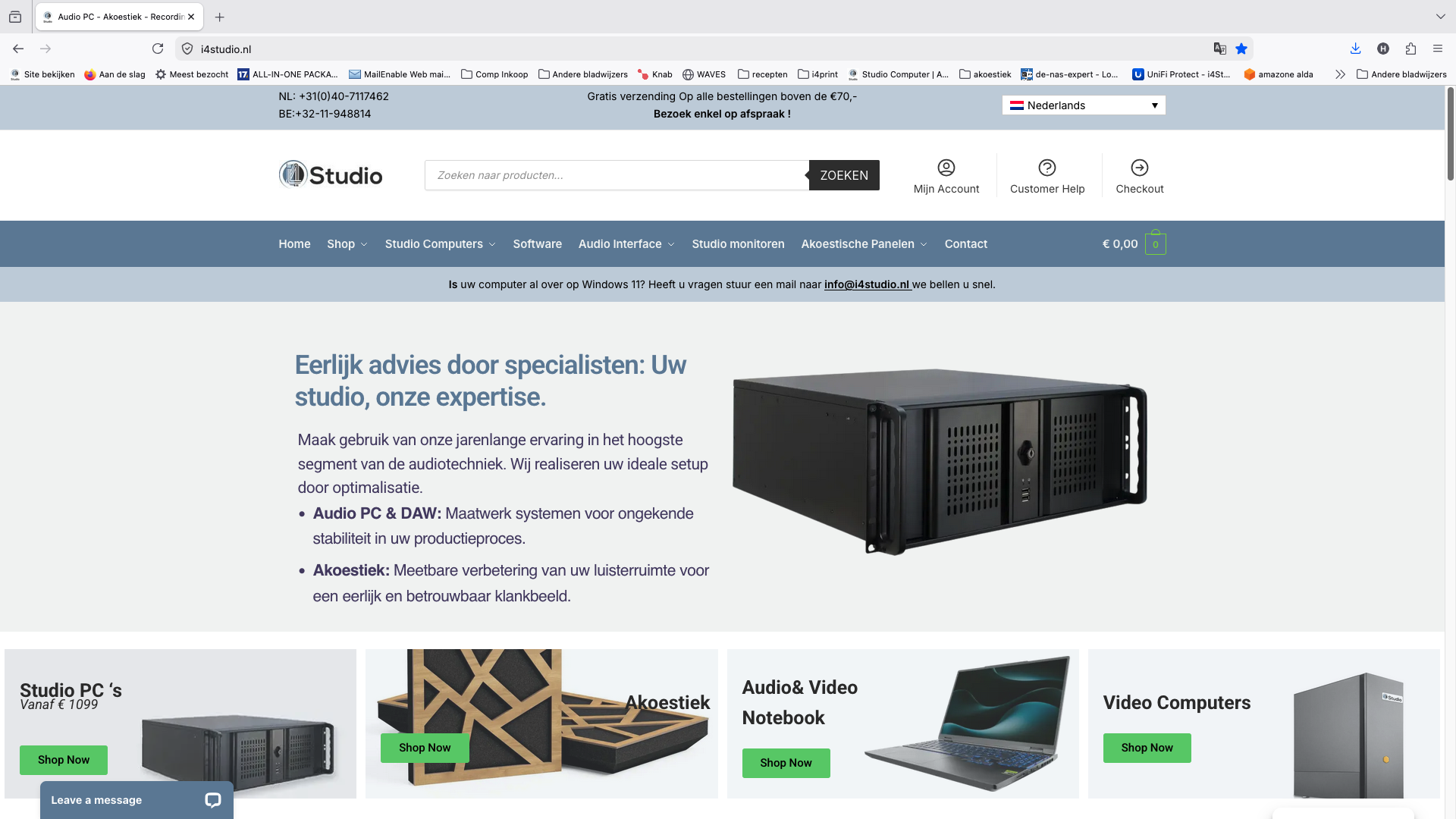
Check out the studio PC options at I4studio and find out which system best suits your workflow. Want to know more about which components really advance your production? The page on studio pc components gives you a clear overview of what counts under the hood. I4studio thinks with you, without the hard sales talk.
FAQ
What are the advantages of a custom PC over a standard PC?
A custom PC is tailored to your specific software, workload and work environment. You pay only for what you need and get better performance on the parts that count for you.
Is a quiet PC really necessary for music production?
Yes. Fan noise of 30-40 dB demonstrably affects your concentration and can interfere with recordings. A quiet or fanless PC is not a luxury in a recording room, but a practical requirement.
Can a compact mini-PC be sufficient for creative tasks?
Compact systems such as XPC Slim mini-PCs support multi-monitor use, are suitable for 24/7 running and provide sufficient performance for entry to mid-level graphics work and music production.
Is DIY always cheaper than an off-the-shelf custom PC?
Not always. Self-building can be cheaper at the component level, but the time investment, learning curve and individual warranties per component often make a professionally assembled system the smarter choice for busy independents.
How long will a properly assembled custom PC last?
With modular construction, high-quality components and proper cooling, a custom PC will last five to seven years or more. Interim upgrades to RAM or storage extend the usable life even further.