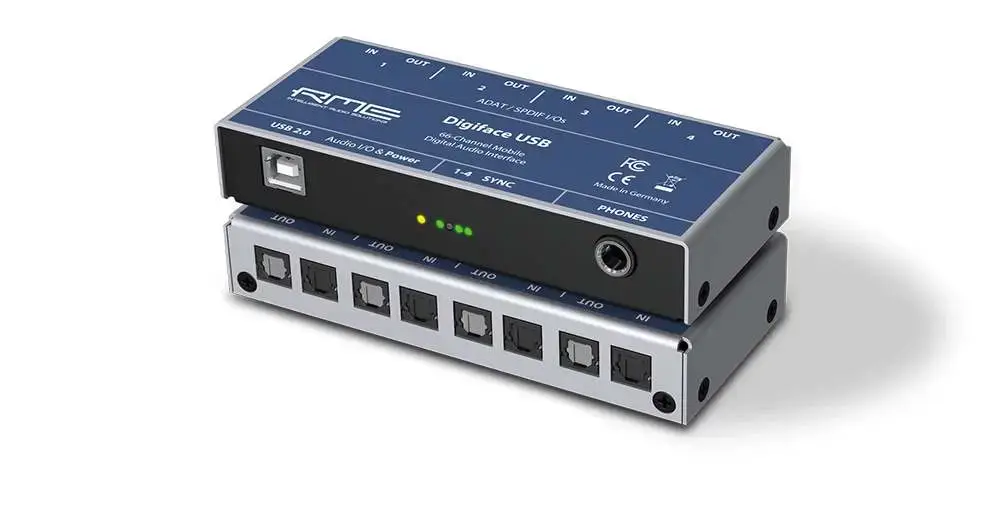


RME DIGIFACE USB
The latest Plug and Play technology ensures easy installation even for the inexperienced user. Numerous unique features and RME’s robust drivers ensure fast, efficient and convenient operation of the Digiface USB. Its small size, weight and bus power supply make the RME Digiface USB extremely versatile and useful. It can even serve as a simple headphone amplifier for mobile use.
Compact, portable and lightweight audio interface
The RME Digiface USB is an extremely compact & portable digital audio interface with 4 optical ADAT / SPDIF I/Os, and a high quality analog line/phone output via 6.3 mm TRS jack. Building on the legacy of RME’s famous HDSP Digiface, a triple ADAT I/O interface with phones and PCI interface, the Digiface USB simplifies connection with USB 2, requires no external power supply, and even adds another optical I/O, resulting in 32 channels of input and output per channel when using ADAT optical.
The analog output hosts channels 33/34, and can be used freely thanks to TotalMix FX, RME’s routing and monitoring solution that has almost no limits in routing and mixing (the Digiface USB does not include FX)
Each single optical port can use ADAT (up to 8 channels) or SPDIF (stereo). While the inputs automatically adjust to the received signal format, the outputs can be individually switched between ADAT and SPDIF operation. SMUX and SMUX4 are supported. Thus, at 192 kHz, 8 channels via 4 x SPDIF or ADAT are possible on both inputs and outputs.
Flexible mixing and routing with TotalMix
Like all the latest RME interfaces, the rme Digiface USB also includes the powerful real-time digital mixer TotalMix FX. This allows virtually unlimited mixing and routing, with all inputs and playback channels simultaneously, to all hardware outputs. The rme Digiface USB has no DSP, so no FX are available. Still, it includes a dedicated Control Room section with Talkback, Main/Phones, fader groups, mute groups, full remote control via Mackie or OSC protocol and much more.
Here are some typical applications for TotalMix:
- Setting up delay-free submixes (headphone mixes). With the Digiface USB, you can create up to 17 completely independent stereo submixes. On an analog mixer, this would be equivalent to 34 Aux sends.
- Unlimited routing of inputs and outputs (free use, patchbay functionality).
- Distribute signals to multiple outputs simultaneously. TotalMix provides advanced splitter and divider functions.
- Simultaneous playback of multiple programs through a single stereo output. The ASIO multiclient driver supports the use of multiple programs simultaneously. If this is done on different playback channels, TotalMix allows them to be mixed and monitored on a single stereo output.
- Mixing the input signal to the playback signal (full ASIO Direct Monitoring). RME is not only the pioneer in ADM, but also offers the most complete implementation of ADM functions.
- Integration of external devices. Use TotalMix to insert external effects devices both in the playback path and in the recording path. Depending on the current application, the functionality is similar to insert or effects send and effects return, for example as used during real-time monitoring when adding some reverb to vocals.
Preferring an internal interface, take a look at the Raydat