
synthesizer
music synthesizer , also called electronic sound synthesizer, a machine that produces and modifies sounds electronically, often with the help of a computer. Synthesizers are used for electronic music composition and live performance.
The synthesizer tone generation generates waveforms and then subjects them to changes in intensity, duration, frequency and timbre at the discretion of the composer or producer. Synths are capable of producing sounds that go far beyond the range and versatility of conventional and traditional musical instruments.
The first electronic sound synthesizer, a gegantic-sized instrument, was developed in 1955 by American acoustic engineers Harry Olson and Herbert Belar in the laboratories of the Radio Corporation of America (RCA) in Princeton, New Jersey. The information was fed to the synthesizer, encoded on a paper punched tape. Intended for research into the properties of sound, the synthesizer attracted composers who wanted to expand the range of available sound or gain total control over their music.
More compact synthesizers were produced in the 1960s—first the Moog and soon after others, including the Buchla and Syn-Ket, the latter about the size of a piano. Most synthesizers had piano-like keyboards, although other types of playing mechanisms have been used. Developed by American physicist Robert Moog , the Moog III featured two five-octave keyboards that controlled changes in voltage (and thereby pitch, timbre, attack, decay of tone, and other aspects of sound), giving the composer or musician an almost infinite variety. to tone control.
This type of analog technology became the basis of both modular and portable synthesizers that were mass-produced in the 1960s and 1970s. A notable use of the Moog was in Alwin Nikolais’ television ballet The Relay. Developed by American scientist Donald Buchla, the Buchla synthesizer was activated by a “keyboard” which was a touch-sensitive metal plate with no movable keys, somewhat similar to a violin flute. It was used in such works as Morton Subotnick’s Silver Apples of the Moon (1967) and The Wild Bull (1968).
The synthesizers mentioned above used subtractive synthesis – the removal of unwanted components from a signal containing a fundamental and all associated overtones (sawtooth wave signals). The harmonic tone generator, developed by James Beauchamp at the University of Illinois, on the other hand, used additive synthesis, where tones were constructed from pure tones signals, ie without overtones (sine wave signals), and offered certain advantages in terms of the nuances of the produced sounds. timbres.
In the late 1970s and 1980s, much more compact synthesizers were developed that used microcomputers and a variety of digital synthesis techniques – such as whole-sound sampling (the digital recording of sounds), Fourier synthesis (the specification of individual harmonics), and FM synthesis (frequency modulation) using sine waves. These instruments included the Fairlight CMI, New England Digital’s Synclavier II, and Yamaha’s line of FM synthesizers.
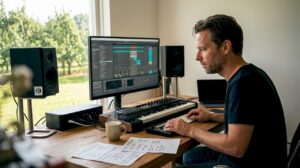
In the late 90s the first virtual synths came on the market, these virtual instruments VSTs were digital models of, for example, a moog, where the sound of the original was emulated using the computer processor.
These virtual instruments run in a computer environment, and often within a DAW such as Cubase and Logic.
With the increasing power of home computers, the virtual synths are also getting better and have the same impact as a hardware synth. With the help of sampling we are able to reproduce sounds that previously could only occur from hardware synths. A good example are the sample players of spectrasonics