Most analysts and manufacturers expect computer prices to continue rising until around mid-2027. It won’t be until the second half of 2027 that a gradual decline might begin. RAM is likely to remain the most expensive component for the longest time: a major memory manufacturer anticipates shortages lasting until at least 2028. If you’re waiting for “the old prices,” you’ll be waiting a long time—and it remains to be seen whether they’ll ever return. Below, you’ll learn why PCs are getting more expensive, which components are seeing the sharpest price increases, what analysts expect for each period, and what that means if you need a studio PC for music production or video editing.
In a nutshell
- Peak around mid-2027: Manufacturers expect PC prices to reach their highest point by then. This may be followed by a gradual decline.
- RAM is the main culprit: in just over a year, the price of RAM rose by an average of 321 percent, SSDs by 121 percent, and graphics cards by 39 percent.
- The reason is AI: memory chips are being funneled en masse to AI data centers, leaving fewer available for regular computers.
- Waiting won’t necessarily pay off: no significant drop in RAM prices is expected in the short term. The outlook for SSDs is slightly more favorable.
- For studio use: It’s better to buy a well-balanced setup with enough memory now than a cheap PC that will start to slow you down in a year.
Table of contents
- Why Computers Have Become So Expensive
- Which components are rising the most in price
- What the market expects through 2028
- What this means for a studio PC
- Buy now or wait?
- Smart Shopping in a High-Priced Market
- Our Take on Price Increases
- A studio PC that fits your work
- Frequently Asked Questions
- Sources
Why Computers Have Become So Expensive
The price increase didn’t start with the computer itself, but with a single component: memory. RAM chips are being bought up in massive quantities for AI data centers, leaving fewer available for laptops, desktops, and gaming consoles in stores.
AI memory is more profitable
AI servers use a special type of memory: HBM (high-bandwidth memory). It’s manufactured in the same factories as the DDR4 and DDR5 memory in your PC. Every wafer a factory allocates to HBM isn’t used for regular RAM.
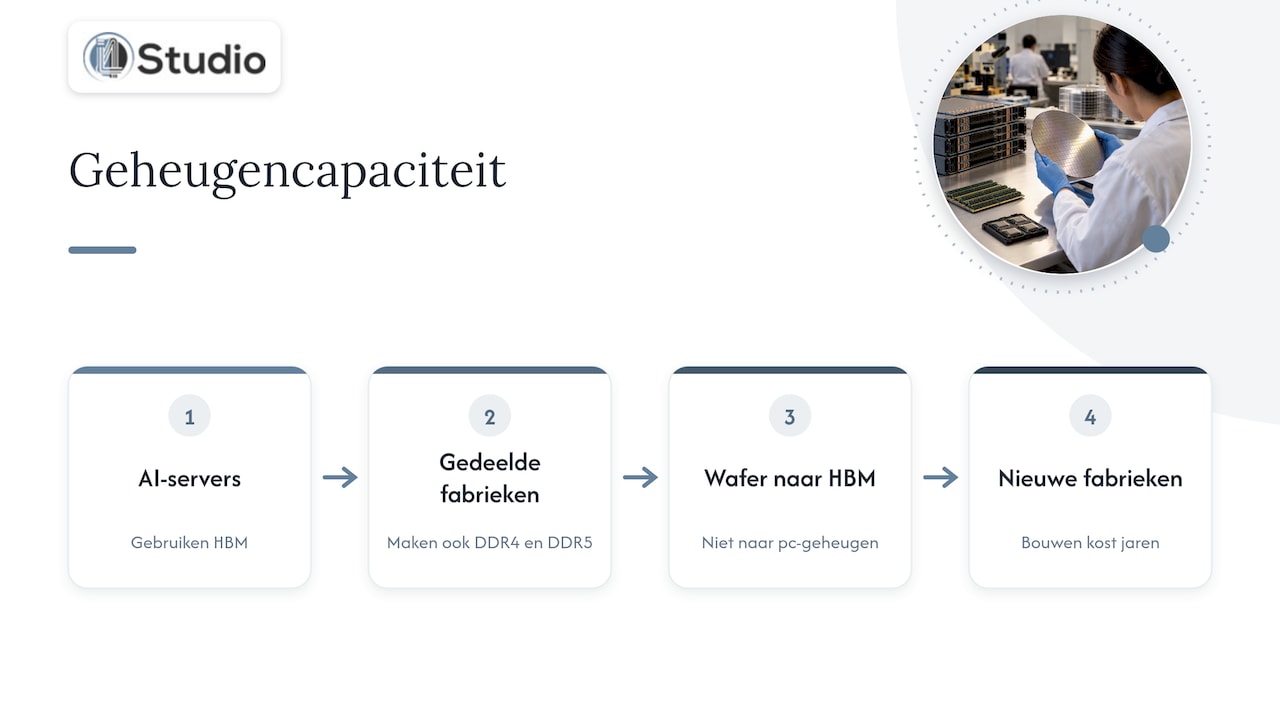
Furthermore, the market is dominated by three major players: Micron, Samsung, and SK Hynix. According to Techzine, these three have a shared interest in keeping supply tight, because the margins on AI memory are much higher. Building new factories takes years, so additional supply won’t be available anytime soon.
From memory to the entire PC
Memory is found in virtually everything: working memory, SSD storage (NAND flash), and the video memory on a graphics card. As a result, the shortage affects nearly every component. A PC builder or manufacturer therefore pays more for multiple parts at once, and those costs are ultimately passed on to the buyer.
Which components are seeing the sharpest price increases
Not every component has become equally more expensive. Here is an overview of the average increase over just over a year, as measured by Bright:
| Part | Average price increase | What this means for you |
|---|---|---|
| Random Access Memory (RAM) | 321% | The biggest expense when upgrading or buying a new PC |
| SSD Storage | 121% | Large project files and sample libraries are becoming more expensive |
| Graphics Cards | 39% | Most noticeable during video editing and 3D rendering |
| Complete DIY PC | 51% | A build from last year now costs more than half as much |
The difference is clearly visible in euros. According to c’t, 32 GB of DDR5 now costs at least €400, and the price gap with DDR4 is widening. For a producer working with 64 GB or more, memory is therefore often more expensive than the processor.
Less hardware for the same price
Manufacturers try to keep the retail price as consistent as possible. They don’t do this by earning less, but by cutting corners on the specifications. Some Windows laptops come with 8 GB of RAM instead of 16 GB at the same price. Configurations with 4 GB graphics cards or older DDR4 memory are also appearing to cushion the price increase.
Tweakers editor Tomas Hochstenbach already pointed out on NOS that consumers are now likely getting worse hardware for the same price than they did a year ago. So don’t just look at the price tag—focus on what’s inside.
Market Forecasts Through 2028
The forecasts vary, but they all show the same pattern: first, a further increase, then a gradual decline. Here is an overview by period:
| Period | Forecast | Source |
|---|---|---|
| Fourth Quarter of 2026 | PCs will become another 5 to 20 percent more expensive, depending on the configuration | ICT Magazine |
| Mid-2027 | PC prices reach their peak | Tweakers |
| Second half of 2027 | A slight decline due to improved component availability; SSDs may become cheaper | Tweakers, G2A News via TrendForce |
| Throughout 2027 | DRAM price per gigabit is set to rise by more than 43 percent | Notebookcheck |
| 2028 | According to Micron, the memory chip shortage will continue at least until then; analysts don’t expect a significant decline until then | NOS, Notebookcheck |
The CEO of a major Taiwanese PC manufacturer stated that the peak will occur in mid-2027. That is a forecast, not a guarantee. Techzine points out that the memory market is cyclical and that a price drop is far from certain.
Demand is falling, but prices haven’t yet
High prices are holding back sales. Worldwide, PC shipments in the third quarter of 2026 fell by 22.4 percent compared with the same period a year earlier. Normally, lower demand would put downward pressure on prices. But as long as AI data centers continue to buy up memory, declining consumer demand has little effect on chip prices.
What this means for a studio PC
For a regular office laptop, 8 GB of memory is a nuisance. For a studio PC, it’s a hard limit. Audio and video have different demands than email and web browsing, and that’s exactly where the memory shortage hits hardest.
For producers and musicians
- Sample libraries reside in your RAM. Orchestral libraries, drum samplers, and extensive piano patches load large portions of their samples into RAM. Insufficient RAM means delays, glitches, or tracks you’ll have to bounce.
- Low latency requires balance. A DAW runs stably at low buffer sizes when the processor, memory, storage, and audio interface are well-optimized to work together. A single weak link causes dropouts.
- Fast storage matters. Projects, samples, and recordings on a fast NVMe SSD load noticeably faster. With SSD prices on the rise, it’s wise to deliberately choose between a system drive and a separate drive for samples.
If you want to know which audio components really make a difference, read our article on what to look for in an audio PC or check out our DAW hardware recommendations.
For video editors
When it comes to video editing, the graphics card plays a more significant role. A card with little video memory is more likely to freeze when working with 4K footage, effects, and color correction. So pay extra attention to configurations with 4 GB graphics cards that are now appearing on the market: they’re designed to keep the price low, not to smoothly play back a timeline with heavy footage. RAM is also a key factor: cache files, previews, and running multiple programs simultaneously can quickly require 32 GB or more. In our overview of studio PC specifications for 2026, you can find out what you need for each type of work.
Why Cutting Back Is Actually More Expensive in the Long Run
If you buy a PC now with too little memory just to save money, you’ll probably want to upgrade within a year. But that memory will still be expensive by then. So you’ll end up paying twice: first for a PC with too little memory, and then for an expensive upgrade. That’s why you should choose a configuration right away that will meet your needs for the coming years.
Buy now or wait?
There is no one-size-fits-all answer. According to the NOS, the old advice to wait until hardware becomes cheaper is no longer a given, because AI companies continue to drive up demand for computing power. These questions will help you decide:
- Do you make money with your computer? A producer, mixing engineer, or editor who gets stuck right now loses time and gigs every month. Waiting for a downturn that might not happen until 2028 will end up costing more than it’s worth.
- Is your current system still running smoothly? If everything is working well and you can hold out for another year and a half, you can wait until the second half of 2027. Keep in mind, however, that the expected decline is modest.
- Which component do you need? No significant drop in RAM prices is expected in the near term. For SSD storage, there’s a greater chance of lower prices in the second half of 2027.
- Can you upgrade smartly? If you have a solid foundation, a targeted upgrade is often more cost-effective than buying a completely new PC.
- How much does downtime cost you? A crash during a recording session or an export that takes hours also comes at a cost. Be sure to factor that into your decision.
Smart Shopping in a High-Priced Market
If you decide to buy now, follow these steps to get the most out of your budget:
- Determine your actual memory needs. Check your DAW or editor to see how much RAM your largest projects use. Add some room for growth, but don’t just blindly buy the maximum amount.
- Check the specs, not just the price. Compare the memory, storage, and graphics card line by line. A PC that costs the same as last year may have fewer features.
- Choose a platform with room for expansion. Free memory slots and additional M.2 ports make it possible to buy more components later when prices drop.
- Allocate your storage wisely. Use a fast system drive and a separate drive for samples or footage. You can always add more storage later, when SSD prices are more affordable.
- Have your configuration tailored to your work. A PC that’s been built and tested for audio or video ensures you don’t pay for components you won’t use.
- Don’t forget the rest of your studio. Even the best PC won’t help much if your space is echoing or your monitoring isn’t set up right. A good audio interface, studio monitors, and acoustic panels play just as big a role in what you hear. Those categories aren’t directly affected by the memory shortage.
Do you already have a computer that still works just fine, but doesn’t have enough memory or storage? Then check out the options for upgrading your computer.
Our Perspective on Price Increases
Every day, we build studio computers for producers, musicians, and video editors, and we see how memory prices affect quotes. Still, our advice isn’t to “just wait and see.” A studio PC is a tool. If it starts acting up today, it’ll cost you time and inspiration today.
What we do see: people cutting corners in exactly the wrong places. A fast processor with too little RAM, or a cheap PC with a configuration that isn’t optimized for low latency. That’s more of a problem in the studio than spending a few hundred euros extra. That’s why we work with you to assess your actual projects: how many tracks, which plug-ins, which sample libraries, and what video material. Based on that, we’ll put together a system that runs smoothly and leaves room for future expansion.
No one knows exactly when prices will turn around. What we do know is that a well-designed PC will last for years. In a high-priced market, that’s the best protection you have.
– harold
A studio PC that fits your work
At i4studio, we build studio computers for audio and video with a focus on stability, low latency, and personalized support from industry experts. Our studio PCs start at €1,099, and we tailor each configuration to fit your workflow.
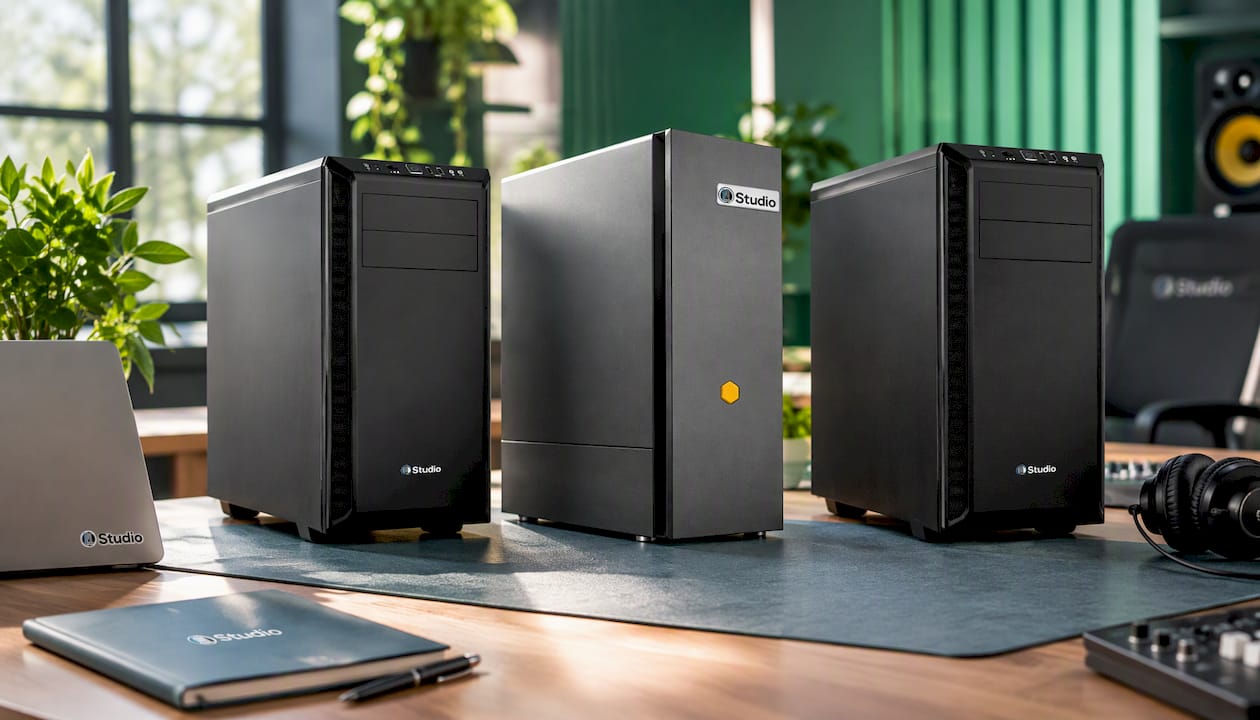
If you’re looking for a solid foundation for music production, the Power Producer Silver DAW is a logical place to start. If you’re working on demanding projects or combining audio with video editing, check out the Tower of Power Gold ULTRA 7 or the Tower of Power Diamond DDR5. Not sure about the right amount of memory? Ask us, and we’ll help you figure it out before you order.
Frequently Asked Questions
Will laptops and PCs become even more expensive in 2027?
Probably, at least in the first half of the year. Manufacturers expect the peak to occur around mid-2027, followed by a gradual decline. Analysts expect RAM prices to continue rising throughout 2027.
Why have SSDs become so expensive?
SSDs use NAND flash memory, which—like RAM—is in short supply due to demand from AI data centers. As a result, SSDs became 121 percent more expensive on average in just over a year. For storage, however, the likelihood of lower prices in the second half of 2027 is greater than for RAM.
When will RAM prices return to normal?
Virtually no one expects that to happen by 2028. Micron anticipates shortages until at least that year, and analysts don’t foresee a significant decline until then. It is uncertain whether prices will return to their previous levels.
Is it a good idea to buy a PC with 8 GB of RAM to save money?
Not for music production or video editing. Sample libraries, plug-ins, and video previews use a lot of memory, so you’ll quickly run out of space with 8 GB. Upgrading later is expensive as long as RAM remains scarce, so it’s better to choose enough memory right from the start.
Is it better to upgrade my current PC than to buy a new one?
If your processor and motherboard are still up to the task, targeted upgrades are often more cost-effective. Additional memory or a fast SSD can significantly boost an existing system’s performance. If your platform is outdated or unstable at low latency, a new studio PC is usually the better investment.
Sources
NOS: Laptops, gaming consoles, and smartphones are much more expensive due to AI data centers
Tweakers: PC prices will peak in mid-2027, but will fall afterward
ICT Magazine: PC Price Increases to Continue Well Into 2027
Techzine: PC Demand Plummets—Will Manufacturers Start Dropping Out?
Bright: Building your own PC has become more than half as expensive in just one year
c’t: Price Gap Between DDR4 and DDR5 RAM Continues to Widen
The Verge: PC shipments fell by more than 20 percent in Q3
Computable: PC Market in a Slump Due to Memory Chip Shortages
Notebookcheck: DRAM Crisis—Analysts Expect a Drastic Price Drop in 2028
G2A News: When Will PC Parts Prices Go Down?