
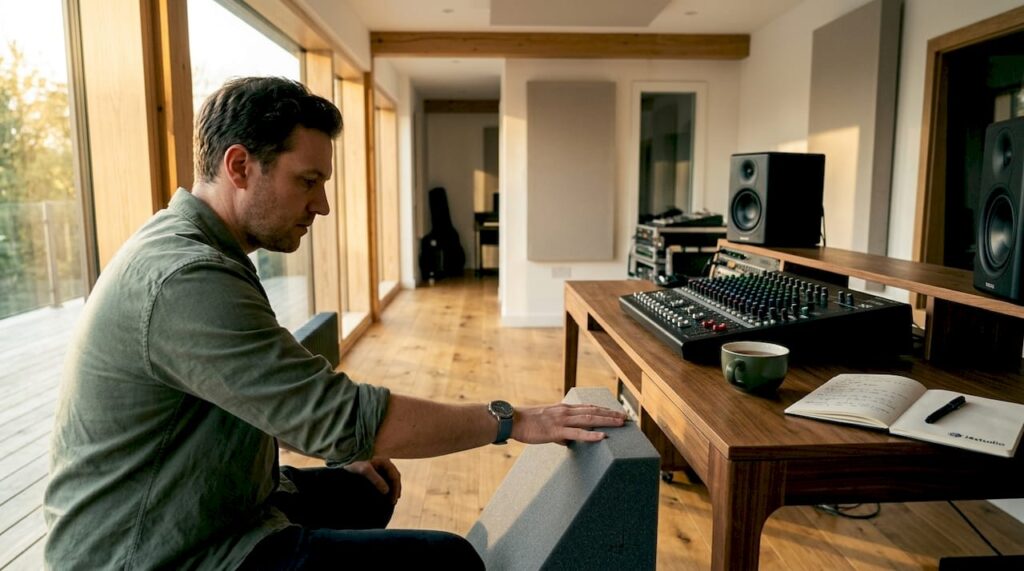
Briefly:
- Acoustic bass traps reduce variations in bass response in small studios. They dampen standing waves and ensure a more consistent sound reproduction. The use of mineral wool and strategic placement in corners improves the accuracy of monitors.
Acoustic bass traps are absorptive panels that specifically absorb low frequencies, thereby fundamentally improving sound quality in a studio. Without this treatment, the bass response in an untreated 4-by-3-meter room can vary by up to 20 dB depending on the listening position. This makes reliable monitoring impossible. Bass traps reduce that variation to 3–6 dB—which is the difference between a mix that sounds good everywhere and one that only works from your seat. For musicians and audio professionals who want to understand why acoustic bass traps are important, the answer begins with the physics of low frequencies in small spaces.
How do bass traps work, and what is their purpose in a studio?
Bass traps work by converting low-frequency sound into heat through friction within a porous material. Long-wavelength sound waves, such as bass frequencies between 60 and 150 Hz, penetrate deep into the material and lose energy there. Standard foam sound absorbers stop this process as early as 200–300 Hz, leaving the problematic bass tones completely unaffected.
The main problem in small studios is standing waves. These occur when a sound wave bounces back and forth between two parallel walls and amplifies itself at specific frequencies. The result is a listening position where the bass is overly prominent, and another position just one meter away where the bass almost disappears. Bass traps dampen these standing waves and make the soundstage consistent.
A lesser-known advantage is that high-quality bass traps cover a wide frequency range from approximately 50 Hz to 4 kHz. They are therefore not a one-dimensional tool. They simultaneously improve clarity in the midrange and upper-midrange, which enhances the overall acoustic treatment of a room.
- Standing waves are dampened, resulting in a more even bass response throughout the entire room.
- Reverberation time in the low-frequency range decreases, which improves the clarity of recordings.
- Listening consistency improves: your mix sounds the same from more listening positions.
- Broadband absorption ensures that the midrange also benefits from the treatment.
Pro-tip: Check the reverberation time in your studio using a free measurement program such as REW (Room EQ Wizard). If the reverberation time at 80–120 Hz is too long, that’s a clear sign that you need bass traps.
Which materials and shapes are most effective?
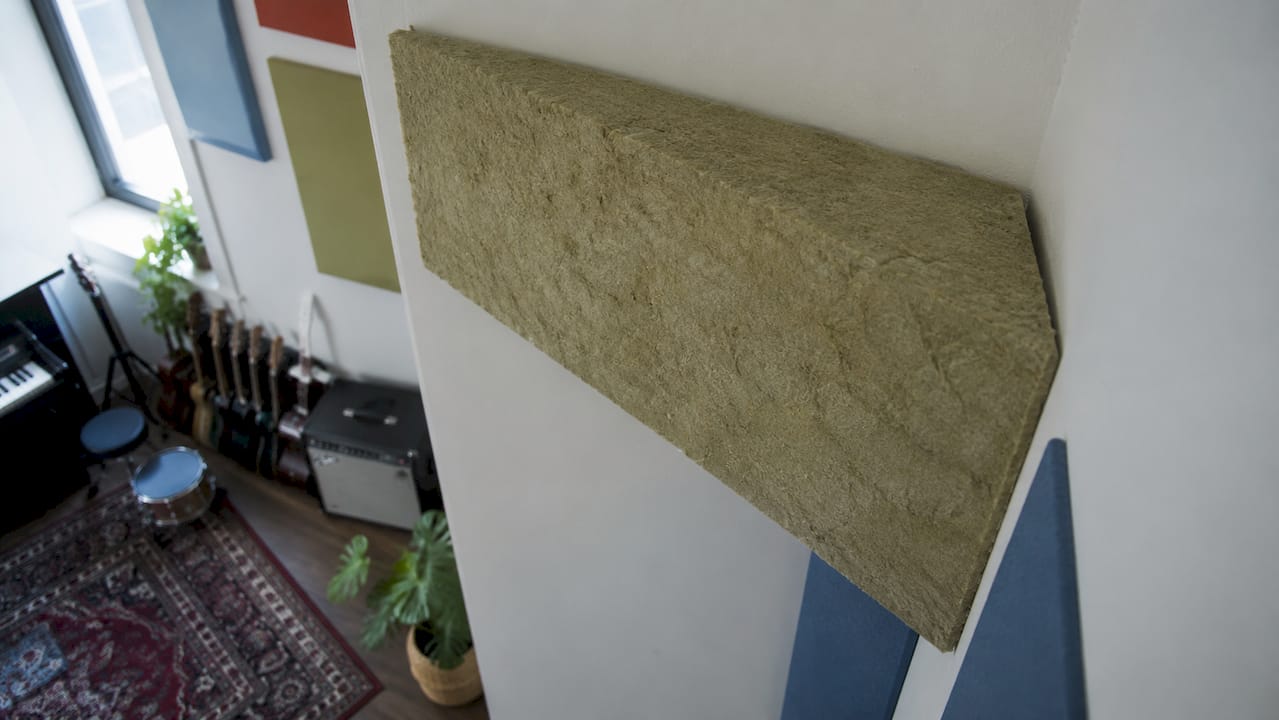
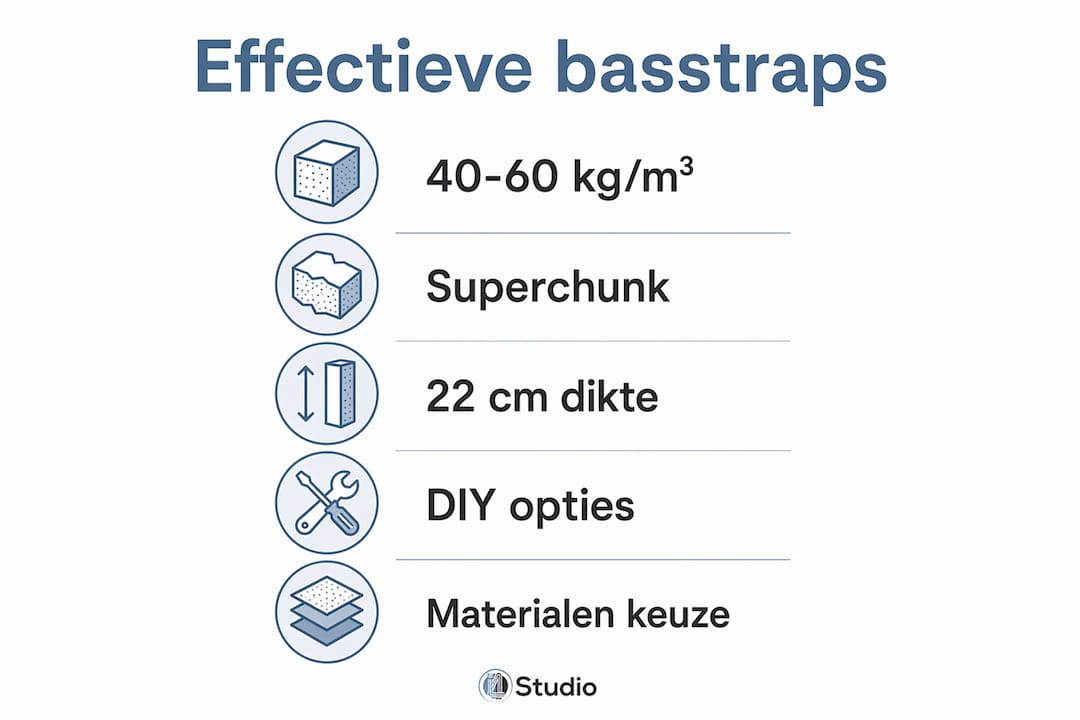
Mineral wool with a density of 40–60 kg/m³ effectively absorbs low frequencies down to approximately 50 Hz. That is the threshold below which most problematic bass frequencies in small studios lie. Foam simply cannot cover this range. Its higher density ensures that longer sound waves encounter enough resistance to lose energy.
| Material | Effective range | Cost | Suitable for |
|---|---|---|---|
| Mineral wool (40–60 kg/m³) | 50 Hz to 4 kHz | Low to medium | Professional and DIY bass traps |
| Standard acoustic foam | 200–300 Hz to 4 kHz | Low (€15–40) | Mid and high frequencies only |
| GIK Acoustics deep panels (up to 22 cm) | Effective down to 50–60 Hz | High | Professional listening rooms |
The shape of a baststrap determines how much of the material comes into contact with the sound wave. The superchunk shape—a triangular block of mineral wool that fits into a corner—is particularly effective. Superchunk shapes increase the contact surface area and depth of the absorptive material, which directly enhances effectiveness at low frequencies.
GIK Acoustics is introducing deep bass trap panels with a thickness of up to 22 cm. Panels of this thickness effectively absorb frequencies down to approximately 50–60 Hz, making them suitable for spaces where the lowest frequencies pose the greatest problem.
Pro-tip: Build your own bass traps using Rockwool or Knauf Insulation with a density of 40–60 kg/m³. DIY solutions perform better than store-bought foam and cost significantly less.
How do you strategically place bass traps for maximum effectiveness?
The placement of bass traps largely determines their effectiveness. Bass tends to accumulate most in corners, because that’s where two or three walls meet and sound waves build up. Placing them in corners is therefore always the top priority.
- Floor-to-ceiling corners first. The four vertical corners of a rectangular room are the primary locations for bass traps. This is where bass levels are highest.
- Ceiling-to-wall corners behind the monitors. The corners directly behind your listening position and behind the monitors are the second priority.
- Side walls at the first reflection points. Once the corners have been treated, panels installed at the first reflection points on the side walls help to further improve the overall acoustics.
- Measure after each addition. Use measuring equipment to check whether the bass response is becoming flatter. Without taking measurements, you won’t know if your approach is working.
- Add more than you think you’ll need. More bass traps result in a more linear soundstage. Even with fully covered corners, bass issues may persist if the total amount of absorptive material is too small.
A common mistake is to stop after installing two or four corner panels. A room’s acoustics are only truly even when measurements confirm it. Don’t rely on your ears alone, because they adapt to the room. A measurement microphone and REW will give you objective data.
Acoustic treatment of your studio always starts with bass traps, because low frequencies cause the most variation and are the hardest to correct with EQ or software.
What are the specific benefits of good bass traps for your mix?
A well-treated room changes the way you work. Without bass traps, uncontrolled standing waves can result in muddy mixes. With bass traps, you’ll hear the bass range clearly and sharply, which directly influences your mixing decisions.
- Reliable monitoring. You hear what’s actually in your mix, not what the room adds or takes away.
- Crisp basslines. The kick and bass are clearly distinguishable from each other, even at lower volumes.
- Fewer corrections afterward. Mixes created in an acoustically treated room sound better on other systems without additional EQ adjustments.
- Greater confidence in mix decisions. A flat bass response provides greater confidence when evaluating low frequencies in a mix.
- Better recording quality. Recordings made in an acoustically treated room contain less ambient noise and resonance in the low-frequency range.
Almost every listening room struggles with a muddy sound due to a buildup of low frequencies. Tackling frequencies starting at 50–60 Hz yields the greatest audible improvement in any system. This is no minor improvement. It’s the difference between a room that deceives you and one that helps you.
Musicians working in the performing arts and music industries will recognize this immediately: an untreated space takes more time to mix than a well-treated space saves.
What are the most common misconceptions about bass traps?
The biggest misconception is that foam is sufficient for bass absorption. Foam panels cost around €15–40 and are widely available, but they don’t effectively absorb sound until 200–300 Hz. The problematic bass frequencies between 60 and 150 Hz pass through foam virtually unimpeded. Anyone who covers their studio with foam and expects the bass problems to disappear will be disappointed.
A second misconception is that a few bass traps in the corners will completely solve the problem. Even with many bass traps in the corners, bass issues may persist. The goal is not to completely absorb sound, but to make the acoustics measurably linear. That requires more material than most people expect.
- Foam is not a substitute for mineral wool at low frequencies.
- Two corner panels are rarely enough for a complete treatment.
- Measurement is required. Without measurement data, you won’t know if your approach is working.
- Quality matters more than quantity when you’re working with a limited budget.
Pro-tip: Don’t buy expensive commercial bass traps if you’re on a tight budget. Build them yourself using mineral wool of the right density. The performance is comparable or better, and the cost is a fraction of that of commercial alternatives.
For a complete overview of the best acoustic products for your home studio, I4studio offers practical product advice tailored to different budgets and room sizes.
Key insights
Acoustic bass traps are the most effective solution for reliable monitoring in small studios, because they dampen standing waves and reduce bass response variation from 20 dB to 3–6 dB.
| Item | Details |
|---|---|
| Bass Response Variation | Bass traps reduce variation from 20 dB to 3–6 dB for reliable monitoring. |
| Choice of Material | Mineral wool with a density of 40–60 kg/m³ effectively absorbs sound up to 50 Hz; foam stops at 200–300 Hz. |
| Placement Priority | Always start at the four vertical corners where bass concentration is highest. |
| Quantity | More bass traps demonstrably result in a more linear and flat soundstage. |
| Measurement is essential | Use measuring equipment to identify bass issues and confirm effectiveness. |
What I’ve Learned from Years of Working with Studio Acoustics
The most underestimated mistake I see among musicians and producers is treating acoustics like a checklist. Put in two corner panels, and you’re done. But acoustics don’t work that way. A room has a character, and that character only really changes when you add enough material to structurally break up the standing waves.
What always strikes me is that as soon as someone works in a well-treated space for the first time, they never want to go back. The clarity in the bass range is anything but subtle. It’s a fundamental shift in how you evaluate the mix. Decisions that used to be guesswork suddenly become self-evident.
My honest advice: measure first, then treat. Many people buy panels based on gut feeling or aesthetics. A measurement microphone and REW don’t cost much and provide you with exact data on where the problems are. That data determines how many bass traps you need and where to place them. Without that step, you’re throwing money away.
Understanding the basics of acoustics makes the difference between a room that just happens to sound good and one that you have deliberately designed for precise work.
– harold
I4studio helps you optimize your studio’s acoustics
A well-designed studio starts with the right products and the right expertise. I4studio provides acoustic panels, diffusers, and complete studio solutions for musicians and audio professionals who take their space seriously.

The Primacoustic London 8 Acoustic Room Kit is a complete acoustic package that combines bass traps with broadband absorbers for comprehensive room treatment. For those looking to further furnish their studio, the Studio Desk Spirit offers an ergonomic work surface that integrates well acoustically into a treated space. I4studio also provides personalized advice on which combination of products best suits your space and budget.
Frequently Asked Questions
What exactly are bass traps?
Bass traps are thick, porous absorbers that convert low-frequency sound into heat through friction. They are specifically designed for frequencies between 50 and 300 Hz, which standard foam cannot handle.
How many bass traps do I need for my studio?
There is no set number. More bass traps demonstrably result in a flatter frequency response. Measure the bass response with REW and add panels until the variation remains below 6 dB.
Where is the best place to put bass traps?
First, place bass traps in the four vertical corners of the room. That’s where bass builds up the most. Next, treat the ceiling-wall corners behind the monitors and the first reflection points on the side walls.
Is foam a good alternative to mineral wool bass traps?
Foam only absorbs sound effectively at frequencies of 200–300 Hz and is not a substitute for mineral wool at lower frequencies. For the bass range between 60 and 150 Hz, only materials with a density of 40–60 kg/m³ are effective.
Can I make bass traps myself?
Yes. DIY bass traps made of mineral wool with the right density perform better than commercial foam and cost significantly less. Use Rockwool or similar mineral wool and build “superchunk” shapes for the corners.