RME Fireface UCX II
40 Channel Advanced USB Audio Interface
The RME Fireface UCX II is a professional audio interface developed by RME (RME Audio GmbH). An updated version of the RME UCX, it features a number of improvements, including a larger number of inputs and outputs and improved audio quality. It has 18 inputs and 18 outputs, including 8 analog inputs and outputs, 8 channels of ADAT and 2 channels of S/PDIF. It also includes a built-in microphone preamplifier, and offers low latency and high-quality audio recording and playback. The rme fireface UCX II is often used in professional recording studios and by sound engineers, musicians and producers. It is a very versatile device, allowing you to connect a wide range of audio sources and devices to your computer, and it supports up to 192kHz/24bit audio resolution.
The RME Fireface UCX II is a highly integrated and complete pro audio solution in an ultra-compact format for studio and live recording and music production. It continues RME’s long tradition of designing compact advanced interfaces packaged in a half-rack unit that would normally be divided into two or three 19-inch panels.
This unique audio system can transfer analog and digital audio data directly to Windows and Mac computers. The latest Plug and Play technology guarantees easy installation, even for the inexperienced user. Numerous unique features such as a well-thought-out settings window and an integrated routing solution ensure fast, comfortable and efficient operation of the rme Fireface UCX II.
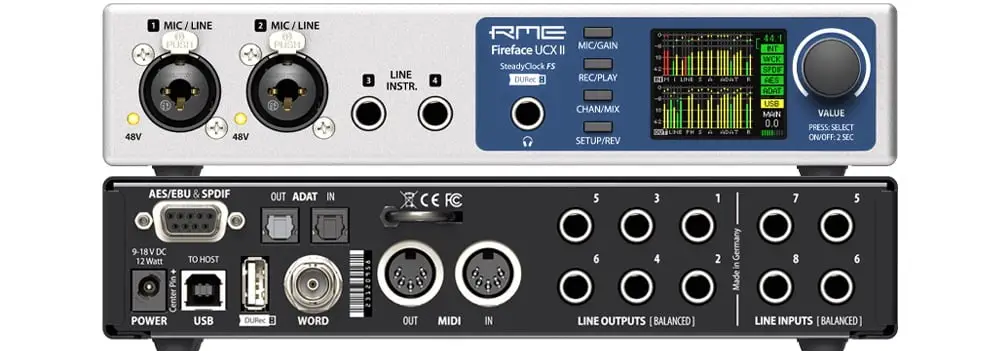
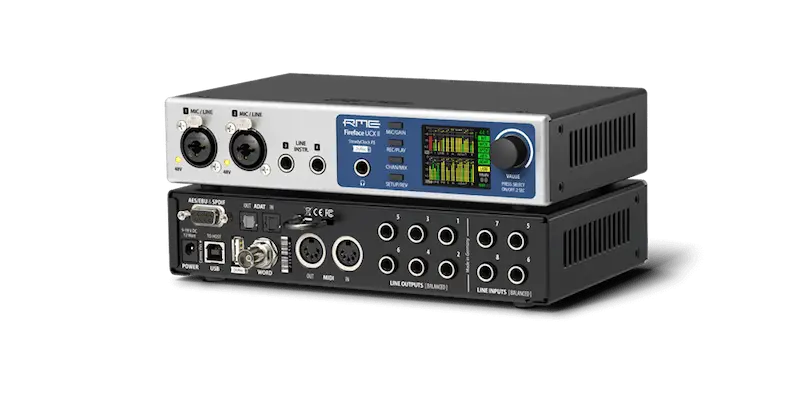
The RME Fireface UCX ii includes two microphone/line preamps in XLR combo configuration on the front panel, along with two digitally controlled line/instrument inputs, followed by a headphone jack, several control knobs, a display and the master volume knob. On the rear is a set of ten analog balanced line inputs and outputs, MIDI I/O, ADAT I/O, AES/EBU and SPDIF I/O, USB 2.0 and a switchable wordclock I/O.
With the SteadyClock FS, the Fireface UCX II features the latest clock and jitter suppression technology from RME. SteadyClock FS is based on a femtosecond clock and reduces the intrinsic jitter when converting from and to analog across all digital formats to a new all-time low.
Full standalone functionality UCX 2
Control all device states directly from the front panel for easy, direct access to all functions. Four keys and the encoder, the high-resolution and bright color display and a well-thought-out menu structure allow the user to quickly change and configure the settings of the device. In addition, the internal memory allows for permanent storage of six different states of the device. Therefore, the RME Fireface UCX II can operate completely stand-alone, without any connected computer. In stand-alone operation, it can change into completely different devices with a simple push of a button. Furthermore, TotalMix FX can also be controlled via MIDI.
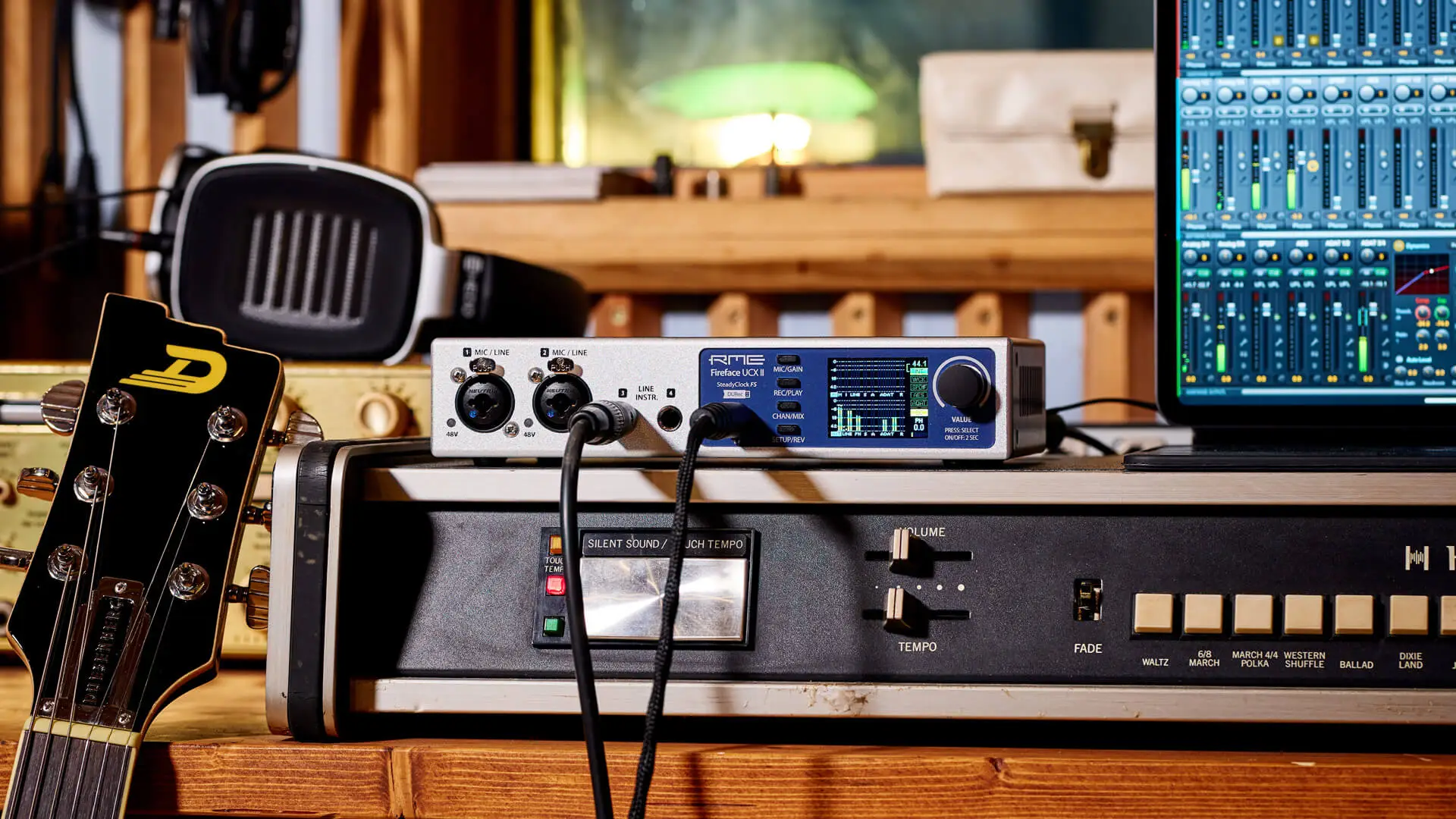
40-channel RME UCX II ready for your Mobile Recording Rig
DURec is an integrated digital recorder for all inputs and outputs directly to USB memory devices via the rear USB port. Allows you to record to USB thumb drives or hard drives with a capacity of up to 2 TB. The recording functionality is provided by the internal DSP and is therefore independent of a connected Windows or Mac computer. This USB port can also be used for direct connection of RME’s optional ARC USB remote control.
Direct USB recording converts the RME Fireface UCX II into a stand-alone field recorder and a powerful multichannel live player for earlier recordings, such as for virtual soundchecks. Live concerts, band rehearsals or impromptu jam sessions can be recorded and played directly from the medium – even completely stand-alone without a computer or software. All input and output channels can be selected individually for recording and playback.
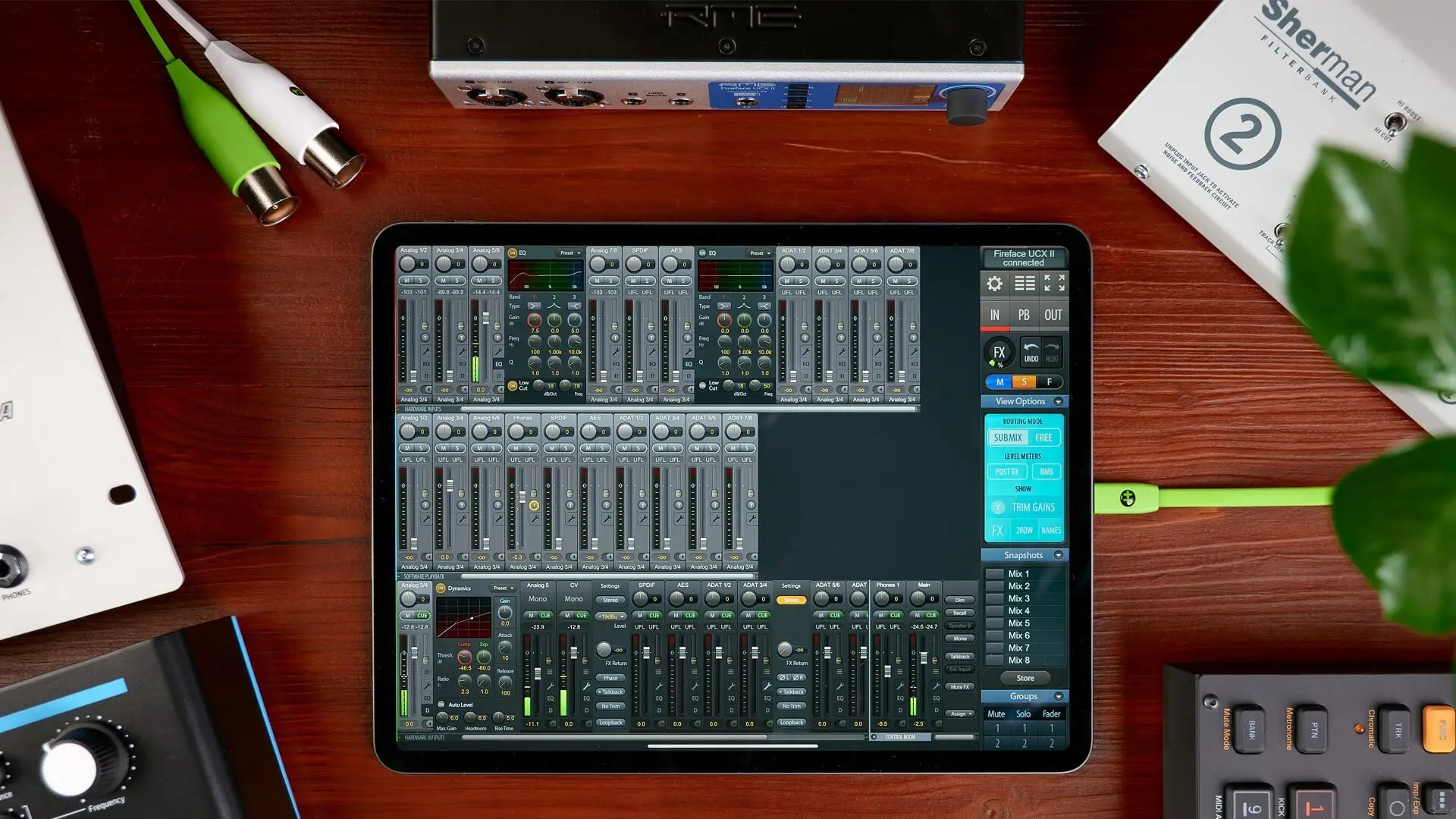
The RME UCX II comes with the TotalMix FX DSP mixer that offers extensive routing and monitoring options, as well as the DIGICheck Analyzer that allows digital data inputs to be measured and analyzed in both directions with maximum precision. TotalMix FX can completely replace an external mixer, making it possible to create multiple latency-free monitor mixes with EQ, Dynamics, Reverb and Delay for all outputs, incl. mixing head monitors and headphones for musicians.
The additional TotalMix Remote is a remote control for TotalMix FX, to control the hardware mixer and effects in RME audio interfaces. TotalMix Remote mirrors the current state of the host system on the iPad and Windows/Mac computers – the complete mix status, the entire routing, all FX settings, down to the level meters and all in real time. Easily adjust all mixer and FX settings remotely, via Ethernet and Wi-Fi.
DC Coupled Outputs – CV/Gate Voltage Control
Most audio interfaces have traditionally been designed with so-called ‘AC-coupled outputs’, which use capacitors to filter out extremely low frequencies.
While these frequencies are generally considered undesirable for audio and potentially cause damage to other equipment – an example where DC coupling remains desirable is the world of modular synthesizers, where static or slow moving signals are used to control various parameters such as pitch values. or LFOs.
All line outputs of the RME Fireface UCX II are fully DC-coupled, allowing control voltages (CV) or gate information to be sent to modular synthesizers (such as the popular Eurorack and Moog/MOTM/Synthesizers formats) and other studio hardware
Specifications: RME Fireface UCX II
The UCX II is a 40-channel USB 2.0 audio interface (USB 3.0 compatible) known for its extremely low latency and robust drivers.
General Characteristics
Channels: 20 input and 20 output channels (total 40).
Sample Rates: Up to 192 kHz at 24-bit resolution.
Display: Bright color TFT display for metering and settings.
DURec: Direct recording to USB sticks or hard drives via the USB port on the rear.
SteadyClock FS: Ultra-low jitter technology for superior AD/DA conversion.
Inputs.
2 x XLR/TRS Combi: Microphone/Line inputs with digitally controlled gain (up to 75 dB).
2 x Line/Inst: 6.3mm TS inputs on front panel (suitable for guitars/basses).
4 x Line In: Balanced 6.3mm TRS inputs on the rear panel.
Outputs.
6 x Line Out: Balanced 6.3mm TRS outputs.
1 x Phones: Powerful stereo headphone output on the front panel.
Digital Connectivity
ADAT I/O: 8 channels (up to 48 kHz) or S/MUX (for higher sample rates).
SPDIF I/O: Coaxial (via supplied breakout cable).
AES/EBU I/O: Via breakout cable.
MIDI I/O: 1 x In & 1 x Out (via breakout cable).
Word Clock: I/O via BNC connectors.
Frequently Asked Questions (FAQ)
1. What is the biggest difference from the original UCX?
The UCX II has a completely updated design. The main additions are the color display, DURec functionality (recording without a computer), the improved SteadyClock FS and a major upgrade in the quality of the preamps and converters.
2. Can I use the UCX II without a computer (Stand-alone)?
Yes. Thanks to the front panel display and rotary knob, you can adjust almost all settings directly on the device. Combined with DURec, you can even use the interface as a standalone recorder for live performances.
3. What exactly is DURec?
DURec stands for Direct USB Recording. It allows you to record all 40 channels (or a selection of them) directly to a USB storage medium that you plug into the back of the interface. This is ideal as backup during live shows or for mobile recording without a laptop.
4. Will the UCX II work on an iPad?
Yes, the interface features a Class Compliant (CC) mode. This allows you to connect it with a camera adapter or directly via USB-C (on newer iPads) for use with apps such as Cubasis or Auria Pro.
5. What is TotalMix FX?
TotalMix FX is RME’s included software mixer. It allows you to create complex routing and apply latency-free effects (such as EQ, Reverb and Echo) to your monitor mixes without taxing your computer’s CPU.
6. Do I need a USB 3.0 port?
No, the UCX II uses the USB 2.0 protocol. Because RME writes their own USB controllers, USB 2.0 bandwidth is more than sufficient for 40 channels, even at 192 kHz. By the way, it works perfectly on USB 3.0 and USB 4/Thunderbolt ports.
Also works fine with the RME ARC Usb